




Judge approves Rochester transit agency’s new school service plan
ROCHESTER, N.Y. — In a new twist to a case pitting transit agency against school bus contractor, a judge in late January struck down a decision by the...

ROCHESTER, N.Y. — In a new twist to a case pitting transit agency against school bus contractor, a judge in late January struck down a decision by the Federal Transit Administration (FTA), paving the way for the Rochester-Genesee Regional Transportation Authority (RGRTA) to create new bus routes to serve students.
Robin Leeds, industry specialist for the National School Transportation Association (NSTA), said that the ruling came as a surprise.
“The courts generally defer to the regulatory agencies to interpret their own rules,” Leeds said. “The judge is being very aggressive.”
The FTA had ruled in January 2007 that RGRTA was providing illegal service for the Rochester City School District (RCSD), displacing routes that had been operated by Laidlaw Education Services (which is now part of First Student).
Later in the year, U.S. District Judge David Larimer upheld the FTA’s ruling but, on two occasions, extended the deadline by which RGRTA was supposed to cease its school routes.
RGTA proposed to replace the routes in question with new routes that it would call “Express Service.” The service would be clearly marked as open to the public, and it would run along existing routes but bypass downtown Rochester. And while the agency’s original routes at issue had no stops within 1.5 miles of schools — because RCSD doesn’t receive state subsidies for busing students within that range — the Express Service would.
Still, the FTA determined in October that the Express Service would also be in violation of its school bus regulations.
The regulations — issued in 1976 by the FTA’s predecessor, the Urban Mass Transportation Administration (UMTA) — prohibit federally subsidized transit agencies from providing school transportation “that exclusively transports students and school personnel in competition with a private school bus operator.”
However, an exception is given for “tripper service,” which is defined as “regularly scheduled mass transportation service which is open to the public, and which is designed or modified to accommodate the needs of school students and personnel, using various fare collections or subsidy systems.”
Tripper buses can’t carry designations such as “school bus” or “school special,” and they have to be part of the transit agency’s regular, published route service and stop at regular service stops.
Another exemption from the school bus regulations is granted to transit agencies when no school bus contractor can provide the service a district requires.
In the Rochester case, the district had decided before the 2006-07 school year to move the start time of some of its high schools to an hour earlier. Laidlaw reportedly could not continue to provide service for those high schools because of a conflict with the service it was providing for RCSD’s elementary schools.
The district then entered into a “tripper service subsidy agreement” with RGRTA to serve the high schools. In June 2006, a union representing Laidlaw employees filed a complaint with the FTA, alleging a violation of the school bus regulations.
RGRTA’s Express Service was proposed to replace the original routes at issue, but the FTA found that it was “not generally designed for the public” and that “the demand for this service comes from RCSD, not the general public.”
In Larimer’s January ruling, the judge found that the FTA was “arbitrary and capricious” in denying the Express Service.
The judge pointed to a notice that the UMTA had issued to accompany the school bus regulations. The UMTA wrote that “federally assisted buses must remain open to the public at all times and be clearly marked for public use. This requirement was added to prevent federally assisted operators from operating special routes for schoolchildren which are not generally available to the public.”
Citing the notice, Larimer wrote that “UMTA did not state, then, that routes must be generally designed for the public, but that they must be generally available to the public. The clear import is that the agency sought to prohibit subsidized operators from running buses for schoolchildren from which other members of the public are excluded.”
Larimer also cited an earlier case, United States ex rel. Lamers v. City of Green Bay, in which the court determined that a federally subsidized transit agency “may completely redesign its transit system to accommodate schoolchildren as long as all routes are accessible to the public and the public is kept informed of route changes.”
Larimer wrote that the FTA appeared to be selectively interpreting its school bus regulations by ignoring the statement that tripper service may be “designed” to accommodate students. He said that the RGRTA’s proposed Express Service appeared to meet all of the criteria for permissible tripper service.
The judge extended the stay of the FTA’s cease-and-desist order until March 24, allowing RGRTA to continue its original school routes until it could implement the new Express Service.
At press time, the parties opposed to RGRTA’s proposed service — including the FTA and the school bus union — were weighing their options for appealing the decision.
The NSTA, which has been providing support to the school bus side of the case, said that the decision could hinder the FTA’s ability to enforce its school bus regulations.
“Obviously, it’s going in a direction that we’re not happy with,” Leeds of NSTA said. “We hope that it’s limited for the time being, and we’ll carry on when we decide what option is best.”
More Safety
From Reactive to Proactive: Making Every Ride Visible
Smart technology only delivers its full value when it works together. See how Catalyst connects proven industry platforms to move student transportation from reactive to proactive.
Read More →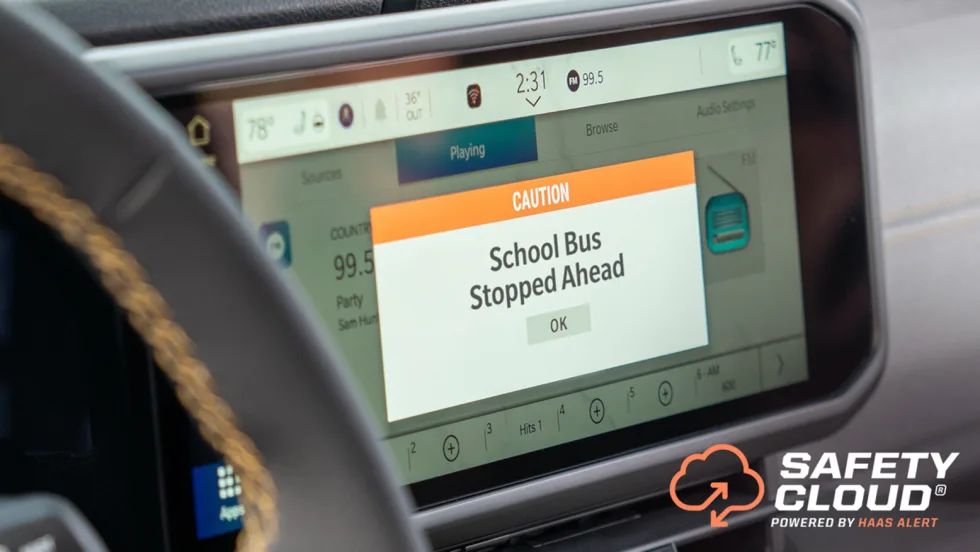
HAAS Alert’s Safety Cloud Warns Motorists of Stopped School Buses
Through a transponder or Samsara connection, the product lets school bus fleets send advance warnings to approaching drivers through in-vehicle alerts.
Read More →
HopSkipDrive Reports Progress on Safety Advisory Council
More than a year after forming the council, independent safety experts have helped shape new rider-safety features and policy progress, with a new goal to address rider behavior.
Read More →
What the 2026 National School Bus Safety Month Resolution Means for Student Transportation
The bipartisan resolution highlights illegal school bus passing, student safety during loading and unloading, and the need for driver training and public education.
Read More →
School Bus Stop-Arm Violations Decline 53% Across Verra Mobility Programs
Verra Mobility shares how school bus stop-arm cameras and school zone safety programs are changing driver behavior, reducing violations, and protecting students.
Read More →
Most Bus Crashes Aren’t Your Fault. Here’s How to Prove It.
A guide for what to do in between a school bus crash and a claim: what to preserve, who to notify, and how to keep the facts available when they matter.
Read More →
National School Bus Safety Week 2026: Tips, Toolkits & Resources to Keep Students Safe
School bus safety takes more than awareness. Explore expert tips, enforcement strategies, and free resources to help protect students on every ride.
Read More →
2 Killed, Dozens Injured in Florida School Bus Crash
A multi-vehicle collision caused a Polk County school bus carrying 37 students to overturn on its way to Winter Haven High School.
Read More →
Illegal School Bus Passing Drops 24% in New York Districts
With fewer than 5% of citations involving repeat offenders, Westchester County officials said enforcement, education, and community partnerships are helping change driver behavior.
Read More →
School's Back. Here's What Happened to Traffic, Speeding & Distraction
What happens to traffic when school resumes? New data analysis examines changes in distracted driving, congestion, and speeding around schools.
Read More →