




How Transit is Filling Gaps in School Bus Transportation
With budget situations not looking rosy at school districts across the country, school bus transportation has become a cost-cutting target for many sc...
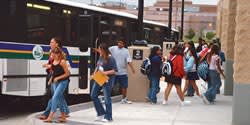
With budget situations not looking rosy at school districts across the country, school bus transportation has become a cost-cutting target for many school boards.
In some cases, the result has been reductions in service or the implementation of parent-pay systems. In other cases, school districts have partnered with local transit properties to provide students with a cost-efficient alternative to yellow buses.
Although safety concerns immediately come to mind when students use public transit vehicles to get to and from school, the alternative in many cases is that these students walk, bicycle or ride in cars with friends or family — each with more inherent risks than the use of transit buses.
This article discusses how transit authorities across the country have built relationships with their local school districts and developed student programs in this fast-growing transportation market.
Develop partnerships
How do partnerships between transit agencies and school districts develop? Sometimes, transit agencies approach school districts to offer their services to students. Such was the case for the Muncie Indiana Transit System (MITS). MITS, which operates 30 fixed-route buses within a 22-square-mile service area, approached its local school system with the idea of transporting high school students to avoid the problem of duplicate service.
“We were seeing more and more where our buses on our regular fixed-route service were following the school buses along a lot of the same routes,” says Mary Gaston, assistant general manager for MITS.
The transit agency secured a two-year contract in 1997, which they have since renewed after each term. The partnership, says Gaston, was easier to develop because a MITS board member who was also the president of the school board at the time had already established a communication path between the two.
Service opportunities
Transit agencies also have opportunities to offer their services to schools when students do not have any alternatives or do not meet certain requirements to ride the school bus.
Two-and-a-half weeks before the start of the 2004-05 school year, USD 501 in Topeka, Kan., cut transportation service to students who lived within a two-and-a-half mile radius of school as a cost-saving measure. “We had 6-year-olds walking through horrible neighborhoods to get to school,” says Nancy Johnson, director of media and community relations for Topeka Transit.
In addition, the school board awarded its school transportation service to a school bus contractor that was apparently not well prepared. “The first couple of days, they ran three or four hours late, and a bus loaded with students got lost,” Johnson says.
To alleviate the situation, Topeka Transit, which has 14 fixed routes and carries just over a million passengers a year, stepped in. “We first mapped out how many of our fixed routes passed the schools within the 2.5-mile radius, and we drove them to see how many blocks these kids would have to walk if we did fixed route,” says Johnson.
Next, the transit agency distributed laminated maps and brochures on how to ride the system to the schools and reinstated a $15 monthly student rate. In the first five weeks of program implementation, Johnson says student ridership on the system increased by 25 to 30 percent. “We offered an alternative [to the school district] that was already there,” she says of the service.
Transit fills the gaps
Additional opportunities for transit agencies include providing student transportation services to special schools, such as magnet programs that do not offer transportation. Nashville’s Metropolitan Transportation Authority (MTA) revamped its youth program, called Quest, to cater to students in this particular market.
“We have optional schools and academically challenging institutions that did not provide transportation to students, so there was a market to fill,” says Patricia Morehead-Harris, MTA’s communications director. Under the new program, anyone age 19 and under can purchase any pass or ride any MTA bus for a dollar or less.
Magnet programs and special classes can also be created because of the availability of public transportation. “Transportation can be provided for those isolated students who would otherwise be unable to attend the programs due to their distance from the school and the inability of the yellow bus to go that far out to get the student,” says Liliane Agee, marketing and community relations manager for Palm Tran in West Palm Beach, Fla.
{+PAGEBREAK+} Parents require education
In addition to courting the school districts, transit agencies have to curry favor with parents in the community as well. Providing parents with information about the service helps quell their fears and preconceived notions they may have about public transportation.
Every year, MITS dispatches staff members to school orientation meetings and registration days with schedule information and maps showing parents where students would board the bus. “It took a while for parents to be comfortable with students riding a transit bus as opposed to the yellow school bus or their own personal vehicles,” MITS’ Gaston says.
Topeka’s Johnson agrees. “Parents did voice their concerns. We needed to educate them and work through the stereotypes.” Parents were also encouraged to ride the bus with students before school started to help with the transition.
Some transit agencies, however, are not able to overcome parental concerns when it comes to transporting students. The Regional Transportation Commission of Southern Nevada (RTC) met with resistance when it tried to devise a student transportation program.
“A couple of years ago, the school district approached us about developing a student transport program,” says RTC spokeswoman Ingrid Reisman. “Once a little bit of negative feedback came out at the public meetings, the school district decided they didn’t want to do it.”
Although the RTC does not have a formal student program, they do offer a $15 monthly youth fare and an outreach program called Let’s Go, consisting of presentations and activities tailored for different grade levels. The program focuses on safety, how to use the system and the role that transportation plays in students’ lives. Classes receive a presentation from an outreach specialist, and teachers are provided with information and activities to further reinforce what the students learn.
The difference in safety
While educating parents was key for acceptance of the program, educating students on safety and the differences between transit and school buses was paramount.
The City of Rome (Ga.) Transit Department goes to its local schools to train students on lessons of safe riding. “We tell them how we don’t have stop arms on our buses, and that they have to be safe when they are crossing the street,” says Transit Director Kathy Shealy.
“Probably the biggest difference is that traffic does not stop for public buses like it does for the school bus,” Gaston says.
Safety was also an important issue for Topeka Transit, which developed an intensive marketing campaign to educate the public about the importance of safety. The campaign included TV, radio and newspaper interviews, as well as signs affixed to the backs of buses cautioning drivers of children crossing. “We tell all kids that they need to cross at cross walks and that they can’t just run out in front of traffic,” says Johnson.
Johnson is also developing a program that will employ older students to become mentors to younger students and help them safely ride the system.
Monetary, ridership benefits
Once a partnership between the transit agency and school district is enacted, schools stand to benefit by saving money, while the agency boosts its ridership figures.
By contracting its high school student service to MITS, Muncie Community Schools (MCS) saved approximately $200,000 in 2004. “We’ve eliminated 14 or 15 bus routes, so financially it’s a win for us,” say Bill Reiter, director of facilities and operations with MCS.
“We do not charge them for the service, and the students do not pay to ride the system,” MITS’ Gaston says. The philosophy behind the program is that the transit agency could save taxpayers in the community from paying for the duplication of service. “Our gamble is that the revenue will come back to us through the state funding formula because of the increased ridership,” she says.
When it began offering rides to high school students in 1997, MITS carried 500 to 600 trips a day. Today, it carries up to 1,000 one-way trips.
Palm Tran’s Agee says that its program is very cost effective for the school district and taxpayers. “The district approached Palm Tran about 12 years ago, and it has snowballed ever since,” she says. Annual passes through the system cost students $255 for the year from July 1 to June 30. “We are receiving more inquiries about the program and look forward to increasing our ridership in the coming years.”
Students accounted for 17 percent of the Sacramento (Calif.) Regional Transit District’s (SRTD) ridership in 2003, a growth of 2 percent from the previous year, says SRTD Planner Greta Vohlers of the system’s successful student rate program.
Training future riders
In addition to the cost savings to the school districts and increased ridership to transit systems, student transit programs help create future riders of public transportation.
One of the biggest benefits of transporting students is that they become accustomed to using public transit. That spills over into other areas of their life, Gaston says.
More Management

How to Build a Better Driver Training Program
Ready to boost up your school bus instructor training? Here’s how to pick the right talent and improve recruitment, retention, and safety.
Read More →
CALSTART and Forth Combine to Form Catalyst Mobility
The new name represents a renewed vision for the nonprofit focused on advancing clean, equitable, and affordable transportation solutions that move people and goods.
Read More →
What Makes a Great School Bus Driver Trainer?
Choosing the right school bus driver trainer takes more than experience. Learn six keys to selecting and developing trainers and evaluating program effectiveness.
Read More →


School Bus Contractors Expand Through New Deals, Acquisitions & Partnerships
STA's Canadian division acquires Ontario-based G&L Stevenson Transport while Durham School Services adds a new district contract in California, First Student adds a New Jersey contract, and Minnesota Coaches acquires Halo Transportation.
Read More →
Logan Bus Company Rolls Out AI Phone System for NYC School Bus Families
A summer pilot found that AI agents could handle most routine calls, freeing up time for customer service staff to focus on emergencies and complex family concerns.
Read More →
From Intent to Impact: What I Learned About Leadership from TAPT
A Texas transportation supervisor shares lessons on self-awareness, accountability, managing stress and building trust — and why investing in leadership development matters at every stage of your career.
Read More →
NAPT Names 2026 Award Recipients, Hall of Fame Inductee
Who earned national recognition for their work in student transportation? This year, NAPT named five recipients of its 2026 awards for service, safety, and leadership, plus its newest Hall of Famer.
Read More →
2026 State of Student Transportation Report
Driver shortages. Rising costs. Growing safety expectations. More data, but not enough time to act on it. The 2026 State of Student Transportation Report reveals what transportation leaders say is putting the most pressure on their operations—and where they’re investing next. See how your priorities compare.
Read More →
How to De-Escalate an Angry Person: 5 Steps for Handling Workplace Conflict
What makes emotions run high, and how should you handle an angry colleague or parent? Follow these steps for staying calm, listening, showing empathy, and resolving conflict.
Read More →
What Readiness Looks Like This School Year
Learn about the challenges shaping the 2026–2027 school year, from persistent driver shortages and budget pressure to technology and readiness gaps. See how school districts are responding and adapting in Zonar’s 2026 Back-to-School Readiness Report.
Read More →