




How to Cut Costs by Mastering Time and Space, Part 2: Zero with an Asterisk
Learn how a paratransit service absorbed 16% more passengers with no added cost. The example can be applied to pupil transportation: Optimizing the spatial and temporal relationships of one’s service area can yield big cost savings.Second in a series of occasional articles
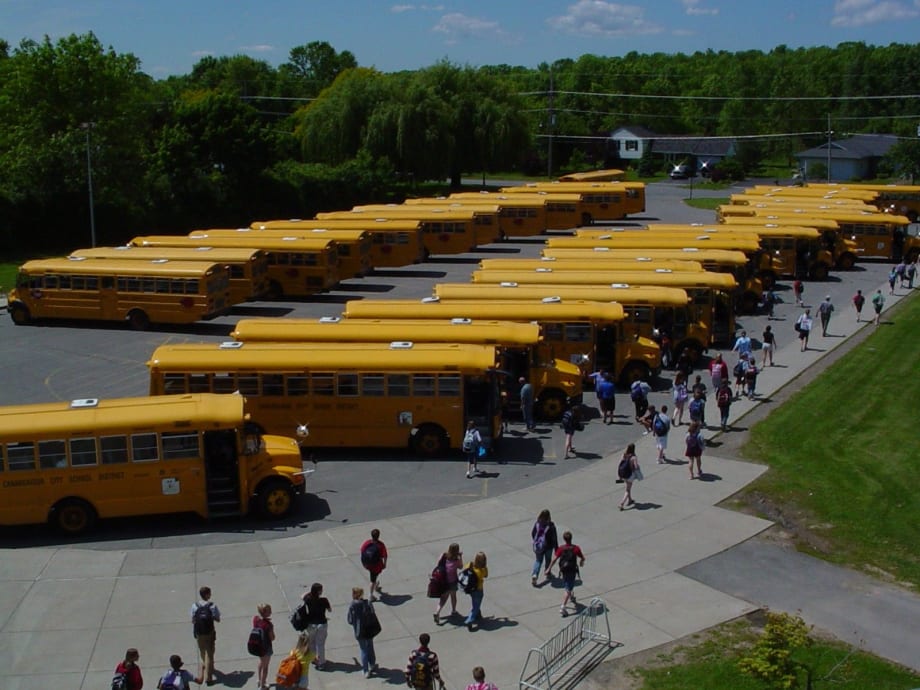
In 1982, I began providing paratransit service to physically and developmentally disabled adults in two large Los Angeles County service areas: the San Fernando Valley and the Antelope Valley. Because the same students attended the same schools every day, our system resembled special-education service almost identically, at least from a system design and spatial/temporal perspective.
Because of my unique approach to efficiency, we quickly began serving every program in our two service areas with a single exception: the second-largest program located in the very center of our principal service area.
Of the 950 students transported overall in the San Fernando Valley, we took roughly 84% of them — mostly to non-centrally located programs, including many in the distant outskirts — while another service provider transported the final 150 to the school/workshop in the service area’s epicenter.
This arrangement not only compromised our efficiency, but the efficiency of our lead agency’s entire system. So, almost from the inception of our involvement in the program, we practically begged them to put the remaining program “out to bid.” Finally, they did.
The incumbent provider’s costs were openly announced as $38,000 a month (or about $456,000 a year — at a time when I believe our total budget for a bit more than five times as many students traveling to about 30 programs literally all over the place was roughly $5 million).
Knowing what integrating this final program into our overall service area could achieve, we bid zero. That’s right, zero. But with an asterisk. This asterisk was of little concern to someone like myself with an understanding of time and space. Yet how did I know we could absorb 16% more passengers at no additional cost?
The asterisk: setting start times
Working with a huge map of this service area covered with dots for all 950 passengers (including the new ones) color-coded to larger dots representing the destinations, and with a handful of grease crayons, I simply re-routed the entire system.
Particularly with the new program located where it was, and the fact that so many of our existing vehicles passed close to it on their way to the programs we were already serving, I found that I could transport the entire 950 students in the same number of vehicle service hours. The cost of the few additional vehicles would be covered by the profits from the 16% more passengers we hauled.
How was I able to do this? The answer is the asterisk: We simply demanded the right to set the start times of all the programs. That’s all. We would not change the duration of a single program, thus requiring no institutional changes whatsoever. Instead, our changes merely affected various degrees of convenience and inconvenience (and sometimes merely preferences) to school and workshop personnel, our passengers, their parents and guardians, and, of course, our drivers and management.
It should be noted that we changed a few of these programs’ start times somewhat radically — more than a typical public school system could likely do, as a practical matter — because we transported solely adults and infants. So, a few of our programs were instructed to begin as early as 7 a.m., and one small program as late as 9:45 a.m., although most of the late ones began no later than 9 a.m. Many programs’ start and end times were not changed at all. Most of the other changes were not very significant.
These changes caused their fair share of major to minor inconvenience, and drew their share of whiners. But our lead agency informed the whiners that money does not grow on trees and gave them a vision of the many things that could be done with the extra $500,000 a year our changes made available.
Scores of our passengers (as well as the lives of many people we did not transport) obtained significant benefits, including more staff, salary increases and many other things that were clearly out of reach without these savings.
Applicability to pupil transportation
The goals of the approach noted here were and are no different from the goals of any school serving K-12 students. If anything, starting many programs later eliminated the hardship of one parent having to arrive home mid-afternoon more than it created a hardship for a fellow parent having to arrive to work a bit later.
In simple terms, school hours are usually earlier than work hours in the a.m. period, and significantly earlier in the p.m. period. So in the majority of cases, our approach brought these two schedules closer together.
By far, the most essential point of this experience was that it illustrates the enormous magnitude of cost savings possible by making a single change. A 10% cost savings from a single change — one that included adding 16% more passengers — may not be possible in a public school environment where the extremes of a few schools’ start and end times are more limited.
And, of course, existing spatial relationships may not make such gains possible. But even if not, we are talking about a degree of cost savings that dwarfs anything else a school district can possibly do outside of making radical increases in walking distances, eliminating general-education services altogether, or “mode-splitting” high school (and often junior high school) students to transit where it is available.
I am not claiming that other things should not be done. Instead, I am claiming that optimizing the spatial and temporal relationships of one’s service area is where the big cost savings come from, and that this process should be exhausted long before endless time is spent doing anything else.
[PAGEBREAK]

Ned Einstein, a consultant and forensics expert in various transportation fields, found a way to re-route a paratransit service he worked for, so it could absorb 16% more passengers with no added cost.
Knowledge and aptitude
Not everyone possesses the same aptitude for this exercise that I do. And few have had a career with the luck mine brought me — including examining 30 paratransit systems while directing the U.S. Department of Transportation’s first nationwide examination of them and, in the process, figuring out the factors that govern system efficiency.
But I have always felt that “schedulers are made, and dispatchers are born.” In other words, while much of dispatching skill is God-given, much of what I have been able to accomplish can be learned. And I suspect that the school bus community is filled with individuals who can effect similar changes, even if not quite as dramatic as in the example above.
A lot of the success depends on the variables at one’s disposal. Frankly, the more poorly arranged (or unarranged) ones’ existing variables are (refer to Part 1 of this series, March 2014, pg. 26), the greater are the opportunities to effect significant improvements. Regardless, someone with a good feel for organizing temporal and spatial variables is likely going to be able to accomplish a lot if given the latitude.
Bringing in an expert can pay off
The costs of bringing in a system design expert for a couple of trips, plus the week or two it would take that expert to transform your system to a model of efficiency (my effort took a single weekend) would likely pay for itself in the first few months.
Of course, your district would inherit these savings forever. Also, once your operation had become more efficient, you would have learned the dynamics of improving it and could likely improve it further, often with little or no outside help.
The point is that savings of this magnitude are absolutely possible. Further, the affordability of making such changes is trivial compared to the payoffs: My firm, for example, would undertake such an effort for a school district — with possibilities for meaningful savings — for incidental costs (i.e., air, train or mileage and hotel costs) plus a percentage of the cost savings.
In other words, your costs even with outside help would actually be negative in the long run. And the risks would be minimal: No one who does not have the ability to effect such savings would agree to perform such an effort at practically no cost other than a moderate percentage of the cost savings.
Savings are possible
To be realistic, everyone who falls off a turnip truck may not be able to look at a map full of colored dots and see what I see, or figure out how to rearrange them to reduce vehicle hours of service, ride times and everything that comes with it. But if you cannot, there are those who can — and with the right help, you can milk the last ounce of savings from a given situation if you’re willing to bother.
The first step is recognizing the magnitude of what is possible. A prudent second step might be to try to see what you can accomplish on your own. From this article and the previous installment, what is possible should be clear, as should be the approach to affect it.
If your school district is financially strapped, it’s time to make the effort to do something about it. The tools for this have been available for decades, and the transportation systems I myself designed were not the first to prove it.
You can find far better examples of the dramatic differences between knowledge and ignorance in the essay on my website (www.transalt.com) titled “Principles of Paratransit System Design,” where knowledgeable demand-responsive systems in low-density areas have delivered nearly 10 times the efficiency of ignorant ones in high-density areas.
Changing school start times is a significant step in the right direction, but it only scratches the surface, as this series of articles will increasingly reveal.
The next installment will address how you can apply these principles to optimize the tiers of service you may already be providing.
Read "How to cut costs by mastering time and space, part 1."
Ned Einstein is a consultant and forensics expert in various transportation fields, including school bus, transit, paratransit and motorcoach. He welcomes comments, criticism and feedback. He can be reached at einstein@transalt.com
More Management

How to Build a Better Driver Training Program
Ready to boost up your school bus instructor training? Here’s how to pick the right talent and improve recruitment, retention, and safety.
Read More →
CALSTART and Forth Combine to Form Catalyst Mobility
The new name represents a renewed vision for the nonprofit focused on advancing clean, equitable, and affordable transportation solutions that move people and goods.
Read More →
What Makes a Great School Bus Driver Trainer?
Choosing the right school bus driver trainer takes more than experience. Learn six keys to selecting and developing trainers and evaluating program effectiveness.
Read More →


School Bus Contractors Expand Through New Deals, Acquisitions & Partnerships
STA's Canadian division acquires Ontario-based G&L Stevenson Transport while Durham School Services adds a new district contract in California, First Student adds a New Jersey contract, and Minnesota Coaches acquires Halo Transportation.
Read More →
Logan Bus Company Rolls Out AI Phone System for NYC School Bus Families
A summer pilot found that AI agents could handle most routine calls, freeing up time for customer service staff to focus on emergencies and complex family concerns.
Read More →
From Intent to Impact: What I Learned About Leadership from TAPT
A Texas transportation supervisor shares lessons on self-awareness, accountability, managing stress and building trust — and why investing in leadership development matters at every stage of your career.
Read More →
NAPT Names 2026 Award Recipients, Hall of Fame Inductee
Who earned national recognition for their work in student transportation? This year, NAPT named five recipients of its 2026 awards for service, safety, and leadership, plus its newest Hall of Famer.
Read More →
2026 State of Student Transportation Report
Driver shortages. Rising costs. Growing safety expectations. More data, but not enough time to act on it. The 2026 State of Student Transportation Report reveals what transportation leaders say is putting the most pressure on their operations—and where they’re investing next. See how your priorities compare.
Read More →
How to De-Escalate an Angry Person: 5 Steps for Handling Workplace Conflict
What makes emotions run high, and how should you handle an angry colleague or parent? Follow these steps for staying calm, listening, showing empathy, and resolving conflict.
Read More →
What Readiness Looks Like This School Year
Learn about the challenges shaping the 2026–2027 school year, from persistent driver shortages and budget pressure to technology and readiness gaps. See how school districts are responding and adapting in Zonar’s 2026 Back-to-School Readiness Report.
Read More →