




How Dispatchers Fill a Pivotal Role
The dispatch position can be one of the most demanding in pupil transportation, but it is at the hub of an operation’s success. Here’s a look at the skills dispatchers need to handle the job and its inherent stress.
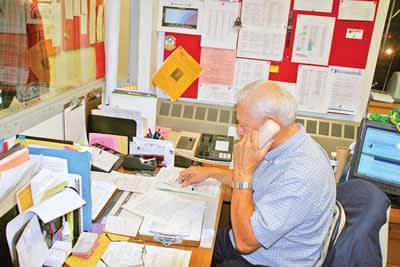
Ray Crystal of Fairport Central School District in New York takes on the myriad challenges of dispatch duties.
Fairport Central School District
It’s a typical morning at the dispatch desk. A driver is calling on the radio, another employee is calling on the phone to say they are not working this afternoon, a mechanic is listing the buses being serviced that afternoon, the high school athletic director is calling in looking for the soccer team’s bus and an angry parent walks in to register a complaint.
On the front line in the transportation department, dispatchers face these constant demands as they fulfill the great challenge of providing safe transportation for children. To be effective, they must first be a great communicator. They must also be able to manage time wisely, multi-task and juggle the many pulls on their attention without becoming sidetracked.
Like a circus performer who must stay focused on the saucers he is spinning on sticks, a dispatcher must remain focused every moment of the day to maintain effective communication. Unlike the circus performer, however, a dispatcher can suffer much more than a few broken dishes if his concentration falters.
During the normal course of business, stress is a given for dispatchers. Especially during the three busiest times of the day — morning roll-out, mid-day dismissals and afternoon roll-out — dispatchers must remain calm, cool and collected as they execute their many duties.
Every day, they must listen to radio conversations, anticipate what actions need to be taken and prioritize responses on the spot. They have to know which buses are out of service for maintenance or repair and assign spare buses, which drivers are out sick and which subs will fill routes, what field and sports trips are scheduled and what to do if emergencies arise.
Communication is key
Being a great dispatcher does not happen by simply sitting down in the dispatch chair. The person filling the job must be an excellent communicator — someone whose skills can help build positive relationships in the school district and the community, someone who demonstrates respect and knows when to listen and when to talk.
Today’s dispatcher must be proficient in many methods of communication. It is essential that he be able to communicate professionally by phone, by two-way radio and, of course, face to face.
A dispatcher must also be able to articulate thoughts clearly by e-mail, since the medium is widely used by parents and administrators. A watchful eye to word choice is paramount because it is difficult to convey a positive tone of voice through the often curt, quick notes that are dashed off online. In addition, etiquette skills while using instant messaging can make or break a dispatcher. Communications can seem unprofessional; the abbreviated language and acronyms used in instant messaging can sometimes be misunderstood.
Whenever and however they communicate, their voice must always be clear and credible. When answering the dispatch telephone, a smile needs to come through to the person on the other end. A professional, personal and polite greeting can have a positive impact on callers and relax an uptight parent who calls in worried about a late bus. Listening actively and not letting thoughts wander is also important. Inattention and passivity can come through on the phone and exasperate an already concerned parent.
A caring dispatcher remembers to empathize and apologize when appropriate. The old saying, “You have two ears and one mouth — use them appropriately,” is good to remember during any interaction. Many times parents just want to vent and feel that they are being heard.
Especially during an emergency or disaster, dispatchers must be able to remain calm, focused and unemotional. The radio must be treated with respect. It should also be policed for unnecessary or personal conversations (such as, “Meet me at the diner after your run”) to avoid frustration when important communications need to be relayed.
Actions such as sarcasm, snapping back at rude or irritating drivers, or repeatedly calling a substitute driver to inquire what time he will arrive at a stop should be avoided at all cost. Such approaches can be toxic to an operation and can also cause undue pressure on a driver, distracting him and jeopardizing student safety. If a substitute driver is running late, it would be better to ask how many minutes he is running behind and let appropriate staff members know so that messages can be relayed to parents who call in.
Evaluate policies
To improve communication, sometimes it is helpful to review and change policies. For example, in 2006, the Fairport (N.Y.) Central School District looked at its long-standing practice of having the dispatcher call drivers on the radio each day to let them know the names and addresses of students who were not riding the bus.
This seemingly small action caused operational problems in terms of the time-consuming task of keeping up with parent phone calls and relaying messages while performing other morning functions. Many times, a driver, knowing that a student did not need to be picked up, would alter the route, avoid a street or leave later. Sometimes, a bus that should have been on time would then run into more traffic and wind up being late for other stops, prompting complaint calls from parents.
The school district evaluated the practice and determined that there was no need to call in this information. Drivers were required to run their routes as written. If the student was out at the bus stop, the driver was to stop; if not, the driver was to drive past the stop. The school district reported that the time crunch problems were alleviated. Many drivers also commented on how much radio communications were improved.
Radio communication can be enhanced by teaching drivers some simple techniques, such as holding the microphone close, turning up the volume and projecting in order to be heard over engine noise and student conversations. To make sure the beginning of a message is heard, drivers can pause for a few seconds before speaking rather than keying the microphone and starting to speak immediately.
Stress comes with the job
Besides their dynamic, fast-paced work environment, today’s dispatchers face issues and pressures that did not exist a few decades ago.
Their responsibilities have increased because of mandates such as the No Child Left Behind Act and, in some places, restrictions to keep sexual predators from living near bus stops. A dispatcher must take time to become acquainted with such laws and the accompanying company or district policies. They should also be familiar with other policies regarding communication and confidentiality, as well as accidents, incidents, abductions or anything that would involve them directly or indirectly.
Many dispatchers have learned lessons the hard way in these matters after misspeaking to the press or further antagonizing an angry parent in a pressured situation, when there is not time to think.
Keeping a logbook can help dispatchers manage the mountain of communications they must handle every day. Nothing more complicated than a spiral notebook is needed to record every communication from every mode. It is imperative to date each day and to record the time of every communication.
The log can be used to track driver tardiness, clear up misunderstandings or identify re-routing needs. It can also help document an emergency situation or serve as evidence for the timing of an accident or traffic infraction involving a school bus. In the midst of a dispatcher’s busy morning routine, the extra work may seem burdensome; but once the practice becomes a habit, it can be an invaluable tool.
To alleviate stress in a job where concentration is essential, a dispatcher must have proper rest and nutrition to stay focused and centered. A dispatcher must also be able to step away from the stress: going for a walk or sitting quietly in a park during lunch or on a break may be the best way to make it through a busy afternoon.
Dispatchers have one of the hardest jobs in the pupil transportation industry; their work is the hub of an operation’s success. As the “voice” of a contract or district operation, they set the “feel” of the department through interactions with drivers, attendants, mechanics, parents, childcare providers, athletic directors, administrators and students.
It takes a special person to excel as a dispatcher. The person who sits in that chair must be a true professional, possessing the skills, attitudes and qualities that are necessary to “keep the saucers spinning” as they execute their duties and meet the many demands of the job.
The role of the dispatcher may be stressful, but it can also be satisfying, with the potential to touch — and save — lives every day. A dispatcher is the heartbeat of a school transportation department — pivotal to an efficient and safe operation.
Peter Lawrence is director of transportation at Fairport (N.Y.) Central School District. Paul Overbaugh is curriculum development specialist at the Pupil Transportation Safety Institute in Syracuse, N.Y.
Quick Answers
Dispatchers are at the hub of an operation’s success, coordinating and managing logistics to ensure safe and efficient pupil transportation.
*Summarized by AI
More Management

Meet the 2025 School Bus Driver Hero Winner: Annette Brown
We caught up with Wa-Nee Community Schools' Annette Brown on site at SBFX, where she was named the 2026 School Bus Driver Hero Award winner. Hear about her reaction, what she loves most about being a school bus driver, and more!
Read More →
Predictability Is Like Ketchup (According to 6-Year-Olds)
To students, a different school bus can feel like a full-blown crisis. One driver reflects on why familiar routines, showing up on time, and being reliably boring matter more than we think.
Read More →
Samsara Launches Free Driver Rewards Program
The new Driver Perks program gives eligible professional drivers access to discounts and offers without adding a cost for participating fleets.
Read More →

How Tax-Exempt Municipal Leases Can Help Finance School Buses
Let’s explore school bus financing options, including municipal leases, vendor payable accounts, and balloon payments, and how they can help stretch fleet budgets.
Read More →
Nominate Rising School Transportation Pros Under 40!
We’re searching for the next generation of leaders making an impact across the K-12 student transportation industry to recognize as SBF’s 2027 Trailblazers. Nominations are open now!
Read More →
Changing Lanes: BusWhere, EverDriven, InterMotive, Summit School Services, Switzer-Carty & Thomas Built Buses
Check out who's been hired, promoted, and appointed to leadership positions at various school transportation suppliers, contractors, and manufacturers.
Read More →
The Most Expensive Thing You Do Before Selling a School Bus: Wait
When should you sell an aging school bus? Learn how maintenance, mileage, corrosion, specifications, and timing can affect resale value long before the auction.
Read More →
American Student Transportation Partners Acquires AJ Myers and Sons
A new deal brings a 75-year Pennsylvania student transportation provider into one of the nation’s largest private school bus contracting groups.
Read More →
What I Brought Home From SBFX: Relationships, Leadership, and Preparing What's Next
Who could lead your transportation operation tomorrow if you couldn't? Bernando Brown explores succession planning, mentorship, and preparing emerging leaders to step up.
Read More →
Inside School Bus Fleet ConneX 2026: Industry Leaders Connect in Scottsdale [Photos]
See highlights from SBFX 2026 in Arizona, where school bus operators and suppliers gathered for meetings, education, networking, awards, and more.
Read More →