




Home Visits Help to Maximize Parent Collaboration
Parents of children with disabilities can provide useful information about their children if we give them the opportunity. A home visit by transportation staff can initiate a productive partnership.
How many times have you heard the expression, “Walk a mile in someone else’s shoes”? Too often, that expression is tossed about but quickly forgotten, particularly as it relates to parents of children with disabilities. We are quick to acknowledge the challenges they face, but are then unrelenting in our expectations of them.
I was talking to a mom of a child with autism a few months ago about the standard rule, “Have your child ready 10 minutes before the pick-up time.” We add that to our policy almost without thinking, considering it the height of reasonableness, but as she related to me, “My son can be dressed and undressed five times in 10 minutes.” If the bus arrives during the “undressed” moment, how does our driver respond? A call to base that Johnny is late again, or do they wait for Johnny to get dressed and greet him with a smile?
Demoralized parents
Parents of children with disabilities are often buried under an avalanche of acronyms, policies and expert recommendations that leave them humiliated, demoralized and suspicious. One study of the special-education process by Adrian T. Bennett found that the “parent-professional interactions are so structured as to render parents effectively powerless as partners in their children’s educational careers.”
As transporters, we cannot change the whole system. We may know about LRE and FAPE; we may even be up on IEPs, FBAs and BIPs, but when they start talking about the WPPSI and WIAT, most of us end up as confused as the parents.
Maybe stepping back and changing our corner of the system could actually even help us do our job better. In fact, that same study found that “parents can be very perceptive about their children’s difficulties and, therefore, have a great deal to contribute to an effective parent-professional partnership.”
Answer their questions
How do we make parents productive transportation partners? First, we give them all the information, we answer all the questions and we communicate responsibly and responsively.
Kathy Furneaux, executive director of the Pupil Transportation Safety Institute, observes, “It’s hard for some parents to trust others with the responsibility of transporting their child. Meeting parents first and creating a relationship will alleviate some of those anxieties. Ultimately, a good relationship with the parent or guardian will serve to enhance the safety of the child.”
For children with severe physical or intellectual impairments, the communication can start most effectively with a home visit and a dry run. Once transportation has been identified in the IEP, it is our job to arrange both the vehicle and equipment necessary as well as identifying appropriate staff and any special training they might need.
The home visit can include information gathering, such as the three-page checklist Dr. Ray Turner includes in “Special-Needs Transportation Best Practice.”
[PAGEBREAK]
The special-needs section of the 2005 National Congress on School Transportation’s National School Transportation Specifications and Procedures includes many great information-gathering forms (www.ncstonline.org), and the National Association for Pupil Transportation has created a CD of special-education forms collected around the country. But, we cannot approach the home visit as a one-way information flow.
Two-way information flow
What these parents need is a two-way information flow — someone to come to their home at a time that is convenient for them, to appear as interested in their child’s success as they are, to outline the transportation process and to answer questions until there aren’t any more.
The visit should include whoever is responsible for arranging transportation and, preferably, both the bus driver and attendant, as well as an interpreter, if necessary.
When transportation starts with person-to-person connections, the parents do not feel they’re handing their child over to a perfect stranger, but to people who have already demonstrated their concern and professionalism.
Find out the necessary information about the wheelchair, identify the medications and medical conditions, and figure out how the bus will be positioned for loading; but also find out what their child enjoys, what makes him frightened, what soothes her.
Don’t just talk to the parents — include the child as well. Don’t make assumptions about what the child can or cannot understand. Talk to them about what the trip will be like, who else rides the bus, what the school looks like. Create as much familiarity as you can.
Include a dry run
The culmination of the home visit is the dry run. The dry run gives the parents and student a chance to experience the bus ride and to visit the new program setting. Naturally, this must be coordinated with the school so a class visit can be arranged if the visit is during class hours. This is not just to make sure the driver knows how to get to the school; it is to familiarize and reassure the parents and child that this is a process that will happen safely and reliably.
Beth Harry, in a study of urban parents, observed, “Parents, for the most part, spent most of their time in their neighborhood and generally considered the city at large dangerous and alien.” She talked with a mother whose 9-year-old child’s program location had been moved four times. The parent I mentioned having spoken to earlier said to me, “I just want them to treat my son as a 20-year-old young man, and not a disease.”
Commitment is critical
Some readers will be thinking that they have enough on their plate already; they don’t have time for this touchy-feely silliness. If you don’t have time for home visits, what else don’t you have time for?
A system that begins with a home visit is more likely to have all the other planning pieces in place as well: maximized use of the “regular” bus with necessary accommodations, medical and emergency information and plans for each child, evacuation plans for all standard emergencies, an accurate route sheet that provides all the necessary information for substitute bus staff and transportation requirements clearly spelled out in the IEP.
What I have seen far too often, particularly in urban settings, is bus staff transporting children with no information, no plans and no administrative support. Developing a relationship with the parents isn’t a possibility because bus staffing is constantly changing due to rapid turnover and high absenteeism and because routes are changed or doubled up when there aren’t enough drivers or attendants. We’re lucky if the driver knows which house it is, let alone thinking that she or he has been inside the house for a home visit or knows life-saving procedures necessary to protect that child’s future.
I refuse to play the liability card, because we should not choose to provide transportation in a reliable and respectful way to protect our and our organization’s respective behinds. We should provide transportation in a responsible way that promotes educational success and student well-being, because a free appropriate public education is a right — not just a legal right but a human right. We can best initiate the provision of that human right with a human-to-human home visit.
Ted Finlayson-Schueler is president of Safety Rules! — a non-profit organization committed to safe school travel. He was executive director of the Pupil Transportation Safety Institute for 14 years and is a doctoral student in disability studies at Syracuse University.
More Special Needs Transportation
Kelli Goterba Named 2026 Special-Needs School Bus Driver of the Year
Through building trust with students and strengthening her transportation team, Goterba exemplifies the impact special-needs drivers can make.
Read More →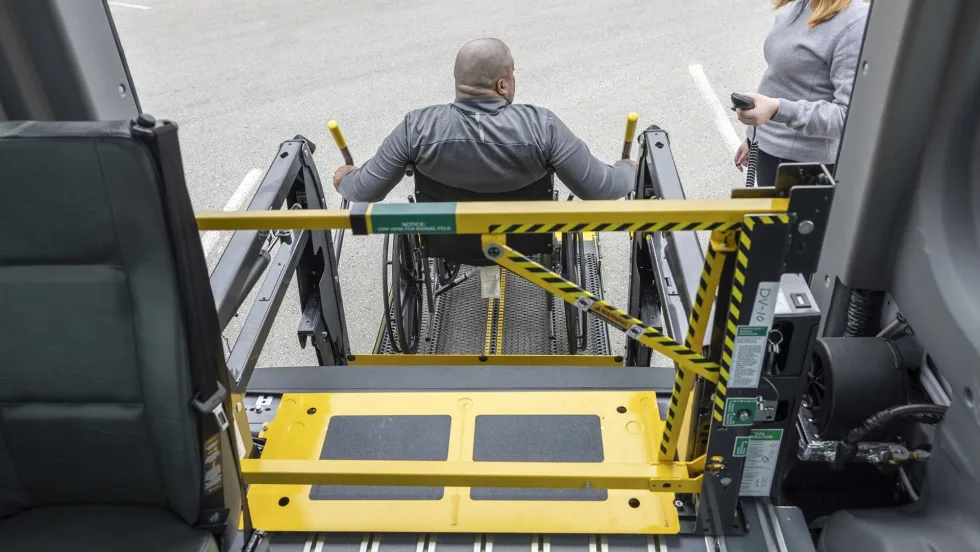
BraunAbility Introduces New Safety Barrier for Wheelchair Lifts
LiftSentinel is designed to add another layer of protection during wheelchair loading and unloading and can be retrofitted to many existing commercial lift installations.
Read More →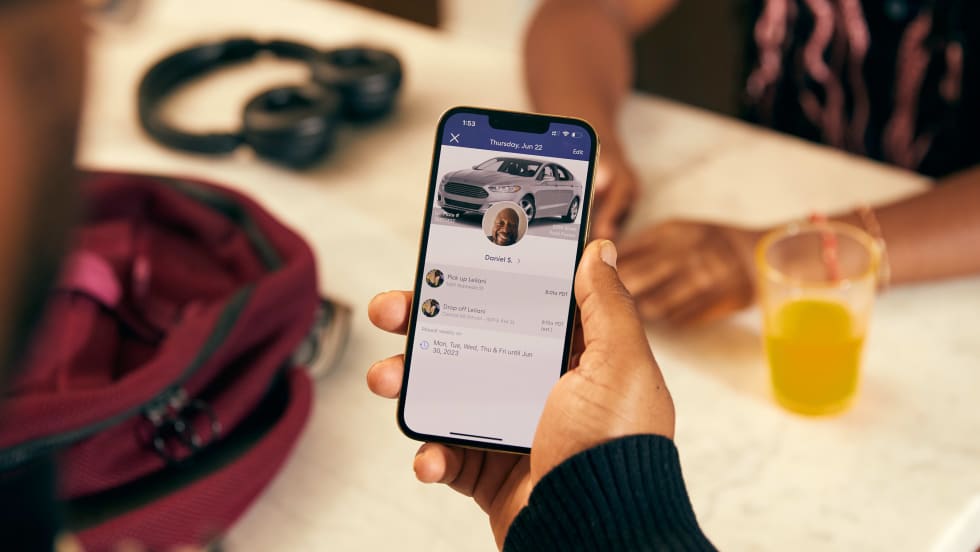
HopSkipDrive Launches New Safety, Driver Consistency Features for 2026-27 School Year
The company’s free ride recording, live ride tracking, and consistent driver assignments aim to improve safety and continuity for diverse student transportation needs.
Read More →
The Most Common Wheelchair Securement Mistakes on School Buses (and How to Fix Them)
Small missteps in wheelchair securement can have serious consequences. Here are 32 tips from experts to reduce risk and increase student safety on the bus.
Read More →
Inside AMF Bruns’ New Showroom: School Bus Securement Solutions Explained
Go inside AMF Bruns America’s new Ohio showroom with Maritza Valentin to see its FutureSafe technology, driver training tools, securement systems, and seating innovations.
Read More →
What AMF Bruns’ New Facility Means for Customers [Video]
Inside AMF Bruns’ new Stow, Ohio, operations: See how expanded space and innovation will enhance customer support and operations.
Read More →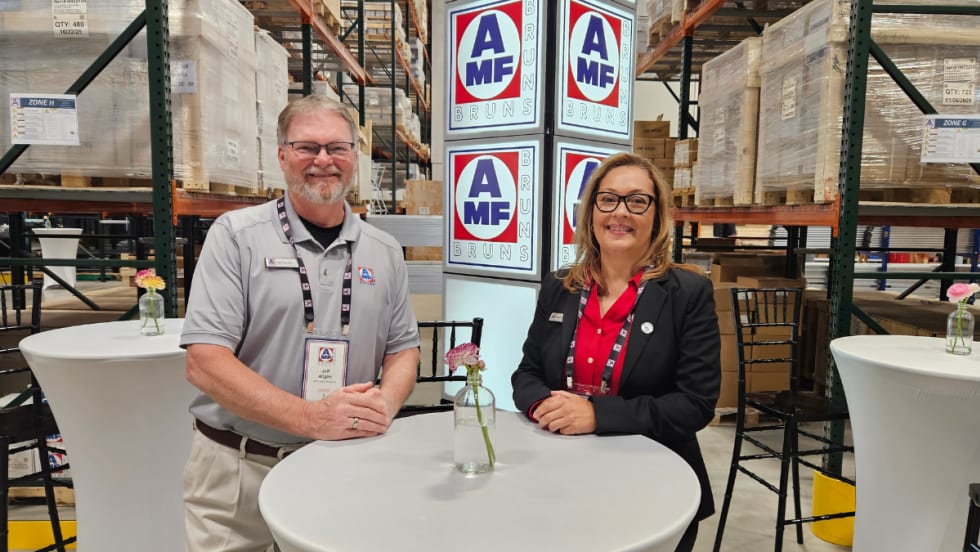
AMF Bruns Expands in Ohio, Investing in Growth and Community
With expanded production space, local investment, and a growing workforce, AMF Bruns is scaling its U.S. presence. Here’s an exclusive first look inside the new Stow, Ohio, HQ.
Read More →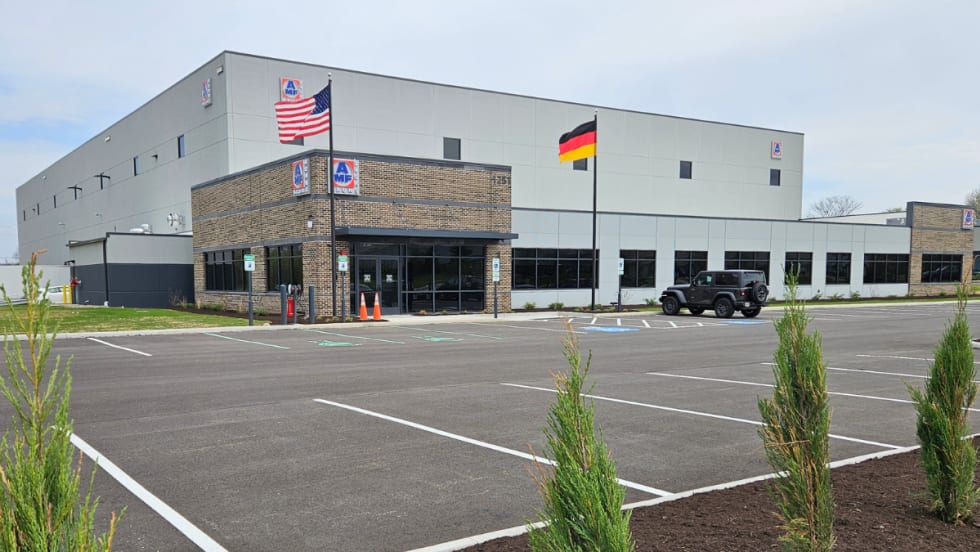
Inside AMF Bruns of America’s New Ohio Manufacturing Facility [Photos]
Take a behind-the-scenes look at AMF Bruns of America’s new 41,000-square-foot Stow, Ohio, headquarters, featuring advanced manufacturing, expanded space, and future-ready mobility solutions.
Read More →
First Student Boosts Student Support in Wichita & Texas
First Student and Wichita Public Schools are using behavioral support strategies to improve student ride experiences, while a separate initiative expands access to after-school programs through a bus donation.
Read More →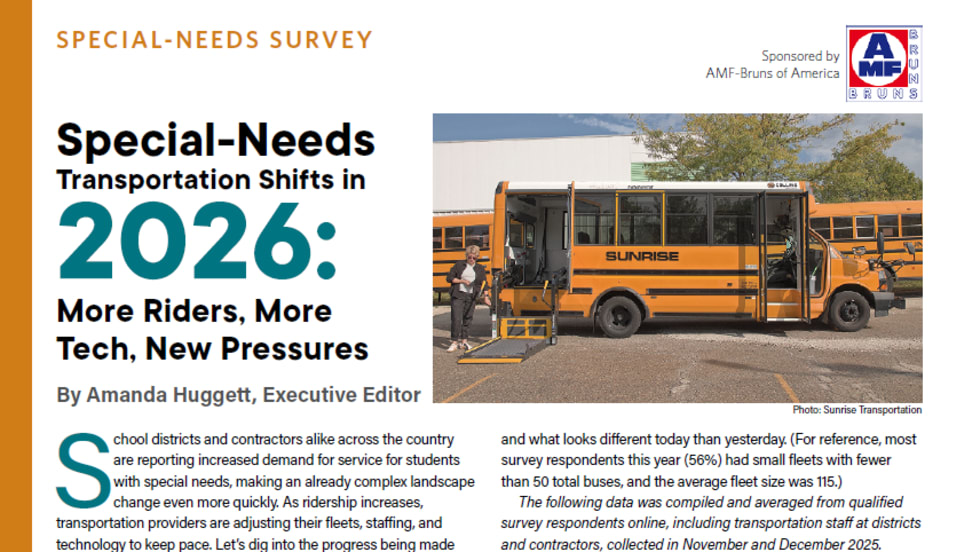
2026 Special-Needs Transportation Survey
What’s changing in special-needs transportation? This year, student transportation operators report a rising need, easing driver shortages, growing tech adoption, and evolving challenges. Sponsored by AMF Bruns of America.
Read More →