




Hands-on help in the bus garage
The business of running a school bus fleet is getting harder all the time. Although most fleets are publicly operated, running school buses is a busin...
The business of running a school bus fleet is getting harder all the time. Although most fleets are publicly operated, running school buses is a business. In this business, however, the bottom line isn’t profit, it’s safety.
That’s why it’s so important to recognize the people behind the scenes (or, rather, under the buses) who make the nation’s fleet of 450,000 yellow school buses as safe as it is. These, of course, are the maintenance supervisors, mechanics, garage helpers, parts people and clerical support personnel.
To that end, for the fourth straight year, we’ve published a special report on exemplary garage operations (“Top 10 Maintenance Programs for 2004”, beginning on pg. 30). If you read through these profiles carefully, you’ll notice a common thread: emphasis on proper technician training and modern equipment.
Training tops the list
It almost goes without saying that mechanics need a strong support system that includes a structured training program. Notice I didn’t say a formal program. With all of the budgetary constraints facing the K-12 education system these days, many school districts and contractors don’t have the luxury of implementing sophisticated training programs. What is needed, however, is a training program that fulfills the basic needs of the garage. And that could be as simple as a conscientious learn-as-you-go system.
We hope that our magazine and its Web site help to fulfill that training need. According to a recent study, school transportation professionals rely on two main sources for information about their industry — trade magazines and Websites. We take that charter seriously, since we are leaders in both areas. Providing you with the knowledge to do your jobs better is what we’re here for.
Our in-house research helps with that task. There’s no clearer example than our maintenance survey in this issue (see pg. 24). In this year’s survey, we found that workload is an issue with many school districts and contractors. Too few mechanics, too many buses, especially older ones. This is a problem that cannot be ignored.
Once the economy recovers and more jobs become available, school bus fleets will be vulnerable to attrition if their mechanics are dissatisfied because of an unreasonable workload.
How to lighten the load
In regard to old buses, school bus operators should be lobbying for as much capital funding as school boards can make available. As you well know, old equipment expands the workload of mechanics, increases repair costs and reduces the safety level of passengers.
If you’re not pushing for the purchase of new equipment, you should be. According to a third-party study conducted by Readex Research, more than four of five (82 percent) of our readers are involved in advising, recommending, specifying or approving the purchase of school buses! A smaller but still significant percentage of you are involved in the purchase of parts, safety equipment, mirror systems, among other things.
You are the people who control both the big purchases, such as school buses, and the little ones, like parts and garage equipment. That means that you’re on the front lines of providing your maintenance staff with the tools and vehicles that will make their lives easier. Don’t miss the chance to improve your maintenance program.
More Maintenance
ASE Highlights School Bus Technician Certification Requirements
ASE is encouraging school bus maintenance professionals to maintain their certifications, highlighting seven specialized tests and five-year renewal requirements.
Read More →
International Adds E-Commerce Capabilities to Fleetrite.com
IC Bus customers can now browse, buy, and track shipments for more than 400,000 aftermarket parts online.
Read More →
The Most Expensive Thing You Do Before Selling a School Bus: Wait
When should you sell an aging school bus? Learn how maintenance, mileage, corrosion, specifications, and timing can affect resale value long before the auction.
Read More →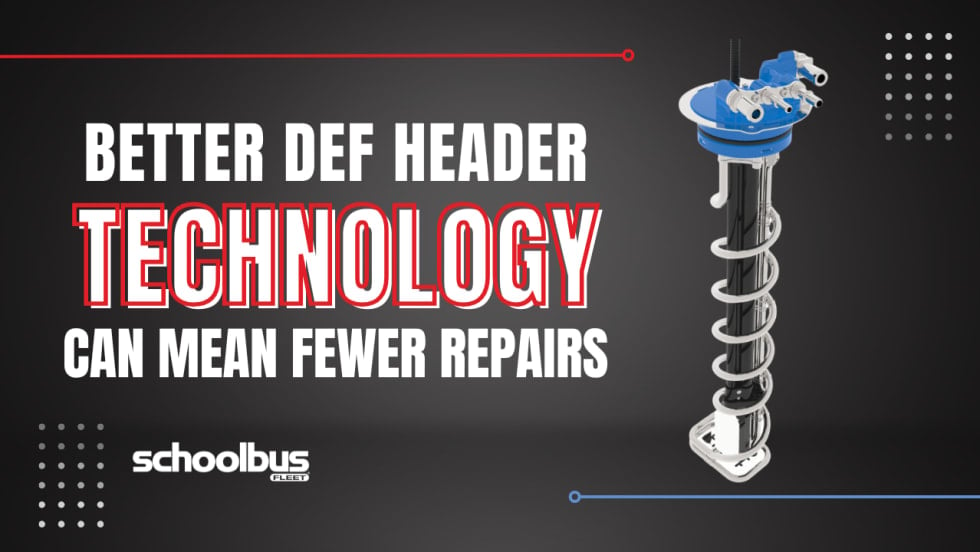
The Evolution of DEF Header Technology: What School Bus Operations Should Know at Replacement Time
See what school bus fleets should consider when replacing DEF headers to improve reliability, reduce repeat repairs, and control maintenance costs.
Read More →
The Essential Guide to School Bus Maintenance and Student Safety
Your district's buses carry students to school every day. This guide shows how predictive maintenance powered by fleet data helps keep buses reliable, drivers accountable and students safer from the first bell to the last stop.
Read More →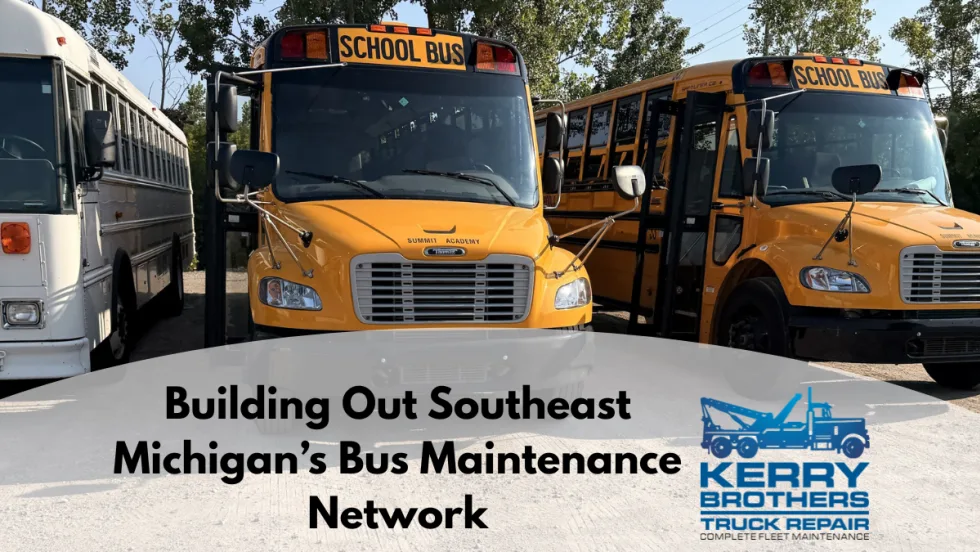
Kerry Brothers Grows Michigan School Bus Repair Network
The acquisition of Downriver Truck and Bus expands Kerry Brothers’ school bus maintenance footprint across southeast Michigan, adding repair capacity, diagnostic resources, and state inspection support.
Read More →
Noregon Introduces CAN Bus Diagnostic Tool, Expands JPRO Features
CAN Mentor and the latest JPRO update aim to simplify vehicle network diagnostics and improve repair efficiency for technicians of all experience levels.
Read More →
Cummins on Smarter, Simpler Engine Innovation
Cummins discusses its first-ever gasoline engine for school buses, EPA 2027, and why bus fleets still want durable, simpler internal combustion options.
Read More →
Report: 72% of Diesel School Buses Now Use Advanced Low-Emission Engines
New data shows advanced low-emission diesel technology continues expanding across school bus fleets, even as electric bus adoption gains momentum.
Read More →
Vampire Tools' CAIMAN 7.5-Inch Multi-Purpose Screw Extractor Long-Nose Pliers with Crimper
Vampire Tools introduced the VAMPLIERS Caiman 7.5-inch multi-purpose pliers, combining screw extraction, cutting, crimping, and gripping functions into a single tool designed for fleet maintenance professionals.
Read More →