




Guard Your Buses Against Corrosion
A chemical now being applied to roads can cause expensive damage to buses over time. Bolster vehicle safety and service life by conducting corrosion inspections and choosing the right protective products.
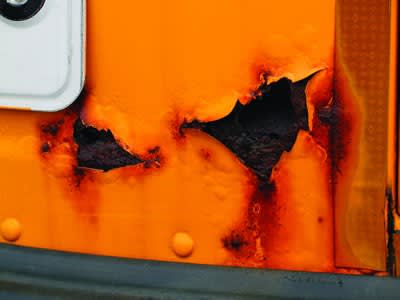
Did you forget about corrosion? Was it all in the past? Did it seem like the problem was gone but now it’s back?
Don’t blame your equipment supplier — they’re probably doing more now than ever to prevent corrosion. Many areas of the U.S. are seeing resurgence in corrosion issues, including some areas where corrosion has not previously been an issue.
The culprit may be magnesium chloride. The use of this chemical is a relatively new phenomenon. It is favored because it can be applied to roads before a snow or ice event and will prevent the precipitation from accumulating on the road surface. Many states and Canadian provinces are also now using magnesium chloride for dust control on unpaved roads.
A 2002 study performed by the Colorado Department of Transportation found that magnesium chloride was more corrosive than rock salt in certain environments and that rock salt was more corrosive in others. Confusing? Read on.
Having performed testing under three different standards, the department stated the following in its final report: “Since the MgCl2 [magnesium chloride] solution has higher viscosity and stronger hydrophilicity [affinity for water] than the NaCl [rock salt] solution, it is much easier for the MgCl2 solution to stick and crystallize on the surface of the metals under the dry condition and then become solution on the metal surface under the wet condition. This wet-dry effect is responsible for the different corrosion behaviors of MgCl2 under different testing conditions. Therefore, depending on service conditions experienced by automobile components, MgCl2 is more corrosive than NaCl under humid environments, and NaCl is more corrosive under immersion and arid environments.”
Examine that statement and compare it to the environment in which your fleet of school buses operates. Do your buses operate in arid conditions while occasionally being immersed in water? Or is your fleet operating in humid conditions likely to accelerate the effects of magnesium chloride? Take into account that magnesium chloride may be in use for dust control in your area, and you have year-round exposure to a highly corrosive chemical. Corrosion is expensive to repair and can cause structural weakness in critical components.
Take anti-corrosion action
Corrosion repairs are time-consuming and take the bus out of service. Vehicle safety and service life can be extended with an anti-corrosion game plan. You need a strategy for corrosion control beyond what the bus manufacturer can reasonably provide.
That strategy should begin with periodic corrosion inspections. Your state inspection will provide a guideline for areas that should be included. Most state inspection forms mention frame and sub-frame members, doors, the fl oor and the battery box. Other common areas that suffer corrosion are the step wells and the rear panel of the vehicle. The seals around the lights degrade over time, allowing water to enter the rear panel and become a potential cause of severe corrosion.
Once you’ve identified the vulnerable areas, you’ll need to provide some additional protection for them. On the exposed areas, a good-quality undercoating material is the best approach. In the enclosed areas, you’ll need a good-quality rust preventive product or “cavity wax.” The term “undercoating” has often been used as a catch-all term for anti-corrosion materials. In fact, the missions of the two materials are different, and so are their characteristics.
Material matters
Undercoating, because it is exposed directly to the road, must be durable and abrasion-resistant. Cavity wax needn’t have that characteristic, but it must have excellent coverage qualities and crevice penetration to protect crimp seams and other crevices.
You’ll want to select an undercoating product that won’t pocket, peel or dry out and chip off of the bus. The undercoating supplier that you select should be able to document the performance of its product and provide you with comprehensive directions for use. Most undercoating products are simple to apply with inexpensive air-powered equipment.
You may have a mental picture of the La Brea Tar Pits in your shop, but many modern formulas are relatively clean. There are a few different basic materials available. Solvent-based undercoating is the traditional product and has the advantage of a fast setup time to get the bus back on the road quickly. Water- based undercoating products can also be durable and are free of any regulatory issues (although so are many solvent-based formulas).
The drawback to water-based undercoating if you operate in a four-seasons environment is that the bus cannot be put outside during freezing weather until the coating is fully cured. This is typically 24 hours. Also, water-based products cannot be shipped long distances during cold weather. If frozen, they’re usually ruined. Your supplier should be able to make a recommendation based on your environment, work area and operating conditions.
In the enclosed areas or cavities of the bus, a cavity wax type of rust preventive material will be best suited to fi ght off corrosion. Again, the supplier should be able to document the material’s performance and offer comprehensive instructions for its use. These products are application-sensitive, so the equipment selected should be recommended by the material supplier.
An atomizing or “fogging” system of application works best for the cavity areas, as the technician has no sight line to the work. Some cavity wax products have the opposite electric charge, as does the bus body, so when introduced into the cavity, they’ll search for bare metal.
Lasting protection
You may need to touch up your undercoating application from time to time due to road debris striking the material and removing it. With the right material, this should be minimal and, being exposed, the application can be easily inspected. The cavity wax application should be a single application that would only need to be redone in the event of a collision repair.
Depending on the age of the bus, some surface preparation of the underbody may be needed, and if the unit has been in service for any length of time, a pressure washing of the underbody will be an important step in preparation.
Including the prep time, your labor should not exceed four hours, and your material cost should be $250 or less. Compare these costs to the cost of corrosion repairs and it will be evident that providing your buses with additional corrosion protection will pay for itself.
Applying undercoating and rust prevention products is simple. All you need are the lift and the compressed air you already have, along with the material manufacturer’s recommended application equipment and training manuals. Take on corrosion with a directed preventive maintenance program, and corrosion may, once again, be a thing of the past.
David Besuden is vice president, sales and marketing, at Automotive International Inc. For more information, e-mail him at dlb@autoint.com or visit www.valugard.net.
More Maintenance
The Essential Guide to School Bus Maintenance and Student Safety
Your district's buses carry students to school every day. This guide shows how predictive maintenance powered by fleet data helps keep buses reliable, drivers accountable and students safer from the first bell to the last stop.
Read More →
Kerry Brothers Grows Michigan School Bus Repair Network
The acquisition of Downriver Truck and Bus expands Kerry Brothers’ school bus maintenance footprint across southeast Michigan, adding repair capacity, diagnostic resources, and state inspection support.
Read More →
Noregon Introduces CAN Bus Diagnostic Tool, Expands JPRO Features
CAN Mentor and the latest JPRO update aim to simplify vehicle network diagnostics and improve repair efficiency for technicians of all experience levels.
Read More →
Cummins on Smarter, Simpler Engine Innovation
Cummins discusses its first-ever gasoline engine for school buses, EPA 2027, and why bus fleets still want durable, simpler internal combustion options.
Read More →
Report: 72% of Diesel School Buses Now Use Advanced Low-Emission Engines
New data shows advanced low-emission diesel technology continues expanding across school bus fleets, even as electric bus adoption gains momentum.
Read More →
Vampire Tools' CAIMAN 7.5-Inch Multi-Purpose Screw Extractor Long-Nose Pliers with Crimper
Vampire Tools introduced the VAMPLIERS Caiman 7.5-inch multi-purpose pliers, combining screw extraction, cutting, crimping, and gripping functions into a single tool designed for fleet maintenance professionals.
Read More →
How Advanced Diagnostics Helps Bus Fleets Stay Ahead of Repairs
Chat with Noregon’s Kevin Smallhorn at ACT Expo about bus diagnostic tools, telematics integration, CNG maintenance support, and strategies to help reduce downtime and improve uptime.
Read More →
How School Bus Fleets are Getting Ahead of Breakdowns
Don’t let bus downtime wear you down. Here’s how bus operators are shifting from manual processes to AI-powered, data-driven maintenance systems for improved reliability and safety.
Read More →
Pennsylvania School Bus Maintenance Team Praised for Dedication to Safety
Matthews Bus Company’s West Jefferson received a letter of commendation from the Pennsylvania State Police for their fleet inspections.
Read More →
From Chaos to Clarity: How School Districts Are Running Leaner Transportation Operations
Covering 38 routes on a Friday afternoon. Buses idling while routes overlap. Parents calling nonstop about late arrivals. Sound familiar? This whitepaper explores how district transportation leaders solved these exact problems — and what measurable results followed.
Read More →