




'Great Fleets' designed to encourage all fleets
Few people outside the industry understand the day-to-day challenges of running a school transportation program, large or small.
The air is thin where you toil. A minor slip can lead to tragedy. Public expectation is high, sometimes too high, especially when you consider the limited resources at your disposal. Few people outside the industry understand the day-to-day challenges of running a school transportation program, large or small. You accept these conditions and actually embrace them. You campaign for safety through diligent driver and passenger training and community awareness programs. You support a strong maintenance program. You buy the best equipment. You challenge your entire staff to suggest ways to improve the operation. And you listen to them. That’s why we’ve created “Great Fleets Across America” — to recognize school bus operators like you.
We say ‘great,’ not ‘greatest’
Note that we didn’t title this section “Greatest Fleets Across America.” That would be presumptuous. The fleets profiled in this section certainly are among the best and the brightest, but we’re not crowning them as “the greatest.” What we’re trying to do is recognize top-notch fleets that are providing safe and efficient school transportation. This industry receives so little positive notice that we thought it was time to create some of our own. Identifying school transportation programs around the country that meet high standards in the areas of safety, training and maintenance was easy. Narrowing down the candidates to just one in each state was much more challenging. Without first-hand knowledge of these operations, we relied on recommendations by state directors of pupil transportation, state pupil transportation and contractor associations and members of our Editorial Advisory Board. Our thanks to everyone who provided input. Your assistance was invaluable. Don’t fret if you believe that your program was overlooked. Next year could be your turn. Yes, we plan to reprise this section in 2000. And next time around, we’re going to open up the nomination process. We’ll begin publishing a nomination form next spring. Remember, it’s never too early to start thinking of ways to improve your program. You might also want to “borrow” ideas from this year’s Great Fleets. Just in case you’re too busy to read through all 50 profiles in this issue, I’ll summarize some of the traits shared by many of the selected fleets.
Year-round driver recruitment
Strong emphasis on customer service
Mechanics urged to attain ASE certification
Drivers encouraged to participate in roadeos
Conscientious preventive maintenance programs
Drivers rewarded for perfect attendance
Drivers rewarded for avoiding preventable accidents
Computerization of routing/scheduling, fleet maintenance
Standardization of equipment
Staff input encouraged
Greatness is an attitude
There are thousands of ways to improve your transportation program. Some are feasible; some aren’t. One tactic that doesn’t require school board approval is improving your attitude. Adopt a positive, upbeat outlook and encourage all employees to do the same. Any good fleet is more than the sum of its parts. They have a positive energy that’s hard to miss. That’s because it is powered by people with the desire to do their jobs a little better today than yesterday. These people share their optimism and enthusiasm with others. They believe in duty and obligation. They refuse to take short cuts. They are the core of a competent, diligent school bus fleet, perhaps even a Great Fleet.
More Management

EverDriven Launches Route Consolidation Calculator to Estimate Diesel Savings
As diesel prices hit record highs, the largest alternative transportation provider says a 10% route consolidation could save a 120-route district more than $78,000 a year in fuel alone.
Read More →
Zum Secures Continued Financing Support for School Bus Expansion
Generate Private Credit has financed approximately $75 million in school bus deployments across three states, supporting more than 500 buses as Zum expands across the county.
Read More →
Beyond Discipline: A Different Approach to Student Behavior on the Bus
After implementing a dean of students program in Oregon, North Clackamas is seeing positive improvements. Here’s how it worked. The Route is brought to you by IC Bus.
Read More →
A Dean of Transportation's Different Approach to Student Behavior on the School Bus
After implementing a dean of students program in Oregon, North Clackamas is seeing positive improvements on the bus. Here’s how it worked.
Read More →
Inside NAPT ACTS 2026: Highlights from Louisville
From federal updates and student behavior strategies to new school bus technology and industry awards, see highlights from NAPT ACTS 2026 in Louisville.
Read More →
Meet the 2025 School Bus Driver Hero Winner: Annette Brown
We caught up with Wa-Nee Community Schools' Annette Brown on site at SBFX, where she was named the 2026 School Bus Driver Hero Award winner. Hear about her reaction, what she loves most about being a school bus driver, and more!
Read More →
Predictability Is Like Ketchup (According to 6-Year-Olds)
To students, a different school bus can feel like a full-blown crisis. One driver reflects on why familiar routines, showing up on time, and being reliably boring matter more than we think.
Read More →
Samsara Launches Free Driver Rewards Program
The new Driver Perks program gives eligible professional drivers access to discounts and offers without adding a cost for participating fleets.
Read More →
How Tax-Exempt Municipal Leases Can Help Finance School Buses
Let’s explore school bus financing options, including municipal leases, vendor payable accounts, and balloon payments, and how they can help stretch fleet budgets.
Read More →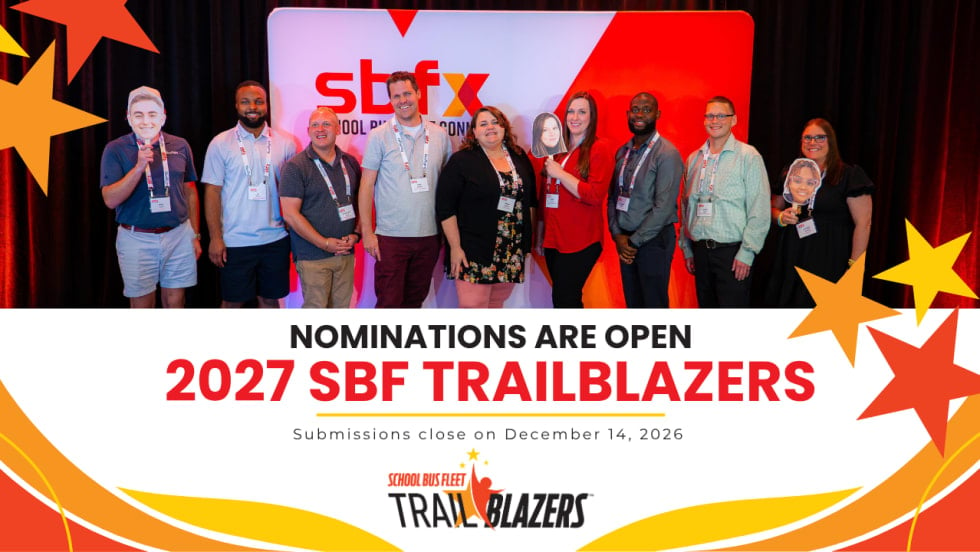
Nominate Rising School Transportation Pros Under 40!
We’re searching for the next generation of leaders making an impact across the K-12 student transportation industry to recognize as SBF’s 2027 Trailblazers. Nominations are open now!
Read More →