



Great Fleets Across America (Part V)
Small Community Plus Ship-Shape Operation Equals Success Riverside Community School DistrictOakland, Iowa It’s been said...

Small Community Plus Ship-Shape Operation Equals Success
Riverside Community School District
Oakland, Iowa
It’s been said over and over again that there is strength in numbers. Whoever coined the phrase probably meant larger numbers, but the transportation team at Riverside Community School District in Oakland, Iowa, has shown that strength can be found in any numbers, even smaller ones.
A family affair
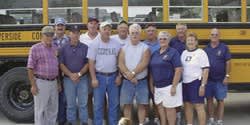
David Danker, transportation director, leads a team of 17 dedicated school bus drivers who transport 450 students daily using a fleet of nine route buses. The small but efficient department serves only one school, but students converge from three towns — Oakland, Carson and Macedonia — to attend the school.
Danker is entering his 20th year with the school district. He has served 10 years as supervisor and was a driver for 10 years. Previous to his work in transportation, Danker farmed full time, raising crops of corn, beans and alfalfa and a herd of cows. Although he farms part-time now, Danker says he loves farming and transportation equally. But the close relationships fostered at the transportation garage make being there more like family fun than work.
“I think one of our greatest strengths is our rural community,” Danker says. “It’s small enough that we all know each other.” The small but close-knit community is analogous to the setup of the transportation department. The small team shares a high level of camaraderie.
“Since we’re as small as we are, I consult with the drivers a lot,” Danker says. He delegates strategically and efficiently. This helps to keep mileage down, and the staff members seldom if ever balk at taking an extra run here and there.
Inspiring new hires
Attrition rates are low at Riverside Community Schools. Drivers tend to stay put almost until retirement. Last year, a driver retired from the department after 37 years of service. Another driver, who is still with the district, has driven for 35 years.
“I’ve only got one person on staff who has been here for less than five years,” Danker says.
Since new hires are rare, training is an unusually low-key and individualistic endeavor. Danker works with any new hires personally, showing them the ins and outs of driving before sending them out with another driver. The state has a 12-hour class or an in-service that each driver completes. There’s also a yearly three-hour in-service for all drivers required by the state. Most drivers hired at Riverside have been subs. Many have other work experience behind the wheel, such as driving trucks.
Riverside Community Schools currently purchases about one bus a year. The district had been behind with this schedule but recently got back on track.
“We’re at about state average, which is between a 7- and 8-year-old fleet,” says Danker. He surmises that the department will resort to purchasing a bus every other year since it is now running 14 buses. Previously, it ran 19 buses.
{+PAGEBREAK+} Equipment check
The fanciest thing Danker might spec on his buses is a PA system, which he says his drivers really enjoy. Colored floors, which come in gray, blue or tan, are really the only specialty items that he has to have on his buses due to the limestone roads in that region of the United States. “We’re on these white limestone roads, and on the black bus floors, everything shows,” says Danker. “It’s just horrible to try to keep the floors clean.”
All of the buses have video cameras installed. The VHS cameras are used to monitor student behavior, and the entire fleet is equipped with Motorola radios.
The preventive maintenance schedule for Riverside’s buses is every 5,000 to 7,000 miles or every three months, whichever comes first. It consists of oil changes, exhaust, U-joint and drive shaft inspections and brake checks. This is the average for diesel vehicles, but gas vehicles sometimes run a little shorter.
“We also have a yearly chassis inspection that’s conducted every year,” says Danker.
As communication with drivers is good, Danker doesn’t have to say much to get them to bring the vehicles in for timely maintenance calls. Primarily, Danker services the vehicles himself, but he receives assistance from a driver who helps out in the shop on a part-time basis.
The state of Iowa requires that the district run 10 percent ethanol. The rest of the fleet runs on pure diesel. Danker is satisfied with the fuels he runs, but if biodiesel or soy diesel becomes more affordable, he’ll look into that.
Generally, vehicle inspections have been exceptional at Riverside Community School District. With its last inspection, there was only one bus that had a problem, but the district has gotten rid of that vehicle, leaving a nearly flawless fleet.
Decreased ridership
Although things may look or sound rosy at the district, Riverside does have its challenges. The district has experienced declining enrollment over the past 10 years or more. Two school districts merged 12 years ago.
Oakland Community Schools and Carson-Macedonia Community Schools merged to become Riverside Community School District.
The district cut about 13 routes down to nine, yet it still has to cover the same number of miles as before. “We’re just picking up a few fewer kids,” Danker says, “But the enrollment is starting to level off.” Still, trying to keep hours to a minimum has been a challenge.
Community ties
The district has built a strong and helpful relationship with the Pottawattamie County Engineering & Secondary Roads Department, which is responsible for all construction, maintenance, repair and resurfacing of pavement in the county highway system. The engineering department alerts the district whenever there are any road closures or detours.
— ALBERT NEAL
FLEET FACTS
Buses - 14
Students transported daily - 450
Total number of students in district – 685
Schools served – 1
Staff – 17
Area of service - 240 square miles
Average driver wages - $26.60 per route, $8.25/hour for activity trips
{+PAGEBREAK+}
A History of Great People
Student Transit – Eau Claire Inc.
Eau Claire, Wis.
For a school bus company with a long history, it seems appropriate that its greatest strength is its long-term employees.
Student Transit - Eau Claire’s senior-most driver has been with the company for 35 years. Many drivers have been there more than 15 years. And the office staff members have an average of 32 years of service.
Phil Fey, president of Student Transit, says the employees are not only experienced, but they care about children and are dedicated to safety.
At the company’s annual banquet this past year, awards were presented for a total of nearly 1,000 years of safe driving among about 100 drivers.
“And we’re fussy about those awards,” Fey says. “If someone has an accident, they don’t get one.”
Interesting history
The story of Student Transit - Eau Claire reaches back more than 60 years, beginning with Ray Fey Sr. — Phil’s grandfather.
Ray Sr. sold buses and trucks out of Duluth, Minn. At the time, power companies in Wisconsin and Minnesota owned many of the city transit systems because they used electric streetcars.
When the power companies began to get out of the streetcar business, Ray Sr. began selling them gas-powered buses.
“Then the public service commission said, “We don’t want you running city buses — they’re not electric anymore,’” Phil explains.
So when Northern States Power, a regional company, had to get out of the bus business, Ray Sr. was given the opportunity to buy Eau Claire’s buses. He and a few partners began running Eau Claire Transportation Company in 1939.
One of the original investors was Andrew “Bus Andy” Anderson, who was a co-founder of Greyhound Bus Lines. Anderson later sold his shares to Fred and Ray II, Phil’s father and uncle, respectively.
The company operated transit buses in Eau Claire and two other cities until 1975. That year, the Feys sold their city buses to the cities but retained the school bus contracts, eventually keeping just Eau Claire’s.
Today, Student Transit - Eau Claire runs nearly 100 yellow school buses. Phil, who joined the family business in 1966, operates the company with his sons, Jim and Ray III. Fred, now 91, still goes to the office every day and, as Phil says, “tells us what to do.”
Smooth operations
Student Transit’s fleet covers more than 200 square miles, which includes rolling hills that are often covered in snow during the winter. The occasional ice storms are, as Phil says, “our worst enemy.”
The area of service has traditionally included a large rural contingent, but Phil says that it’s becoming more and more urban. The company currently transports 8,000 pupils to 28 schools throughout the Eau Claire Area School District.
The school bus fleet consists of all Thomas Built Buses, the majority of which are Type Ds. Even the buses equipped with wheelchair lifts are full size.
Ray III, who is vice president along with his brother, Jim, says the company tries to buy between six and eight new buses each year. There are still some early-‘90s models in the fleet, but Ray says that Student Transit’s three technicians keep all the vehicles in top shape. Nearly all repair work is done in house.
{+PAGEBREAK+} The company’s preventive maintenance schedule brings in buses every 3,000 miles for a basic lube and inspection. The oil-change frequency is about 6,000 miles on average.
Phil says that the fleet always looks good because of the company’s bus washer and because nearly all of the buses are parked in a heated storage facility, which helps protect them from the elements.
Keeping the buses inside also helps the drivers in performing their walk-around inspections, since they don’t have to deal with rain or whatever else might be falling from the sky.
Great relationships
One of the keys to Student Transit’s success is the strong relationship it has fostered with the district, including administrators, principals and teachers.
“We really feel like we’re an extension of the school board and district,” says Phil. “We try to be a part of their administration.”
Such is their relationship that the company becomes deeply concerned when costs that are out of their control begin to climb.
Student Transit has had a fuel-adjustment clause in its contract for about 20 years. Phil estimates that for the first 15 years of the agreement, the company credited the school district more than $500,000.
Unfortunately, for the past four or five years, the company has had to get additional funding from the district because of high fuel prices.
Still, Student Transit’s cost-per-pupil is well below the state average. “We take a lot of pride in that,” says Phil.
The company also maintains strong ties with other contractors in the state through the Wisconsin School Bus Association.
Phil was president of the group from 1997 to 1999, and he has served on the board of directors for many years. Before him, his father, Fred, held a spot on the board. Phil says he hopes that one of his sons will soon become involved with the association.
A different type of cargo
After the Gulf Coast destruction caused by Hurricane Katrina, Student Transit was presented with a significant opportunity to help with relief efforts.
Community members were organizing a drive to gather supplies for hurricane victims, but they needed a way to get the goods to their destination.
Student Transit stepped up and donated one of its older buses that had been taken out of service but was still in good shape mechanically. To prepare it for the 1,150-mile trip, the staff removed all of the seats, changed the tires and checked over the vehicle. The company also provided the first tank of gas.
A local resident with a CDL drove the bus — which was loaded with the community’s gifts of school supplies, toiletries and other items — to Shreveport, La., where many hurricane victims were staying. The bus was then donated to relief workers to help in their efforts.
“When we heard about what had happened down there, we wanted to do something to help,” Jim says. “This was a great chance for us to be a part of the cause.”
— THOMAS MCMAHON
FLEET FACTS
Buses - 94
Students transported daily - 8,000
Total students in district - 11,800
Schools served – 28
Transportation staff – 108
Area of service - 237 square miles
Average driver wages - $14/hour
More Management

5 Questions: How CharterUP Brought a Marketplace to Student Transportation
What does it take to bring a transportation marketplace into K-12? Hear firsthand what CharterUP has learned about the unique needs of schools and bus operators.
Read More →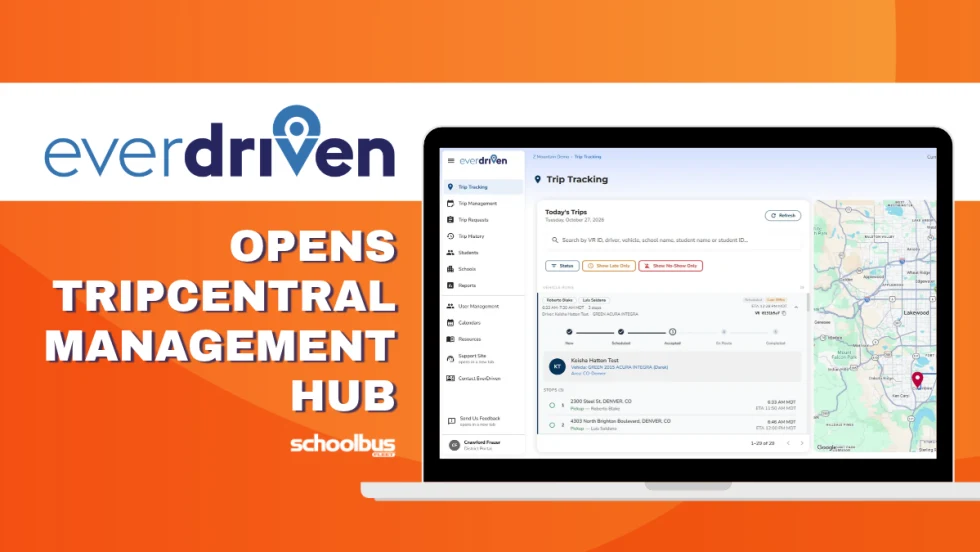
EverDriven Expands TripCentral Transportation Management Platform to All Partner Districts
The platform provides school districts with real-time trip tracking, student transportation scheduling tools, and pickup and drop-off management capabilities.
Read More →
6 School Transportation Trends to Watch: 2026 District Survey Results
School bus buying is up, fuel choices are shifting, and driver shortages persist. This and more in the latest K-12 public school survey, plus the largest fleets in the U.S.
Read More →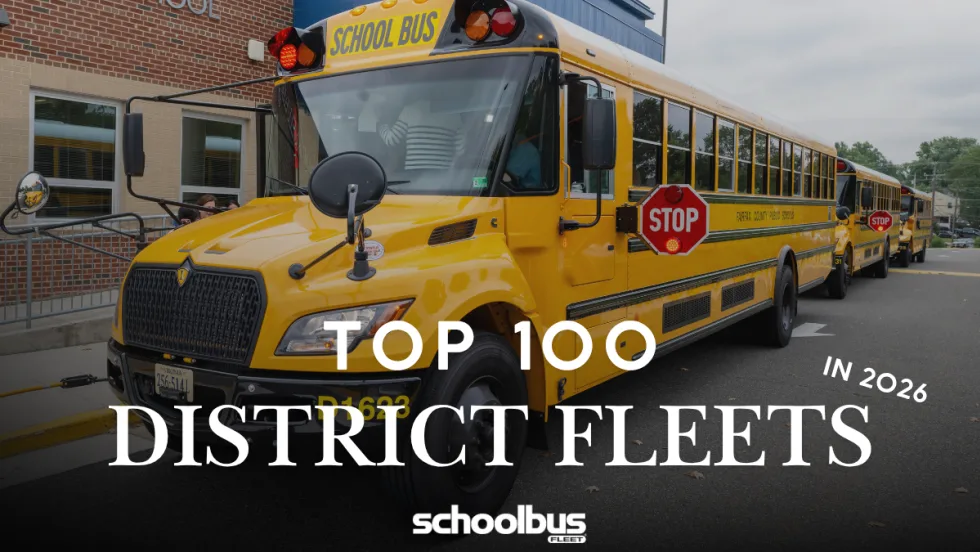
The 100 Largest School Bus Fleets in America: 2026 Rankings
Which public K-12 school districts are the largest in the nation in terms of bus fleet size? Here are the new standings of the top 100 district fleets.
Read More →
EverDriven Launches Route Consolidation Calculator to Estimate Diesel Savings
As diesel prices hit record highs, the largest alternative transportation provider says a 10% route consolidation could save a 120-route district more than $78,000 a year in fuel alone.
Read More →
Zum Secures Continued Financing Support for School Bus Expansion
Generate Private Credit has financed approximately $75 million in school bus deployments across three states, supporting more than 500 buses as Zum expands across the county.
Read More →
Beyond Discipline: A Different Approach to Student Behavior on the Bus
After implementing a dean of students program in Oregon, North Clackamas is seeing positive improvements. Here’s how it worked. The Route is brought to you by IC Bus.
Read More →
A Dean of Transportation's Different Approach to Student Behavior on the School Bus
After implementing a dean of students program in Oregon, North Clackamas is seeing positive improvements on the bus. Here’s how it worked.
Read More →
Inside NAPT ACTS 2026: Highlights from Louisville
From federal updates and student behavior strategies to new school bus technology and industry awards, see highlights from NAPT ACTS 2026 in Louisville.
Read More →
Meet the 2026 School Bus Driver Hero Winner: Annette Brown
We caught up with Wa-Nee Community Schools' Annette Brown on site at SBFX, where she was named the 2026 School Bus Driver Hero Award winner. Hear about her reaction, what she loves most about being a school bus driver, and more!
Read More →