




Great Fleets Across America (Part II)
Advancing With Technology Gaston County Schools Gastonia, N.C. Pupil transportation is not generally considered to be at...

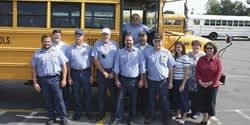
Advancing With Technology
Gaston County Schools
Gastonia, N.C.
Pupil transportation is not generally considered to be at the vanguard of technology. But advancements, especially those concerning safety, are important, and school bus operations can benefit greatly from them when funding permits.
The Gaston County Schools transportation department, located in Gastonia, N.C., has been successful in integrating various new types of equipment to enhance safety and efficiency.
The operation serves 54 schools in Gaston County, which is just west of Charlotte and comprises about 200,000 people. Each school day, more than 200 county school buses transport about 14,000 students.
Baxter Starr, director of transportation, has been at the district for 27 years. He began working as an accountant before taking the job of transportation supervisor. After 12 years in that position, Starr accepted the director role, in which he has served for the past 11 years.
Great support
Starr says that the operation’s success is due in large part to the support provided by the transportation team and many people outside of the department.
Starr credits the transportation staff, which he says is well trained and has very little turnover. He also stresses the vital role of Grady Truett, assistant director of transportation.
Truett, who has worked for the district for 34 years, focuses primarily on the mechanical aspects of the operation. Additionally, he serves on the state committee that decides specifications for school buses.
“Without his technical knowledge, we would be severely hurting,” Starr says of Truett.
Starr also points to the department’s strong relationship with district officials — from the Board of Education to Superintendent Edward Sadler to Deputy Superintendent Hilton L’Orange — and those at the state level, such as pupil transportation section chief Derek Graham.
Funding made available through these figures has allowed the school bus operation to embrace new technology and make other service improvements.
Cutting edge
The transportation department prides itself on its modern facility and equipment, and it doesn’t shy away from new initiatives.
For instance, the department has implemented a program to begin making its own biodiesel fuel this year. Using kettles from the district’s food service facility and other surplus equipment it has obtained, such as mixing motors, the department will make good use of the 6,000 gallons of vegetable oil the local schools go through each year.
“We’re about ready to go with it — we’re just waiting for the first batch of oil to come out from the schools,” Truett says.
This year, the program will focus on transforming what the schools produce, but Truett says it may tap into supplies from local restaurants as well.
“Hopefully, we can get to the point where we can do a B20 mix,” he says.
The district is also testing GPS systems through a pilot program with 10 buses. Truett says the systems provide vital enhancements to pupil transportation, from tracking buses for efficiency to the security of knowing where a child got off the bus. The district hopes to get funding for instituting the systems in the rest of the fleet over a period of time.
{+PAGEBREAK+} Other equipment on the buses includes air-conditioning systems, which are on all of the district’s special-needs vehicles. And instead of two-way radios, bus drivers use cell phones to communicate with dispatch. All route buses are outfitted with surveillance cameras, which Starr says has had a significant impact on passenger behavior issues.
“In talking with our principals, they all love the cameras,” Starr says. “From my perspective, the number of complaints we get — in terms of parents saying, ‘My child wouldn’t do that’ — has dropped almost to nothing.”
Advanced maintenance
The integration of technology extends into Gaston’s maintenance program.
The garage is equipped with six laptop computer stations, which the technicians use for diagnostics and record keeping. In the event of damage or other visible problems on a bus, the crew uses cameras to take pictures and keep records in their computers.
At 14 years old, the facility is relatively new, and Starr says that it includes plenty of space for necessary maintenance work. The technicians maintain about 350 vehicles at the facility. Buses are brought in every 30 days for inspection.
Last year, all of the technicians participated in a four-week training session. Topics included electrical systems, ABS, Allison transmissions and OBDII emissions testing.
One type of equipment that’s been a huge time-saver for the district is a portable jumping system. Truett says that jumping a bus off of a pickup truck can require some 30 minutes to get enough juice from the battery.
The portable systems, which are equipped on all of the maintenance trucks, are much quicker. “As soon as you hook it up, you can jump a bus no matter how dead it is,” Truett says. And since technicians take their trucks home, they can go directly to any service calls that arise in the early morning.
Safety focus
The transportation department promotes safety within its own ranks as well as to the public.
The district began a transportation safety council, which includes Starr, Truett, other district officials, bus drivers, police and parents. The group meets four times a year to discuss safety issues, and it includes a subcommittee that serves as an accident review board.
The council also plans a year-end transportation banquet, in which awards are given out for years of service and for the top drivers and transportation personnel of the year.
The transportation department has held a “School Bus Awareness Day” at a local Wal-Mart. Staff volunteers showed off a 1950 Chevrolet school bus as well as a new model and handed out safety materials in the parking lot.
For National School Bus Safety Week this year (Oct. 16-22), the transportation department plans to take the vintage bus, with a banner displayed on top, to different parts of the county.
“We restored the bus and painted it in the original colors that were used at that time,” Starr says. “It’s a big hit.”
— THOMAS MCMAHON
FLEET FACTS
Buses — 206
Students transported daily — 14,000
Total students in district — 32,000
Schools served — 53
Transportation staff — 228
Area of service — 400 square miles
Average driver wages — $11/hour
{+PAGEBREAK+}
Overall Efficiency Is Key to Well-Rounded Fleet
Granite School District
Salt Lake City, Utah
Granite School District, located in Salt Lake City, is the state’s second-largest school district. Some of its long-range objectives include increasing the academic achievement of every student and implementing support systems that promote student learning. A major component of these objectives must be supported by a reliable student transportation system, one that can deliver students to schools in a safe, efficient and timely manner. Granite’s transportation department has this base covered.
“They’ve been in the pupil transportation business for a long time,” says Brent Huffman, state director of pupil transportation. “They continuously have a safe, efficient fleet, and the shop personnel are well experienced and proud of the work they do.”
Tom Given, Granite’s transportation director, credits his staff, including all 173 bus drivers, as pivotal to the success of the operation. Still, there are structural designs in place, administered by Given and his managerial team, that ensure a well-run transportation program.
Strategies for success
Granite district uses a tiered bell schedule to maximize bus routes, which allows drivers to cover several runs per day. “Some of our drivers can do up to nine runs in one day — four in the morning, a noon run and four in the afternoon,” Given says. Bell schedules and routes are arranged so that high school students are dropped off first, followed by junior high and elementary school students.
A benefit to this arrangement is the ability to sign more drivers to eight-hour contracts, benefits included. Also, mileage and fuel costs are better managed, as buses remain in a general area. This is advantageous when you have 92 student drop-off locations.
This model has been extended to the special-education program as well. Through what Given calls quadrants, special-education students are concentrated in clusters of schools within the same geographic area.
With systems like these in place, Granite district was already fuel efficient. But the recent increases in fuel costs have been a challenge. Given and staff still remain optimistic while taking proactive measures to control fuel costs.
Granite raised its activity-trip rate to help defray the costs for field trips, conducted special presentations for drivers on idling and held meetings to discuss acceleration and braking techniques. Given says the superintendent and state pupil transportation director, Huffman, visit the state legislature regularly to push for fuel needs. He anticipates an increase of close to $1 million in fuel costs for 2005-06.
Training is high priority
New bus drivers at Granite undergo between 42 and 50 hours of pre-service training, which consists of classroom sessions, behind-the-wheel training and preparation for the CDL test.
Every five years, drivers are required to undergo 30 additional hours of training to improve in such areas as defensive-driving and first aid/CPR. Other topics taught in the training include public relations, student loading and unloading, emergency procedures and activity trips. Eight hours of state-mandated in-service training is supplemented by two to three hours of district training.
The transportation department has a physical assessment system. “One aspect is designed to test a driver’s ability to properly execute an emergency evacuation if necessary,” says Russ Fuller, driver supervisor, assistant to Given and president of the Utah Pupil Transportation Association. “It requires the ability to go up and down the stairs of a bus several times within about 30 seconds, carry a minimum of 40 pounds from the front of the bus to the rear and exit the bus through the emergency door.”
{+PAGEBREAK+} Talking shop to drivers
Granite drivers are encouraged to visit the shop any time to ask questions about their vehicles. “They can always come by and ask us to put a bus on a lift and walk them through its mechanizations from bumper to bumper,” says Keith Wassink, lead mechanic. Drivers fill out vehicle condition reports (VCRs) daily.
VCRs show that a driver has completed pre-trip inspections. “Any time a driver finds something wrong on a bus, they turn in the VCR to the shop,” says Wassink. “We then take the bus, inspect it and repair it if necessary.” A two-part repair order is then produced. A mechanic completes the form by writing down the services he’s done to the bus. One copy is kept with the VCR and the other goes to the driver, who now has a record showing that a service has been completed.
Seniority counts
Turnover is relatively low at the operation, as drivers tend to stick around for the long haul. About 35 drivers have been with the operation for 15 years or more, and that’s not counting the spares. An additional 35 spare drivers have retired but continue to work for the district.
Another reason for low turnover is the district’s adherence to the seniority policy, says Lyn Wallin, dispatcher. “If you’ve been here for a long time, you get to pick and choose your route.”
Services abound
Granite has approximately 2,000 special-needs children that it provides services to. It also serves “504” students. “These are children who have physical disabilities but attend traditional schools,” says Don Bawden, one of Granite’s three area supervisors. “Quite often they’re in wheelchairs. We integrate them with traditional students on buses equipped with lifts.”
The young mothers program uses three buses to pick up student parents and take them to a special program. The youth-in-custody program provides transportation to special units all over the valley for counseling and other services.
Maintenance and equipment
Most of Granite’s buses are replaced after 15 years. Wheelchair buses are replaced about every 13 years. Fuller calculates mileage for bus replacement at about every 185,000 to 220,000 miles. Route buses are typically 10 years old or less.
Equipment specifications include digital cameras (usually BusVision, REI or Bus Watch), air seats and doors, tinted windows, drop chains and an extra stop sign on the back of 30 buses. “We find there’s a decrease in pass-bys with the additional stop sign,” Given says. All buses run on diesel fuel.
Buses are brought into the shop every other month for preventive maintenance servicing. PMs range in detail from general inspections to full servicing.
Granite School District performs its own safety inspections. Each mechanic has been certified to conduct the inspections. Twice a year, the department receives a form from the Utah Highway Patrol that is completed after inspections and then returned to the state. “At its discretion, the Utah Highway Patrol can pull in here at any time and do an unannounced spot inspection, which they do,” says Wassink. “But our inspections are second to none.”
— ALBERT NEAL
FLEET FACTS
Buses — 172
Students transported daily — 12,800
Total students in district — 68,000
Schools served — 92
Transportation staff — 192
Area of service — 90 square miles
Average driver wages — $15.70/hour
More Management

How to Build a Better Driver Training Program
Ready to boost up your school bus instructor training? Here’s how to pick the right talent and improve recruitment, retention, and safety.
Read More →
CALSTART and Forth Combine to Form Catalyst Mobility
The new name represents a renewed vision for the nonprofit focused on advancing clean, equitable, and affordable transportation solutions that move people and goods.
Read More →
What Makes a Great School Bus Driver Trainer?
Choosing the right school bus driver trainer takes more than experience. Learn six keys to selecting and developing trainers and evaluating program effectiveness.
Read More →

School Bus Contractors Expand Through New Deals, Acquisitions & Partnerships
STA's Canadian division acquires Ontario-based G&L Stevenson Transport; Durham School Services adds a new district in California; First Student expands in New Jersey; and Minnesota Coaches rebrands and acquires Halo Transportation.
Read More →
Logan Bus Company Rolls Out AI Phone System for NYC School Bus Families
A summer pilot found that AI agents could handle most routine calls, freeing up time for customer service staff to focus on emergencies and complex family concerns.
Read More →
From Intent to Impact: What I Learned About Leadership from TAPT
A Texas transportation supervisor shares lessons on self-awareness, accountability, managing stress and building trust — and why investing in leadership development matters at every stage of your career.
Read More →
NAPT Names 2026 Award Recipients, Hall of Fame Inductee
Who earned national recognition for their work in student transportation? This year, NAPT named five recipients of its 2026 awards for service, safety, and leadership, plus its newest Hall of Famer.
Read More →
2026 State of Student Transportation Report
Driver shortages. Rising costs. Growing safety expectations. More data, but not enough time to act on it. The 2026 State of Student Transportation Report reveals what transportation leaders say is putting the most pressure on their operations—and where they’re investing next. See how your priorities compare.
Read More →
How to De-Escalate an Angry Person: 5 Steps for Handling Workplace Conflict
What makes emotions run high, and how should you handle an angry colleague or parent? Follow these steps for staying calm, listening, showing empathy, and resolving conflict.
Read More →
What Readiness Looks Like This School Year
Learn about the challenges shaping the 2026–2027 school year, from persistent driver shortages and budget pressure to technology and readiness gaps. See how school districts are responding and adapting in Zonar’s 2026 Back-to-School Readiness Report.
Read More →