




Giant Challenges for Giant Fleets
Managing a large school bus fleet presents special challenges. What are those challenges and how are they handled? Transportation directors at giant fleets provide their insights.
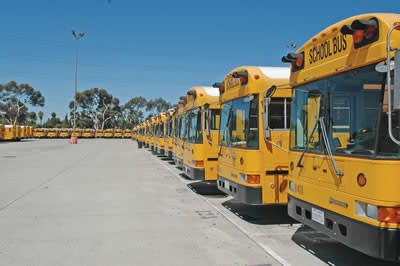
Managing a school transportation operation with more than, say, 200 buses can offer extreme challenges.
First, the sheer size of the operation can be intimidating. Not only are there hundreds of buses and employees to manage, but the director also has to oversee a budget that can run well into the millions. Headaches are more plentiful, too, especially with so many students, parents, teachers and site administrators to satisfy.
“It seems the larger you get, the more complicated things become,”says John Matthews, transportation director at Montgomery County (Md.) Public Schools, which operates more than 1,100 route buses daily to transport 96,000 students. “All problems are multiplied,”he says.
The challenges to effectively managing a large fleet are many. Staying focused on the big picture while never ignoring the details is critical. Creating a team atmosphere by maintaining a visible presence is also important. So is putting together a loyal, dedicated staff of supervisors.
To address these and other challenges, we interviewed more than a dozen transportation directors at large school district fleets. In many cases, their insights are applicable to fleets of all sizes.
“Large or small, we all face the same challenges,”says Alexandra Robinson, transportation director at San Diego Unified School District. Her operation transports more than 22,000 students daily using nearly 580 buses. “Being visible, aware and approachable is definitely helpful,”she adds.
Stay in touch
The logistical difficulty of communicating with hundreds (or thousands) of employees can be immense in a big fleet. Certainly, a transportation director would not be expected to know every employee’s name, but he or she would be expected to maintain an efficient two-way communication flow, either through assistants or other means.
“It’s all about communication,”says Linda Farbry, transportation director at Fairfax County (Va.) Public Schools, which operates nearly 1,300 buses and transports more than 127,000 students.
Farbry admits, however, that communication from drivers has to go through many layers to reach her. She relies on her managers to convey concerns from drivers, which requires that these supervisors meet regularly with their charges. “This is extremely difficult in a period of severe driver shortage when the supervisors are covering as many runs as the drivers are, in addition to many hours of administrative work,”she says.
To facilitate communication, Farbry says the twice-yearly driver in-service sessions exceed the length required by the state “so we can provide additional information and guidance, some humor, a little food and some small door prizes for the drivers and attendants. Networking time allows us to mingle and speak directly to employees.”
“Communicating with 600-plus drivers, 120-plus assistants, garage staff, supervisory staff and others is a challenge,”says David Pace, transportation director at Virginia Beach (Va.) City Public Schools, which operates more than 600 buses daily for route service and transports more than 66,000 students. “We must be creative in our newsletter, two-way radio communications and employee input meetings.”
Rafael Salazar, transportation director at Northside Independent School District in Helotes, Texas, holds a monthly forum in which drivers can address issues and encourages supervisors at the district’s four transportation sites to have an open-door policy. “Finally, we spend time in the drivers lounge speaking with driving staff daily,”he says. His district operates 550 route buses serving 39,000 students daily.
Wandering, with a purpose
Montgomery County’s Matthews stays in touch with his employees by getting out of his office. “Spend time with staff, even if all you do is MBWA (management by wandering around),”he says.
Matthews also recommends getting your hands dirty. “Turn a wrench now and then, just for the fun of it,”he says. “Or you can pump fuel at the bus garage or stop off at the morning layover where drivers gather and buy them a cup of coffee. It goes a long way to building relationships.”
Many directors rely on their supervisors to maintain a personal connection with drivers, assistants and other employees.
“A large operation must rely on its supervisors and managers to provide feedback — good and bad — to prepare for and address issues at upper levels,”says Karen Strickland, general manager of transportation at Hillsborough County (Fla.) School District, which uses more than 1,110 route buses to transport 92,000 students. “I expect our supervisors to keep me informed, but it’s also important for the director to talk with drivers in places they are comfortable, such as drivers lounge, on their bus or in the parking lot.”
It’s also important to stay in touch with labor representatives. John Lombardi, transportation director at the School District of Philadelphia, says monthly industrial meetings help to keep him abreast of issues. “Meeting with union representatives can be a very effective method of heading off problems before they become major issues,”he says. His department uses a combination of 1,300 public and contractor buses to transport 37,000 students.
[PAGEBREAK]
Rely on the team
Teamwork is important at any school bus operation, no matter the size. But it’s especially important when the operation is large and thus has several levels of supervision and coordination.
“The most important thing in managing a large operation is to build a strong team,”says John Fahey, assistant superintendent of service center operations at Buffalo (N.Y.) City School District. “You need to find or develop folks with the right skill sets and manage their ability to succeed.”The Buffalo district, with a contracted transportation operation, allots nearly 600 buses to transport 26,500 students daily.
Rye Merriam, senior director of transportation at Orange County (Fla.) Public Schools, uses the word “team”often in describing the department’s greatest strength and challenge.
With a fleet of nearly 1,000 buses for route service and 70,000 student passengers, Merriam relies heavily on his senior management team. His greatest challenge is “ensuring meaningful communication with all the various elements of the team.”He takes on that challenge by constantly communicating with his senior staff and then observing their actions and by placing strong leaders in key posts.
“You must trust your staff,”agrees Mike Connors, transportation director at Brevard County (Fla.) Schools, which uses 425 route buses to transport 28,500 students. “And you must run an open, honest, ethical operation, and this must be clear to your staff through your actions and words.”
Connors says staff members should be involved in the decision-making process through open discussion. “When your staff recognizes a team decision, you know you have a solid, supportive decision, and they know their participation was important.”
It’s also important for the transportation director to ensure that the department is well represented at the district level. “Make sure everyone district-wide understands the complexities of a large operation,”says Andy Martin, transportation director at School District U-46 in Elgin, Ill. The transportation department operates 325 buses on daily route service, transporting nearly 25,000 students.
Learn to delegate
A good military leader doesn’t stand shoulder to shoulder with the troops in the trenches. That’s the responsibility of field officers and other front-line personnel. Good transportation directors have the same obligation to delegate responsibility to their assistants.
“The key is to decentralize decision-making as far as you can,”says Grant Reppert, transportation director at Gwinnett County (Ga.) Public Schools, which operators nearly 1,500 school buses daily to transport 113,000 students. Reppert says it may be necessary to micromanage a small fleet. “In a large fleet, it’s impossible,”he says. “Realize you are a manager of people and processes, not so much transportation.”
The key, Reppert says, is to train others to make good decisions. “Let them make mistakes, other than safety-related ones, without punishment.”
“It is a must to have a dedicated and qualified staff to delegate to,”says Samuel Davila, transportation director at Conroe (Texas) Independent School District, which runs 325 route buses to transport nearly 27,000 students each day. “It is impossible for a director to make all the decisions all the time.”
Million-dollar question
We asked several transportation directors what they would do if their departments were allocated an extra $1 million.
Many of them said they would increase the pay of their employees, but not necessarily across the board.
Michael Dodson, transportation director at Prince George’s (Md.) County Public Schools, which operates nearly 1,200 buses daily to transport 88,000 children, says he would give cash bonuses to all “high-performing employees,”including drivers, secretaries, driver trainers, classroom trainers and routing supervisors.
Mark Cegelski, transportation director at Cleveland Municipal School District, says he would hire additional management personnel and on-the-road supervisors. With a fleet of 310 buses, Cegelski has problems with driver absenteeism that won’t necessarily be solved by an infusion of cash. “I talk to employees about the importance of being at work, but as long as the district offers 15 sick days and three personal days per year, drivers will continue to use them as vacation days,”he says.
Many transportation directors said they would target new equipment if given a million-dollar bonus. Shortfalls in tax revenue have forced many school districts, large and small, to postpone investments in rolling stock over the past several years.
Some directors would invest the money in infrastructure development rather than new buses. “We spend $3 million per year on new buses,”says William Kyser, transportation director at Katy (Texas) Independent School District. “Even so, we operate 20-year-old buses and have outgrown our two transportation centers. How about a million to invest in the vehicle maintenance shops? In the food chain, they often are the last to see any benefits. I would upgrade the tools, computers, lighting and the air conditioning system.”
The biggest challenge?
Is there any challenge that’s greater than the others? It depends on the unique requirements of the fleet and the manager.
Buffalo’s Fahey says his biggest challenge is staying focused on strategic management when the day-to-day concerns can be overwhelming. “The success of the program requires you to always focus on planning, organizing, leading and controlling, despite the constant tug of the never-ending ‘fires’ that need to be put out,”he says.
Chuck Holden, transportation director at Anoka-Hennepin School District in Coon Rapids, Minn., says his biggest challenge is getting all the bus drivers to convey the message to students and parents that the school district and its bus contractors are genuinely concerned about providing safe, efficient service and that they care about the children. “With hundreds of bus drivers, we still need that message to come across every day on every bus,”he says.
More Management

How to Build a Better Driver Training Program
Ready to boost up your school bus instructor training? Here’s how to pick the right talent and improve recruitment, retention, and safety.
Read More →
CALSTART and Forth Combine to Form Catalyst Mobility
The new name represents a renewed vision for the nonprofit focused on advancing clean, equitable, and affordable transportation solutions that move people and goods.
Read More →
What Makes a Great School Bus Driver Trainer?
Choosing the right school bus driver trainer takes more than experience. Learn six keys to selecting and developing trainers and evaluating program effectiveness.
Read More →

School Bus Contractors Expand Through New Deals, Acquisitions & Partnerships
STA's Canadian division acquires Ontario-based G&L Stevenson Transport while Durham School Services adds a new district contract in California, First Student adds a New Jersey contract, and Minnesota Coaches acquires Halo Transportation.
Read More →
Logan Bus Company Rolls Out AI Phone System for NYC School Bus Families
A summer pilot found that AI agents could handle most routine calls, freeing up time for customer service staff to focus on emergencies and complex family concerns.
Read More →
From Intent to Impact: What I Learned About Leadership from TAPT
A Texas transportation supervisor shares lessons on self-awareness, accountability, managing stress and building trust — and why investing in leadership development matters at every stage of your career.
Read More →
NAPT Names 2026 Award Recipients, Hall of Fame Inductee
Who earned national recognition for their work in student transportation? This year, NAPT named five recipients of its 2026 awards for service, safety, and leadership, plus its newest Hall of Famer.
Read More →
2026 State of Student Transportation Report
Driver shortages. Rising costs. Growing safety expectations. More data, but not enough time to act on it. The 2026 State of Student Transportation Report reveals what transportation leaders say is putting the most pressure on their operations—and where they’re investing next. See how your priorities compare.
Read More →
How to De-Escalate an Angry Person: 5 Steps for Handling Workplace Conflict
What makes emotions run high, and how should you handle an angry colleague or parent? Follow these steps for staying calm, listening, showing empathy, and resolving conflict.
Read More →
What Readiness Looks Like This School Year
Learn about the challenges shaping the 2026–2027 school year, from persistent driver shortages and budget pressure to technology and readiness gaps. See how school districts are responding and adapting in Zonar’s 2026 Back-to-School Readiness Report.
Read More →