




George Krapf Jr. & Sons Is SBF’s Contractor of the Year for 1994
Winner transformed mom-and-pop operation into one of the largest regional contract companies in southeastern Pennsylvania.

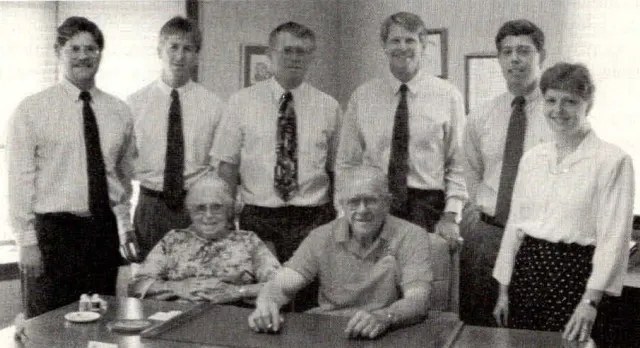
Three generations work at the company today. Front row: George Krapf Jr. and his wife Eleanor; back row, from left: Brad and Gary Krapf, the third generation, and Dallas and Dale, the second generation, with George's grandson, Brent Cumens, and his daughter Alison Bryant.
George Krapf Jr. & Sons Inc. of Glen Moore, PA, is SCHOOL BUS FLEET’s 1994 Contractor of the Year award winner.
The award recognizes school bus contractors who have made significant contributions to the pupil transportation industry in the private sector and in the industry as a whole.
Founded in 1942 by George Krapf Jr., the company currently contracts with six school districts in Pennsylvania. It operates 536 buses that carry 39,350 students to school each day. School transportation is 84 percent of the company’s transportation business — 66% is devoted to regular education transportation, 14 percent to transporting students with special needs and four percent to activity trips. The company also operates paratransit, community, charter and limousine transportation services.
Dale and Dallas Krapf, sons of George Krapf Jr., have run the company since 1967. Dale is secretary-treasurer and Dallas is vice president. SCHOOL BUS FLEET spoke with Dale and Dallas about how the company has changed over the years; what their plans are for the future; and what they attribute to the company’s success.
SCHOOL BUS FLEET: Thinking back on your business, how is the company different today?
Dale Krapf: Probably the first 10 years of the business was a mom-and-pop operation. Back in those days, you didn’t have all the regulations you deal with today, in terms of driver training and commercial driver’s license and drug testing.
The premise that dad started the business with was to have an excellent maintenance program and to provide good service for a fair dollar. I think we still do that today. We are detail oriented in our maintenance program and our safety program with our drivers. Of course, now it’s much more sophisticated. We have computer scheduling, a full-time safety person and several driver instructors. Everything is just more advanced and sophisticated.
Dallas Krapf: I think the one thing that has changed is how we deal with people, whether they’re employees, passengers, parents or school board members. I think to have loyal, dedicated employees you must treat them differently and be aware of their feelings and their lifestyle.
Another point is the paper trail. Everything you do you need to have paperwork documenting it, where years ago none of that was really needed. Also, the liability that we’re all faced with. There are so many people out there who are ready to criticize or cost you money if you don’t do things properly.
SBF: What are your future plans for the business?
Dale: I see our major potential growth in the school bus business. I think as time goes along, we’ll probably have the ability to add more school districts to our existing operation. We have some districts that are fairly close to us — within 15 or 20 miles — that are district owned. With all the tax and budget constraints, I think they’ll probably look more favorably to a conversion in the next couple of years.
We do not see ourselves participating in contracts three states away. That is not something that is a fit for us. It’s more important to apply our energies to operations that are close by.
As a result of the Clean Air Act, we also have a lot of corporate business. We are looking into local transit and shuttle services to and from work, because they have to meet employee trip reduction guidelines. We’re getting a lot of calls from different corporations because of that.
SBF: What about your charter bus service?
Dale: That’s been a nice growth area for us. We’ve grown from two charter coaches in 1983 to 32 full-size coaches and another eight of the mini-buses in the charter coach line. In that operation, we’re servicing the entire suburban Philadelphia area. That’s been good to us over the past 10 years, but I think we’ll see a little tapering off in the growth of that business.
SBF: How do you feel about the increasing number of acquisitions of small companies by larger companies?
Dale: For the most part, it’s been a very positive thing for the industry, because those folks have really strengthened the industry, and in a lot of cases, picked up very good companies. Probably 20 years ago, one of my biggest concerns in developing the school bus business was if we’d ever be able to sell it, whether anyone would be interested. At least there’s a market out there today. In addition to that, the larger companies have added a certain professionalism to the business and created higher standards, because they’re large national corporations with stockholders and they have to do things right.
Dallas: Some of the people we know who have sold to the large groups, in a lot of cases, there was no more family to carry on the tradition. In addition, it takes the burden of the daily responsibilities off of them. In lots of cases, the larger companies hired the person they purchased from and put them to work because of their expertise.
SBF: Should the federal government have a role in privatization?
Dale: I do not think it would be to our advantage or to a positive force in our industry to have a mandated service by a federal or state government. I want to see contractors and school district-owned operators have the same burden of taxation, the same burden of the type of equipment they use on the highway. If we have a level playing field, that’s all we need.
Look at the transit authorities in the United States. They all have tremendous financial problems. Each year they have to look to their local, state and federal governments for additional handouts. When the transit authorities were created through federal and state laws, the biggest transportation monopoly in this country was created and the service has never improved, because it is a mandated program. It’s not based on competition, it’s not based on supply and demand.
A few months ago, I sat in a seminar with some people from the National School Transportation Association (NSTA), and the current president, Noel Biery, said “I just want a chance at bat. That pretty much says it all. Just give us a chance and we’ll take our swing.”
SBF: What were some of the pivotal decisions that helped your growth over the years?
Dallas: When we got involved with having full-time trainers train drivers, I think that was a very good move on our part. Hiring a full-time safety officer to deal with accidents and complaints certainly helped us turn another corner. Standardizing our fleet years ago, buying basically the same type of vehicles, made maintenance much better. At one point we outgrew our building and opened up another shop. That was another positive move — less people working under one roof.
Dale: I think our involvement in industry associations has been key to our success. There’s the Pennsylvania School Bus Association (PSBA) and NSTA. I think I’ve returned from more state and national meetings with good ideas just by rubbing shoulders with other people who are doing the exact same thing we are. It allows you to look at the big picture, as opposed to operating in a vacuum every day.
We’ve been blessed that we have a strong state and national organization to belong to.
We decided several years ago that we had to be more community oriented, that we had to give back to the community. We developed a scholarship program. We’re effective with a number of other community organizations as well as our educational community. I think that’s been a real plus for us as an organization.
Ten or 12 years ago we decided we had to market and sell our business. We realized a lot of parents just assumed their kids were riding on school district-owned equipment. They had no idea the equipment was privately owned or who the operator was. It’s another concept we’ve grown into as we’ve gone along.
SBF: To what do you attribute your success?
Dallas: If you asked what was the number one thing why we were successful over the years, I would really say having wonderful, dedicated employees. We’ve been blessed with great employees over the years and we were able to train them well. We have drivers whose children are driving for us, so we’re going into the second generation of family members working for us.
Dale: To show you the kind of dedication we’ve got from our employees, our drivers have done tremendously well in school bus rodeo competition year in and year out. Seven people from our county go to the state bus rodeo every year. Every year for the past six years, we’ve sent six out of those seven.
More Management

How to Build a Better Driver Training Program
Ready to boost up your school bus instructor training? Here’s how to pick the right talent and improve recruitment, retention, and safety.
Read More →
CALSTART and Forth Combine to Form Catalyst Mobility
The new name represents a renewed vision for the nonprofit focused on advancing clean, equitable, and affordable transportation solutions that move people and goods.
Read More →
What Makes a Great School Bus Driver Trainer?
Choosing the right school bus driver trainer takes more than experience. Learn six keys to selecting and developing trainers and evaluating program effectiveness.
Read More →

School Bus Contractors Expand Through New Deals, Acquisitions & Partnerships
STA's Canadian division acquires Ontario-based G&L Stevenson Transport; Durham School Services adds a new district in California; First Student expands in New Jersey; and Minnesota Coaches rebrands and acquires Halo Transportation.
Read More →
Logan Bus Company Rolls Out AI Phone System for NYC School Bus Families
A summer pilot found that AI agents could handle most routine calls, freeing up time for customer service staff to focus on emergencies and complex family concerns.
Read More →
From Intent to Impact: What I Learned About Leadership from TAPT
A Texas transportation supervisor shares lessons on self-awareness, accountability, managing stress and building trust — and why investing in leadership development matters at every stage of your career.
Read More →
NAPT Names 2026 Award Recipients, Hall of Fame Inductee
Who earned national recognition for their work in student transportation? This year, NAPT named five recipients of its 2026 awards for service, safety, and leadership, plus its newest Hall of Famer.
Read More →
2026 State of Student Transportation Report
Driver shortages. Rising costs. Growing safety expectations. More data, but not enough time to act on it. The 2026 State of Student Transportation Report reveals what transportation leaders say is putting the most pressure on their operations—and where they’re investing next. See how your priorities compare.
Read More →
How to De-Escalate an Angry Person: 5 Steps for Handling Workplace Conflict
What makes emotions run high, and how should you handle an angry colleague or parent? Follow these steps for staying calm, listening, showing empathy, and resolving conflict.
Read More →
What Readiness Looks Like This School Year
Learn about the challenges shaping the 2026–2027 school year, from persistent driver shortages and budget pressure to technology and readiness gaps. See how school districts are responding and adapting in Zonar’s 2026 Back-to-School Readiness Report.
Read More →