game chang·er
noun
an event, idea, or procedure that effects a significant shift in the current manner of doing or thinking about something.
 MENU
MENU SEARCH
What innovations have shaken up the school bus industry, saving drivers and administrators time and money? Here, SBF checks in on how to make the most of available drivers, investigates New York’s new third-party CDL testing rules, and looks at new tech that’s transforming buses.

In the wake of the driver shortage, many schools are finding unique ways to keep operations running, including promoting a positive culture and offering recognition and rewards for the school bus drivers you already have.
Photo: ©GettyImages.com/phototechno & Sonya_illustration
Innovators, disruptors, whatever you call them, the school transportation industry is often filled with dedicated individuals who don’t always accept the status quo, who dream big, solve challenges, and think outside the box. While it’s impossible to cover all of them, SBF did reach out to a few leaders in the space to ask: What are you seeing or doing that is changing the game? Here are just three of the top innovations discovered.
Today’s school transportation director does much more than sit behind a desk and look at bus routes. Many administrators go beyond their job description, often driving buses themselves, trying to retain the drivers they have, recruit more, maintain a positive culture, and juggle new curve balls every day.
Just ask Rose Lee, transportation director at Bonita Unified School District in San Dimas, Calif., who has been trying to solve these very issues. “I think post-COVID, people have been evaluating what they can live on, and how much they want or need to work versus spending their time being home with family,” she said.
There, the district has been contracting more and having other staff drive in a pinch. But, this strained office staff, resulted in overtime, and affected training time, causing them to look into other means of communication like Zonar’s ZPass and MyView systems to reduce the number of calls by allowing parents to track their rider on the bus.
“For us in California, this is also trickling down and crossing over with the new bell schedule law that was implemented this school year for middle and high schools,” Lee added. “Before, we could stagger a lot of our runs to utilize one driver to get multiple grade levels to school when the bell times had gaps. Due to the new law, and the shortage of drivers, we are struggling with multiple sites having the same bell schedule, but we don’t have additional equipment or drivers to accommodate.”
So what does one do in this situation? The Bonita Unified School District addressed it by increasing pay, evaluating benefits for drivers, and increasing driver’s contracted hours.
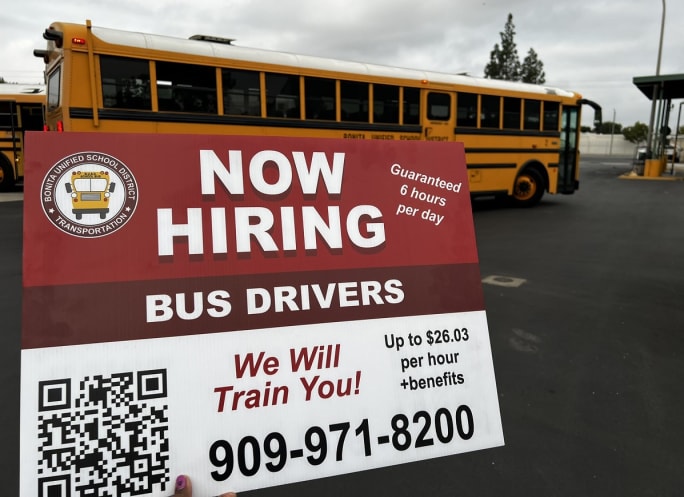
To recruit and retain drivers, many school districts are offering sign-on bonuses, increased pay, or other financial incentives. California’s Bonita Unified School District used these signs to attract new drivers.
Photo: Rose Lee
“We don’t have substitutes, but we try to have cover drivers here,” Lee said. “Cover drivers are full-time drivers with contract for us. Our training timeline depends on the driver’s schedule and the officer’s ability to schedule test. Twenty hours of classroom and 20 hours of behind-the-wheel training are minimum. Then applicants also have to get tested at the DMV and pass their medical exam.”
Shannon Weber, director of transportation at Florence Unified School District (FUSD) #1 in Arizona, feels similar pains, and chooses to focus on driver retention. “I think districts that are creative and have the ability to recognize and reward safety, attendance, and outstanding performance with monetary solutions are at the top of their game,” she said. “Budgets often discourage certain use of funds; however, consistent recognition and competitive compensation, as well as a culture of support, is powerful. I am a firm believer that culture in a department is the biggest thing. People want to be valued, engaged, appreciated, and have some fun along the way.”
Weber says to think of ways to help new trainees feel successful and win in a way that is enjoyable but impactful. This builds confidence before they get in the bus with students on board.
She also recommends strong bus management tools for new drivers. “Teaching them how to handle kids is a big win and the hardest part.” Her other tips include:
Recognize and celebrate accomplishments of all staff, even little wins like seating chart participation and attendance.
Offer tools. If we ask drivers to do something, we must equip them with the tools to succeed: computers, cleaning supplies, training, etc.
If you bid for routes or opportunities, it should be about more than just seniority and include attendance, safety record, bus management, etc., should all be contributors to the “great routes/trips.”
“As leaders, if we say it, it must be so,” Weber said. “We can’t overpromise and underdeliver.”
Of course, there are other solutions outside of your district to combat the driver shortage, too. The niche of smaller contract transportation providers is growing as an alternative mode of getting students to and from school. Companies like HopSkipDrive and Everdriven (formerly ALC Schools) offer options across the country to fill in gaps.
HopSkipDrive also reported that some schools are changing driver requirements, offering stipends to families who opt-out of transportation for the year, and encouraging students to ride bicycles to school.
Local alternative solutions are also popping up. In central Iowa, Kids Zoom is a family-owned operation that serves both local organizations and school districts for preschool through high school. “They have been wildly successful and are growing by the day,” said Max Christensen, consultant for the Iowa Department of Education. Best part is they take a lot of pressure off the schools that don’t have the vehicles and/or drivers to cover this type of transportation.”
While we’ve all been feeling the pressure of the driver shortage, the state of New York and its DMV stepped up to offer an alternative solution: It put together a new program to allow third parties to offer CDL testing.
The move came after voiced concerns of the rigorous requirements weren’t helping ease the driver shortage. Following a phased approach announced in January by New York Gov. Kathy Hochul, the intent was to create more testing locations across the state and expand capacity at state-run sites to reduce the time it takes to put new qualified drivers on the road.

New York followed Pennsylvania’s lead and passed new regulations allowing third parties to offer CDL testing to get new drivers on the road faster. This extends to school districts, contractors, and others.
Photo: Canva
Public and private organizations, including schools, tour bus, bus contractors, and truck companies, are eligible to apply for certification through the state DMV’s website.
Nick Vallone of Rolling V. Bus Corp and president of the New York School Bus Contractors Association (NYSBCA) walked us through the process to get the new program off the ground, which was done with regulation rather than legislation, he said. “Our proactive efforts of pitching this solution to the media and elected officials really paid off when the driver crisis hit home in September 2021. Once this became an issue that crossed the desk of the governor, they were already familiar with the concept of third-party testing and quickly gave the directive to the DMV to establish a third-party testing division.”
So far, Vallone says the results are phenomenal. “We’ve seen an increase in failures at our site, but that has been severely overshadowed by our ability to re-test within a few days,” he said. “In short, we’ve gotten a single candidate through three tests (two fails followed by a pass) in a matter of three weeks without sacrificing an ounce of safety. To get three tests done for the same individual through the DMV used to take 10 to 12 weeks.”
Tammy L. Mortier, NYSBCA’s executive director, agrees, calling it a tremendous benefit for the school bus contractors that are certified. “The New York State Department of Motor Vehicles Third Party CDL Testing program has been an excellent opportunity to help our members with the driver shortage by allowing certified school bus operators to provide private road tests at their facilities,” Mortier said. “This is a huge time saver to get qualified CDL drivers on the road. It's not an easy process, and you must comply with stringent federal and state guidelines to become certified and maintain your certification. Safety is always our number one priority. DMV has been a wonderful partner in this program as we work together to find solutions to the driver shortage.”
Vallone said at least 10 organizations have applied so far, and five are already up and running. It’s not just a program for contractors, though. Recently, Bethlehem Public Schools became a certified third-party tester.
Pennsylvania has had a similar program for years.
On the tech side of things, while telematics itself isn’t new, a newer application of it is factory-installed telematics on the bus. This saves schools from having to install the product aftermarket.
IC Bus says it installs the hardware at its factory, allowing the client to choose the telematics service provider (TSP). “Additionally, if a fleet decides to change their provider, they can still use the same factory-installed hardware as long as it’s an approved TSP partner of IC Bus,” said Sean Slyman, director, connected services at Navistar.
The company references the following benefits reaped from built-in telematics.
Enhanced data security when installed by the manufacturer instead of a third party.
Advanced data for a comprehensive view of vehicle status and operation, and setting the foundation for predictive analytics capabilities.
Bi-directional communication capabilities.
Improved vehicle uptime. No need to take the vehicle out of service for aftermarket device installation, and access to more comprehensive vehicle data allows for better monitoring of the vehicle to prioritize service needs without the vehicle entering the shop.
It’s not just telematics changing the game on buses, though. Shannon Weber says that on-board cameras have brought major advantages, too. “For leaders, it helps us teach and reflect with team members on bus management strategies; for students, it allows us to observe concerns, bullying, and success and improvement; and for school leaders and the community, it reassures transparency.”
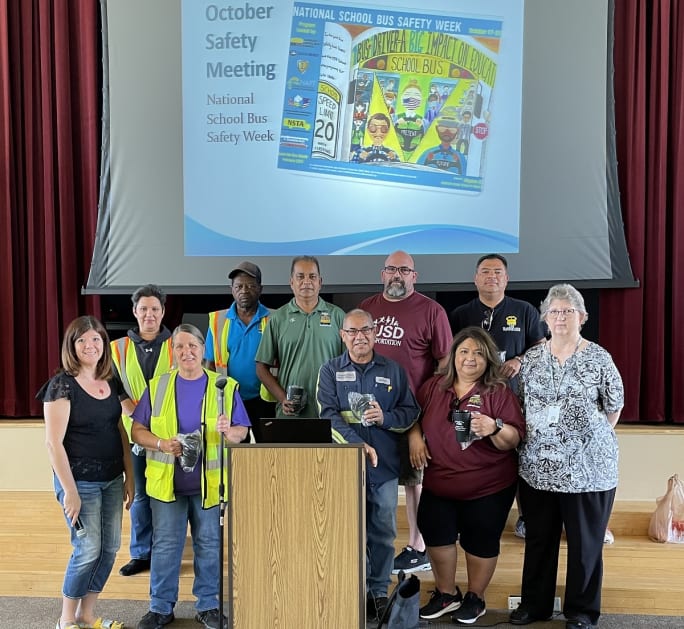
Arizona’s Florence Unified School District #1 transportation staff is recognized for three and five years of service at the district’s Safety Week meeting.
Photo: Shannon Weber
Another unique solution for outside the bus is Thomas Built Buses Saf-T-Zone Pedestrian Detection System, which is composed of LED ground lights on the cross-view mirrors, as well as multiple radar units on a 77GHz frequency band that captures a 360-degree view around the bus. Its radar units are installed on all four sides of the bus and allow precise detection and measurement of a pedestrian or object within 10 feet — covering the entire danger zone. When a pedestrian is detected, the system alerts the driver via feedback in the seat, an audible noise, an in-cabin tablet and through caution lights on the cross-view mirrors. Kendra Eads, vice president of engineering & technology for TBB, said that Saf-T-Zone helps protects pedestrians from accident or injury. “With responsive haptic, audible, in-cabin tablet and light alerts all working together, drivers are able to worry less and focus more on providing a safe ride to and from school,” she said.
We can’t forget to mention other tech tools like rider tracking solutions, collision avoidance systems, stop-arm cameras, maintenance products, advanced fire suppression systems, and the rise in alt-fuel vehicles and infrastructure, too.
There’s always something new in student transportation, and one can only guess the next game-changing innovation to come.

Ready to boost up your school bus instructor training? Here’s how to pick the right talent and improve recruitment, retention, and safety.
Read More →
The new name represents a renewed vision for the nonprofit focused on advancing clean, equitable, and affordable transportation solutions that move people and goods.
Read More →
Choosing the right school bus driver trainer takes more than experience. Learn six keys to selecting and developing trainers and evaluating program effectiveness.
Read More →
STA's Canadian division acquires Ontario-based G&L Stevenson Transport while Durham School Services adds a new district contract in California, First Student adds a New Jersey contract, and Minnesota Coaches acquires Halo Transportation.
Read More →
A summer pilot found that AI agents could handle most routine calls, freeing up time for customer service staff to focus on emergencies and complex family concerns.
Read More →
A Texas transportation supervisor shares lessons on self-awareness, accountability, managing stress and building trust — and why investing in leadership development matters at every stage of your career.
Read More →
Who earned national recognition for their work in student transportation? This year, NAPT named five recipients of its 2026 awards for service, safety, and leadership, plus its newest Hall of Famer.
Read More →
Driver shortages. Rising costs. Growing safety expectations. More data, but not enough time to act on it. The 2026 State of Student Transportation Report reveals what transportation leaders say is putting the most pressure on their operations—and where they’re investing next. See how your priorities compare.
Read More →
What makes emotions run high, and how should you handle an angry colleague or parent? Follow these steps for staying calm, listening, showing empathy, and resolving conflict.
Read More →
Learn about the challenges shaping the 2026–2027 school year, from persistent driver shortages and budget pressure to technology and readiness gaps. See how school districts are responding and adapting in Zonar’s 2026 Back-to-School Readiness Report.
Read More →