




Flexible, Expedited Prep Helps CDL Test Applicants
Overlapping the process with other tests required for hiring along with flexible, customized study preparation are key.


Photo courtesy Student Transportation of America

Photo courtesy Student Transportation of America
A nationwide driver shortage has raised the stakes for recruitment and retention, with school districts and school bus companies responding by raising pay and covering training expenses. Still, another hurdle remains for some would-be drivers: obtaining their commercial driver’s license (CDL).
In a survey conducted by the National Association for Pupil Transportation and School Bus Fleet in 2016, obtaining a CDL was cited as one of four major factors that affect driver recruitment. In addition to the fact that it can take weeks or months to get an exam schedule date, the written endorsement tests are often described as being particularly tough because of the mechanical and air brakes knowledge they require. As a result, many applicants drop out of the potential driver pool because they are intimidated by the questions, says Jeff Cassell, president of School Bus Safety Co.
“This is a very difficult test, and substantial knowledge is required to pass,” he adds. “It usually takes around 20 hours of study over a number of days.”
School Bus Fleet spoke with pupil transportation trainers and directors to find out what they are doing to help applicants get their CDL a little quicker and, hopefully, easier. Flexible, customized study preparation and expediting other test procedures are key, they say.
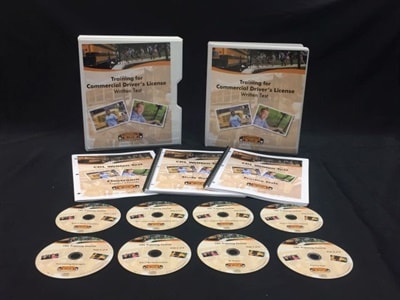
School Bus Safety Co.’s Commercial Driver’s License Test Course is designed to cut study time for the CDL written test from about 20 hours to closer to seven hours.
Flexible Study Aids
Cassell says that his company’s Commercial Driver’s License Test Course can cut the study time for the CDL written test to as little as five to seven hours by using repetition and memory techniques for facts that are difficult to remember.
For example, in the brake test prep, a memory technique employed in the course helps test takers remember that air pressure shouldn’t be reduced by more than 2 PSI in one minute for single vehicles and by more than 3 PSI in one minute for combination vehicles by repeating “Two in one, three in one,” and then asking the question a number of times, Cassell says.
The company piloted the study method on 10 test takers with a trial test while it was creating the course. The test taker who took the longest completed the training to take and pass the test in eight hours, and all the others took less than seven (the fastest did it in four-and-a-half hours). All exam takers involved in the pilot passed the test on their first try.
The course offers 13 practice tests containing a total of 431 questions, covering transporting passengers, air brakes, and safe driving practices. The practice tests are administered on a computer to simulate the process of taking the test at the Department of Motor Vehicles (DMV) to help the applicant get more comfortable with taking the test in that setting.
A course that can be completed via computer onsite or online in addition to on paper can offer more flexibility, because applicants can be directed to the website with a password to do the training at home, at the school district or school bus company’s office, or any other location.
Anecdotal evidence from School Bus Safety Co.’s studies and client feedback indicates that it takes about 10 applicants to produce one qualified school bus driver, and that two or three of those applicants drop out because of the difficulty of the CDL test, Cassell says.
“If you can take 10 applicants and [get] two drivers, you have doubled your drivers.”
Safety staff members at Student Transportation of America (STA) say that using School Bus Safety Co.’s CDL training course in conjunction with in-classroom CDL manual review has helped increase applicants’ ability to pass the test the first time.
Trainers use the course’s videos along with the CDL manual during the first two days of training, in a classroom setting. After they complete each segment, candidates are given a chance to practice what they have learned by taking the practice tests and reviewing their answers. Applicants can also take the courses online at home if time permits or if it is a better option for them, says Nickcol Thomas, the area safety manager for STA’s central region.
Moreover, using the CDL prep course has been seen to help applicants study for and pass the CDL test at a quicker rate than just allowing them to study on their own, Thomas adds.
“We have seen candidates that are taking the course within the first two days pass two of the four tests.”
Since passing the general knowledge test is required to proceed to the skills test, and it has the highest number of questions of all the tests, STA puts more emphasis on that part of the overall test on the first day, which has paid off with a significant average first-time pass rate.
“New applicants believe that the course, along with the classroom instruction, is vital to ensuring that they are confident to take the test and pass the first time,” Thomas says. “For those select few that may not have passed the test the first time, it is reassuring to know that they can come back and get help over the areas that they were weak in.”
There is also a lot of participation in a classroom setting with a trainer, which contributes to a higher success rate, adds Maggie Broerman, STA’s regional director of safety in Pennsylvania.
“The feedback [on the course] has been very positive, which is no surprise, given that recently candidates had an 80% to 90% success rate when going to the DMV for the test,” Broerman says.
Tailoring Training
To customize training, the Montgomery County (Md.) Public Schools transportation department’s full-time instructor focuses on each individual’s knowledge and learning needs, giving more attention to those who need more help, and letting those who are adept at reading in English and work well independently study on their own.
“The instructor targets trainees’ varying abilities to learn the material they need to know,” says Todd Watkins, director of transportation for the district.
As part of a greater effort to enhance the effectiveness of its recruitment and retention program, Salem-Keizer Public Schools in Salem, Oregon, began offering study aids in Spanish, says Michael Shields, director of transportation and auxiliary services at the district. Shields estimates that about 10% to 15% of Salem-Keizer’s applicants may speak English as a second language, and the transportation department is making a diligent effort to help them pass the CDL.
The district offers classes for applicants who want help studying for the CDL test, as well as sample tests in English and in Spanish to aid comprehension for those who speak Spanish as their first language, since the CDL test is only offered in English.
“If they [seek] assistance, we provide them with translations, because they have to take the test in English,” Shields says.
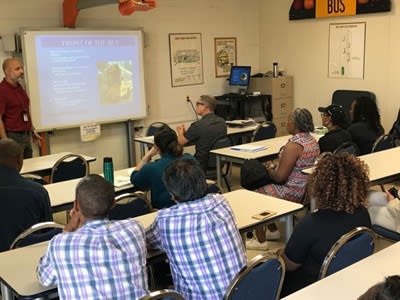
A full-time instructor tailors study help to varying levels of knowledge for driver applicants at Montgomery County (Md.) Public Schools.
Overlapping Steps to Expedite Process
To speed up the process, Montgomery County sends candidates for their drug test and physical, sends their fingerprints in for the background check, and checks references concurrently as they start to help them prepare for the test, Watkins says.
If a candidate gets the go-ahead after those tests, the department starts paying the applicant the next day for their CDL study preparation. On average, it takes candidates about three days to prepare for the written test, Watkins says.
“As long as they are making reasonable progress toward getting their learner’s permit, we are happy to do that,” Watkins says.
Also, rather than spend valuable hours during their bus operator training class teaching the students to do the CDL pre-trip, especially given their varied mechanical knowledge going in, the department teaches pre-trip and vehicle components and systems during the same days (but at different times of those days) that they are preparing for the written learner’s permit test. Then, most students enter the bus operator training class ready or almost ready to pass the pre-trip section of the licensing test.
“This allows us to spend more of the bus operator training class with them actually driving the bus,” Watkins explains.
One other way to get applicants CDL-certified faster is to test in-house. Many states allow third-party testing for the CDL, and Watkins attests to the benefit of quicker exam rescheduling, if needed.
The state of Maryland allows the district to be a Maryland Department of Transportation Motor Vehicle Administration (MVA) self-testing agency. Although applicants have to go to an MVA office to take the written test, trainers from Montgomery County can give them the road and pre-trip portions of the test.
That arrangement especially comes in handy if an applicant isn’t successful in their first test-taking attempt, but came close, or was nervous enough to impact their ability to do well on the test.
“If [for example, an applicant] messed up on the air brake test, if they made simple mistakes, and we knew they knew it going in and failed the test, we as a self-testing agency can schedule them two days later to retake it instead of rescheduling with the MVA,” Watkins says. (The district’s contract with MVA requires 48 hours’ notice to administer a test.) “If we tried to reschedule it with the MVA, the retest could be a month out.”
The only logistical challenge that Montgomery County has encountered in self-testing is making sure the staff member administering the test is certified by MVA to give it and has never participated in the test-taker’s training.
Meanwhile, as School Bus Fleet previously reported, a new law in New Jersey was passed earlier this year to move its CDL testing process into the fast lane.
A-3946, which was signed into law by Gov. Chris Christie in February, established a pilot program in which the New Jersey Motor Vehicle Commission appointed three third-party vendors to administer the knowledge and skills tests for CDLs and endorsements. It will be responsible for overseeing CDL testing by the private vendors, including setting maximum fees that they can charge. That amount will be equivalent to the cost to the state for administering the testing.
State law previously authorized the New Jersey Motor Vehicle Commission to appoint third-party vendors to administer CDL testing, but it reportedly did not establish guidelines for testing or give the agency the power to contract with the vendors.
The chief administrator of the Motor Vehicle Commission will be required to submit an evaluation of the pilot with recommendations to facilitate the permanent use of third-party vendors for CDL testing in November.
More Management

How to Build a Better Driver Training Program
Ready to boost up your school bus instructor training? Here’s how to pick the right talent and improve recruitment, retention, and safety.
Read More →
CALSTART and Forth Combine to Form Catalyst Mobility
The new name represents a renewed vision for the nonprofit focused on advancing clean, equitable, and affordable transportation solutions that move people and goods.
Read More →
What Makes a Great School Bus Driver Trainer?
Choosing the right school bus driver trainer takes more than experience. Learn six keys to selecting and developing trainers and evaluating program effectiveness.
Read More →

School Bus Contractors Expand Through New Deals, Acquisitions & Partnerships
STA's Canadian division acquires Ontario-based G&L Stevenson Transport while Durham School Services adds a new district contract in California, First Student adds a New Jersey contract, and Minnesota Coaches acquires Halo Transportation.
Read More →
Logan Bus Company Rolls Out AI Phone System for NYC School Bus Families
A summer pilot found that AI agents could handle most routine calls, freeing up time for customer service staff to focus on emergencies and complex family concerns.
Read More →
From Intent to Impact: What I Learned About Leadership from TAPT
A Texas transportation supervisor shares lessons on self-awareness, accountability, managing stress and building trust — and why investing in leadership development matters at every stage of your career.
Read More →
NAPT Names 2026 Award Recipients, Hall of Fame Inductee
Who earned national recognition for their work in student transportation? This year, NAPT named five recipients of its 2026 awards for service, safety, and leadership, plus its newest Hall of Famer.
Read More →
2026 State of Student Transportation Report
Driver shortages. Rising costs. Growing safety expectations. More data, but not enough time to act on it. The 2026 State of Student Transportation Report reveals what transportation leaders say is putting the most pressure on their operations—and where they’re investing next. See how your priorities compare.
Read More →
How to De-Escalate an Angry Person: 5 Steps for Handling Workplace Conflict
What makes emotions run high, and how should you handle an angry colleague or parent? Follow these steps for staying calm, listening, showing empathy, and resolving conflict.
Read More →
What Readiness Looks Like This School Year
Learn about the challenges shaping the 2026–2027 school year, from persistent driver shortages and budget pressure to technology and readiness gaps. See how school districts are responding and adapting in Zonar’s 2026 Back-to-School Readiness Report.
Read More →