




More on fire suppression
For more information about bus fire suppression systems, see the following companies’ websites.
• Amerex Corp.: amerex-fire.com
• Firetrace Intl.: www.firetrace.com
• Fogmaker N.A.: fogmaker.com
• Kidde Technologies Inc.:
kiddetechnologies.com
Fire Suppression Systems Increase Automation, Early Detection
Advances in fire suppression technology can help identify and stop an impending bus fire before flames even come into play. The systems can also provide more time for passenger evacuation during a thermal event.
by Brittni Rubin
September 2, 2015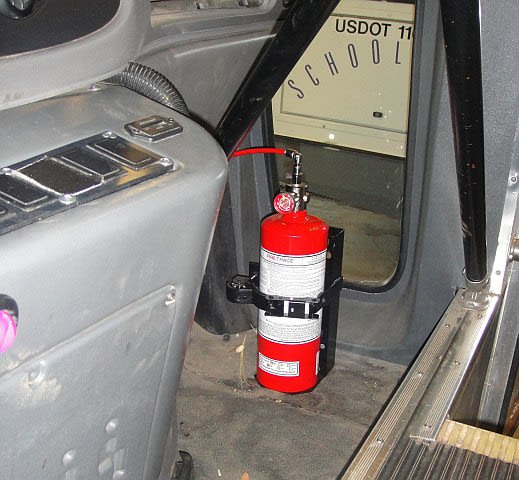
Photo courtesy Firetrace
5 min to read
In recent years, there has been a greater focus on and adoption of fire suppression technology on board school buses in the U.S.
More school districts and states are starting to look at fire suppression systems as a requirement due to the additional time it provides passengers exiting a compromised vehicle during a thermal event.
“There can be [more than] 50 kids on a bus — that’s a lot of precious cargo schools need to look after,” says Scott Starr, director of marketing for Firetrace International, an Arizona-based fire suppression system manufacturer. “Even a few extra minutes could save lives.”
But not only do these systems aid in safe extrication, new advancements can help a system identify and stop an impending fire before flames even come into play.
Many companies report a significant increase in the number of inquiries from both school bus operators and manufacturers. Some municipalities and school districts are looking to retrofit their vehicles, while some bus suppliers want to include fire suppression systems as an option before the time of purchase.
For the specific needs and challenges of the school bus, suppliers of fire suppression systems recommend cost-effective solutions that emphasize simplicity, automation and early detection.
Ease of use
On any given day, the stakes for a school bus driver are high. Not only must the driver transport dozens of children safely to and from school, he or she must also monitor student behavior and maneuver a large vehicle in the process.
In the event of an onboard fire emergency, having to activate fire suppression technology would not only add to the driver’s duties but also possibly delay passenger extrication. Therefore, many system manufacturers focus on ease of use and automation for fire suppression products available in the school bus market today.
The industry as a whole is seeing more pressurized tube systems. For Fogmaker North America (FMNA), an Exton, Pennsylvania-based suppression system manufacturer, this technology is called Loss of Pressure. And Firetrace refers to its proprietary pressure system as Firetrace Detection Tubing (FDT).
According to Jeff Krueger, director of engineering and quality for FMNA parent company USSC Group, the significant advantage of the pressure tubing system is that it doesn’t require any electrical input to initiate. The system activates by sensing heat. Once the temperature reaches a defined point, the detection tube ruptures, opening the release valve and automatically starting the suppression.
Firetrace’s FDT system can be routed throughout the vehicle, especially at known failure and heat-bearing points — places with perceived risk. The detection tubing can be ideal for fire detection in school buses, says Starr, as it can tolerate extreme temperatures and environments. FDT is pneumatically operated (activated by the pressure or exhaustion of air) and requires no power from the bus or driver.
These pressure-oriented non-electric systems also yield a fail-safe quality. Since most fires start with smoke or steam, the fire could, in some cases, be detected through heat before there are even any flames.
Automated fire suppression systems additionally provide higher cost efficiency, as they don’t require extra electrical checks.
“Schools can manage cost by utilizing core products and focused technologies,” Krueger says. “What is truly needed is the fully automated self-contained system. There’s no need for further electronic monitoring and data collection, as found in other industries.”
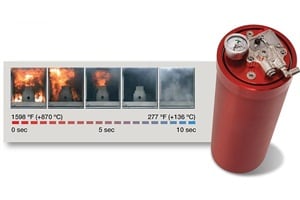
Once onboard temperature reaches a defined point, FMNA’s fire suppression system automatically activates. Detection tubes rupture, and the release valve opens. Photo courtesy Fogmaker North America
Adapting for alt-fuels
As some school districts move toward alternative-fuel buses, fire suppression system manufacturers are continuously evaluating and combatting new risk factors. Two potential issues are increased engine compartment temperatures and gas leaks.
According to Starr, the answer is improved protective measures. This includes the installation of gas detection devices on board the vehicle. Doing so leads to earlier fire detection overall as well.
“Leaking diesel fuel is easy to spot,” Starr says. “But leaky alternative fuels are difficult to detect. If you don’t catch it, the leaking gas may be released into the engine compartment or other enclosures within the bus, and should it build up concentration, it can be a very serious explosion hazard. Alternative fuels change the hazard a bit and require a different set of detection.”
As part of a fire suppression system, manufacturers can offer a protection system to help monitor the gas levels in critical spaces within the bus to prevent them from reaching a hazardous level. Alarms and warnings would go off at the driver’s station, and an alert would be issued on the vehicle.
“There will always be a focus on finding new fuel options and cleaner burning fuel, but I don’t think that poses a big challenge to fire suppression,” Starr says. “The base nature of fire and hazards surrounding fires remain the same. There’s nothing on the horizon that we can’t adapt to quickly or provide a good solution for.”
Liquid or powder?
There are two major methods of putting out fire: liquid and powder solutions. Both are proven methods, according to Science Partner Technical Research Institute of Sweden (SP). The system just needs to effectively knock out all three elements of the fire triangle: oxygen, heat and fuel.
Starr suggests checking to see if a product has a P-Mark before purchasing. The P-Mark, SP’s quality label, means that a product has been officially tested and meets all stringent legal, regulatory and market demands.
One of the most popular fire suppression agents in the U.S. is ABC dry chemical. Commonly found in fire extinguishers, it’s usually a mix of monoammonium phosphate and ammonium sulfate.
“It’s a very fine powder that gets into everything,” Starr says. “Whether on the ground or suspended on the engine, the fire is inundated by the powder. It also prevents re-ignition by coating surfaces and working in spite of air flow.”
ABC is very versatile and works well in three-dimensional environments, making it a good fit for conditions in a school bus, Starr adds.
While prevalent in Europe, liquid solutions — such as water mist systems — have only begun to increase in the U.S. in recent years. Water mist systems attack all three elements of the fire triangle to suppress the fire at its origin and prevent re-flash. The oxygen is displaced when the water mist is converted to steam, which removes heat and extends suppression.
Finally, fuel is blanketed by aqueous film forming foam within the water mist. FMNA’s water mist fire suppression system sprays for one minute and can be designed for longer activation.
Topics:Safety
Subscribe to Our Newsletter
More Safety

How to Build a Better School Bus Driver Training Program
Is it time to strengthen your driver training? Here’s how to pick the right talent and improve recruitment, retention, and safety. This video is brought to you by IC Bus.
Read More →
Recent School Bus Accidents Leave 2 Dead, 2 Injured
Four school bus crashes in Florida, Illinois, and Georgia highlight risks in transportation lots, at bus stops, and during student loading and unloading.
Read More →
Sponsored•September 8, 2026
When Every Second Matters, Clarity Keeps Routes Moving
From routine delays to urgent incidents, strong communication practices help drivers, dispatchers, schools, and families respond with confidence.
Read More →

What Happens When a School Bus Catches Fire — and What Can Help
School bus fires are rare but can be devastating. Learn how advances in fire suppression and asset protection help fleets detect fires earlier, reduce damage, and improve safety.
Read More →
Geotab Launches Tool to Help Fleets Investigate Road Incidents
Geotab Investigations combines telematics data, video, documents, and other evidence to help fleets reconstruct incidents, resolve claims, and determine what happened.
Read More →
Texas Sixth Grader Wins 2026 National School Bus Safety Poster Contest
Sai Darshana Yekolu of Moseley Middle School in Prosper, Texas, was named the newest winner for her artwork, bringing the theme of “Safe Rides, Everyday Heroes” to life.
Read More →
Sponsored•August 27, 2026
Doing More With Less: How Transportation Directors Can Prioritize Safety Amid Budget Uncertainty
With diesel prices soaring and nearly one-third of transportation directors expecting budget cuts, maintaining student safety has never been more challenging. Download this guide to learn how leading districts are prioritizing risk, funding critical safety technology, and building stronger budget cases with data.
Read More →
Walton County Schools Adds Gatekeeper Stop-Arm Enforcement System
The Florida district will deploy Gatekeeper’s updated Student Protector technology, which now incorporates AI to improve video evidence.
Read More →
How To Build a More Secure School Bus Yard During and After Hours
As thefts and overnight security threats continue, school transportation leaders are combining stronger operational practices with AI-enabled surveillance to better protect buses, facilities, and staff.
Read More →
FMCSA Names New Chief Safety Officer: What School Bus Operators Should Know
Steve Dowling is set to lead the federal agency's efforts to advance commercial motor vehicle safety and reduce crashes, fatalities, and injuries on the nation's roadways.
Read More →