




Extracurricular Bus Service Provides Safe Access to Learning, Experiences
Keeping students safe, simplifying coordination, and equitability are just some of the benefits that running school bus service for extracurricular student activities offers. Strapped districts keep costs down through partnerships and being creative withtheir fleets.

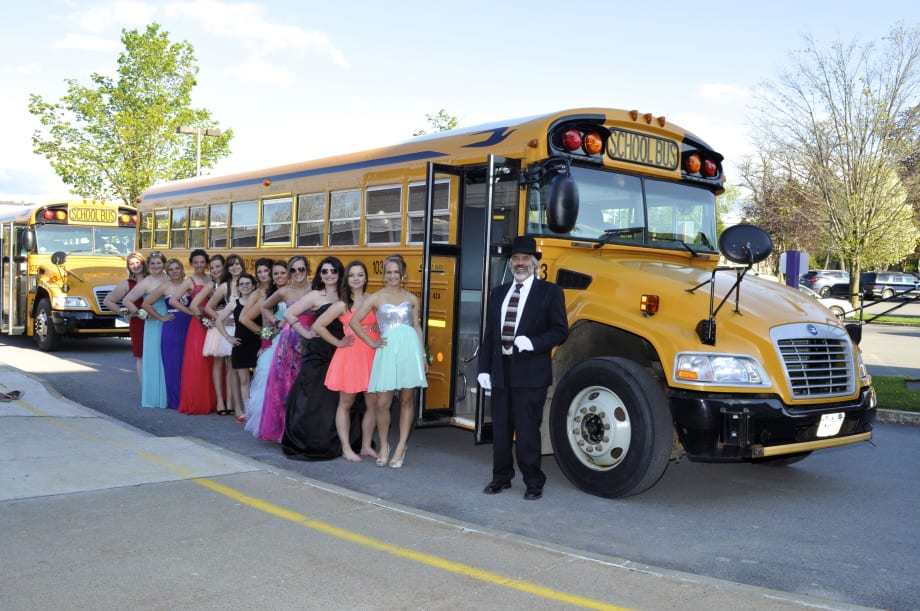
Richfield Springs (N.Y.) Central School ensures a safe and equitable prom experience for all students by providing a “yellow limo” for transportation.
Field trips, sports team competitions, band, play, choir rehearsals and performances and school dances all help students get a better-rounded education. Participating in these extracurricular activities can teach them as much about work ethic, teamwork and responsibility as any of their classes. For many, who can’t even get to school for classes without the benefit of a school bus service, extracurricular transportation is particularly critical to their ability to access these events.
Despite budgetary challenges, many transportation departments have been able to accommodate some types of trips, using partnerships, team coaches as drivers, and even converting school buses to activity buses to save money, while keeping student safety top-of-mind. After all, National Highway Traffic Safety Administration statistics show that students are 50 times more likely to arrive at school alive if they take the bus than if they drive themselves or ride with friends.
Handling field trip costs
Paul Bailey, transportation director of Long Beach (Calif.) Unified School District, says field trips are a big issue in school districts now, due to cost. His district has not had general fund money since 1979, and, consequently, hasn’t paid for trips in a long time, but there has not been a big decline in trips because of lack of funding.
Instead, Long Beach Unified has received outside funding for field trips for many years, providing 8,000 field trips and athletic trips annually, primarily with contracted buses. Every school in the district has business partners, such as Boeing Co. Destinations such as the Aquarium of the Pacific get federal funds for school bus transportation, and parks and recreation departments get state and federal funds to pay for day trips. Music funding comes from a public-private partnership with the Long Beach Symphony.
Additionally, some schools are able to use categorical money, and PTA, booster clubs, community drives and grants for sports activities provide support, mostly for buses.
For financial reasons, however, some districts only do one-way athletic trips to save money, according to Bailey, which he says he understands. “It’s not unreasonable to expect parents to go to games,” he explains.
Shannon Weber, director of transportation at J.O. Combs Unified School District #44 in San Tan Valley, Arizona, says that her district doesn’t transport students home from sports practice now, but there was a time when they did.
“However, because of continued need to be even more efficient with our dollars, we only take them to and home from practices that are not on the district’s campus,” she says.
[PAGEBREAK]
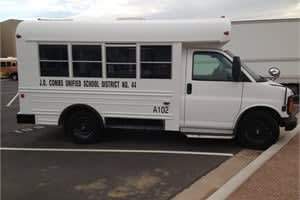
J.O. Combs Unified School District #44 in San Tan Valley, Arizona, offers three 14-passenger activity buses from its white fleet for coaches of small sports teams to drive to nearby out-of-district competitions. All coaches are CDL certified and get school bus driver training.
Converted buses save trip money
Richard Varner, director of transportation at William S. Hart Union High School District in Santa Clarita, California, says his district’s converted activity buses, which the transportation department designed in collaboration with A-Z Bus Sales, recently beat his previous expectation of saving around $4,000 per trip, at least so far.
Varner purchased three new Blue Bird Type D buses three years ago and prepared the specifications for the vehicles to turn them into activity buses. The buses, designed to be comfortable for longer trips, are equipped with coach-style seats and air conditioning, have Wi-Fi capability, and have been certified by the California Highway Patrol. Converting the buses cost $35,000 each and was funded through a lease purchase.
Varner had initially estimated that using these activity buses would cost around $2,000 per trip on the longest trips. The district ran its first out-of-area trip over the summer when the student track team took one of the buses up to Mammoth Lakes for five days. Varner obtained multiple quotes from coach companies, and the lowest he got for the trip was for $10,300. He was able, however, to run the trip with the converted activity bus for $3,400, saving nearly $7,000, or about two-thirds of the transportation cost.
“The coach said for that kind of savings, he doesn’t mind pulling into a rest stop,” Varner says. “It’s been a good move. We plan on coaches seeing more of them.”
As the new school year recently began, the activity buses were put into service almost every day, handling longer field trips. The district conducts, on average, 200 field activity and athletic trips in a given week, Varner says.
Ensuring safe access
Varner was not only driven by budgetary concerns to create the vehicles; he was also focusing on safety.
“There are very good coach companies out there, and there are coach companies that aren’t legal operators. We want to make sure we provide the safest service we can for our kids,” he says.
Weber says her district transports student athletes for about 275 offsite practices and contests per year. For instance, since the district doesn’t have a pool, school buses bring the swim team to and from practice, but the football and baseball teams can practice on campus, so typically parents take them home.
The district has a white fleet with three 14-passenger activity buses, which coaches of small teams, such as the volleyball and badminton teams, sometimes drive to out-of-district competitions that aren’t too far away. All the coaches are CDL certified and get school bus driver training and emergency and evacuation training from the transportation department.
“Anytime we can [transport] our kids with those [drivers] at the wheel, it’s much safer because they have special training, and it helps us to be efficient with the use of the fleet,” Weber says.
For contests that take students away from the district by an hour or two, bus drivers take the wheel and give the coach an opportunity to meet with their team so they’re not driving and trying to talk plays and strategy. “They’re riding along with the kids, so that’s helpful from a safety standpoint,” Weber says.
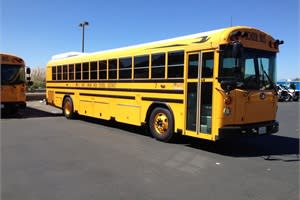
William S. Hart Union High School District in Santa Clarita, California, is using school buses converted to activity buses to save money on field trip transportation.
Equal treatment
Mark Buddle, transportation supervisor for Richfield Springs (N.Y.) Central School, says that the district’s tradition of providing school buses for prom transportation goes back longer than he can remember, and makes the event not only safer but a more equitable experience for all students.
“We had [some] kids renting limousines, and some couldn’t afford that,” he explains.
Now, all the students are treated equally when they go to the prom, arriving at the prom courtesy of a “yellow limo” from the school. “There’s no ‘You got to ride in a fancy limousine and I had to ride in Mom’s whatever.’ It puts the kids on a level playing field,” Buddle says.
Once the school started holding its prom at an off-campus location, students were required to ride school buses as a safety precaution, suggested by Project Prom, a group that organizes prom and other school dances.
“It keeps them all under control,” Buddle says.
More Management

STA Acquires Sunrise Transportation
Student Transportation of America expands in Illinois and Connecticut through Sunrise's fleet of nearly 1,000 vehicles.
Read More →
EPA Opens $180M DERA Funding Round for Diesel Upgrades
The 2026 Diesel Emissions Reduction Act program seeks applications from eligible organizations to accelerate the retirement of legacy diesel vehicles.
Read More →
HopSkipDrive’s CareEngine Targets the ‘Exceptions’ in Student Transportation
The new platform works alongside districts’ existing transportation management systems to coordinate specialized rides, automate last-minute changes, and turn ride data into operational improvements.
Read More →


The Right Ride for Every Student: Navigating the New Student Transportation Ecosystem
How should districts blend school buses with small-vehicle transportation and other options? EverDriven CEO Mitch Bowling discusses safety, costs, partnerships, and strategy.
Read More →
Annette Brown Always Takes the Extra Time: Meet Our 2026 School Bus Driver Hero
For more than 30 years, the Wa-Nee Community Schools driver has treated students like family, combining safety, compassion, and servant leadership to make a lasting difference on and beyond the school bus.
Read More →
How to Build a Better Driver Training Program
Ready to boost up your school bus instructor training? Here’s how to pick the right talent and improve recruitment, retention, and safety.
Read More →
CALSTART and Forth Combine to Form Catalyst Mobility
The new name represents a renewed vision for the nonprofit focused on advancing clean, equitable, and affordable transportation solutions that move people and goods.
Read More →
What Makes a Great School Bus Driver Trainer?
Choosing the right school bus driver trainer takes more than experience. Learn six keys to selecting and developing trainers and evaluating program effectiveness.
Read More →
School Bus Contractors Expand Through New Deals, Acquisitions & Partnerships
STA's Canadian division acquires Ontario-based G&L Stevenson Transport; Durham School Services adds a new district in California; First Student expands in New Jersey; and Minnesota Coaches rebrands and acquires Halo Transportation.
Read More →
Logan Bus Company Rolls Out AI Phone System for NYC School Bus Families
A summer pilot found that AI agents could handle most routine calls, freeing up time for customer service staff to focus on emergencies and complex family concerns.
Read More →