




Enhancing Fire and Smoke Protection
If a bus catches fire, it can spread quickly. Ohio-based SAS Rubber Co. offers door edges, window and escape-hatch gaskets, and other parts that meet stringent flame and smoke specifications for transit vehicles.

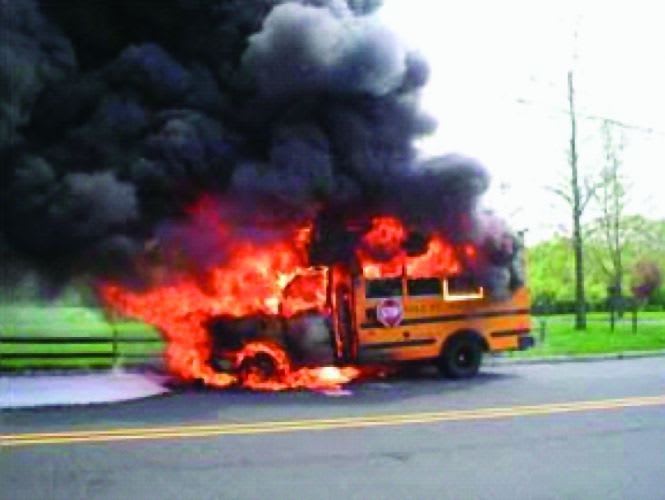
After the deadly Carrollton, Ky., bus crash in 1988, safety improvements were made to prevent another such fiery tragedy.
Those included the upgrading of Federal Motor Vehicle Safety Standard (FMVSS) 301, which specifies requirements for fuel system integrity and security. Another action was the revision of FMVSS 217 to require that the total area of emergency exits be based on the designated seating capacity.
SAS Rubber Co., based in Painesville, Ohio, offers another solution for protecting school bus passengers from fire and smoke. The company manufactures a variety of parts made out of material that meets flame and smoke specifications for mass transit vehicles.
Those standards include the surface flammability requirement of ASTM E162, the surface flame propagation requirements of ASTM C1166, and the smoke optical density and toxic gas generation of ASTM E662.
A safer bus
SAS Rubber says that meeting these stringent specifications translates into the goal of a safer school bus. In the event that a fire breaks out, reducing harmful smoke is a critical part of that mission.
"Investigations that involve fire-related accidents report that death and serious injury occurs more from smoke inhalation rather than contact from open flames," says Donald Patt, executive vice president of SAS.
To that end, the company's products for school buses include sensitized and non-sensitized door edges, window and escape-hatch gaskets, fender guards, rub rail and "just about any parts that can be molded or extruded," Patt notes. The parts are available for new buses or can be retrofitted on older buses.
SAS's rubber compounds are tested by an accredited testing laboratory. The lab issues test results that are required by the federal government in the manufacturing of mass transit vehicles.
Patt notes that in the transit industry, federal funding is tied to meeting the flame and smoke standards, among other requirements. He points out a discrepancy here.
"Mass transit vehicles are protected by low smoke and flame specifications, but school buses for the most part are not," Patt says. "Is it because the mass transit vehicles are federally funded and school buses are not?"
[IMAGE]501[/IMAGE]Long history
SAS Rubber was founded in 1937 by Sol A. Sekki (whose initials provided the company's name). It has changed ownership a few times over the years but has been owned by Yokohama Rubber Co. of Japan since 1992.
With a staff of about 88 people, SAS has two divisions: industrial and hose. The industrial division produces the door strips, gaskets and other parts for school buses and transit vehicles. The hose division manufactures powersteering and air-conditioning hoses for the automotive industry.
"SAS is really a 'job shop' with very few proprietary items," Patt explains. "Our products end up in many different places. That's why we have so many compounds that are designed to meet many specifications for a wide range of products."
Patt came to SAS in 1965 as a factory worker in the mixing department. Then-owner Sam June decided to train him to be a compounder, and after that, Patt continued to work his way up in the company.
He has made school bus safety a focus and even wrote a letter on the subject to SBF several years ago.
The company has set up a Web page at saferbusses.sasrubber.com that gives details on smoke and flame resistance and even features videos of school bus fires.
"Take a look at the burning school bus videos on our Website to see how fast smoke and flame can spread," Patt says.
More Safety
Illegal School Bus Passing Drops 24% in New York Districts
With fewer than 5% of citations involving repeat offenders, Westchester County officials said enforcement, education, and community partnerships are helping change driver behavior.
Read More →
School's Back. Here's What Happened to Traffic, Speeding & Distraction
What happens to traffic when school resumes? New data analysis examines changes in distracted driving, congestion, and speeding around schools.
Read More →
Geotab Expands Fleet Safety Tools With Video Coaching, Risk Insights
New safety and video capabilities aim to help fleet managers assess risk, support drivers, and take targeted action through video coaching, red-light violation detection, and more.
Read More →

How to Build a Better School Bus Driver Training Program
Is it time to strengthen your driver training? Here’s how to pick the right talent and improve recruitment, retention, and safety. This video is brought to you by IC Bus.
Read More →
Recent School Bus Accidents Leave 2 Dead, 2 Injured
Four school bus crashes in Florida, Illinois, and Georgia highlight risks in transportation lots, at bus stops, and during student loading and unloading.
Read More →
When Every Second Matters, Clarity Keeps Routes Moving
From routine delays to urgent incidents, strong communication practices help drivers, dispatchers, schools, and families respond with confidence.
Read More →
What Happens When a School Bus Catches Fire — and What Can Help
School bus fires are rare but can be devastating. Learn how advances in fire suppression and asset protection help fleets detect fires earlier, reduce damage, and improve safety.
Read More →
Geotab Launches Tool to Help Fleets Investigate Road Incidents
Geotab Investigations combines telematics data, video, documents, and other evidence to help fleets reconstruct incidents, resolve claims, and determine what happened.
Read More →
Texas Sixth Grader Wins 2026 National School Bus Safety Poster Contest
Sai Darshana Yekolu of Moseley Middle School in Prosper, Texas, was named the newest winner for her artwork, bringing the theme of “Safe Rides, Everyday Heroes” to life.
Read More →
Doing More With Less: How Transportation Directors Can Prioritize Safety Amid Budget Uncertainty
With diesel prices soaring and nearly one-third of transportation directors expecting budget cuts, maintaining student safety has never been more challenging. Download this guide to learn how leading districts are prioritizing risk, funding critical safety technology, and building stronger budget cases with data.
Read More →