




Enforcing Assigned Routes and Stops
It is important for school districts or contractors who provide school busing to ensure that students use the assigned bus stop and bus run. When this...
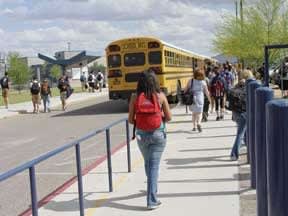
It is important for school districts or contractors who provide school busing to ensure that students use the assigned bus stop and bus run. When this is not enforced, the district or contractor (or both) can be opened up for liability.
Some types of neighborhoods or developments especially lend themselves to this concern. When the population density of students is such that several buses are needed to cover a relatively small area, students will get creative in figuring out how to shave a few minutes off their arrival time at home in the afternoon or to gain a few minutes of extra sleep in the morning by going to a neighboring route they are not assigned to.
Unfortunately, this same creativity will often lead kids to cross major streets, overload the bus they are not assigned to or cause other problems, like bus stop complaints by homeowners due to a large group of students milling around.
Students riding incorrect routes can be a problem even for outlying rural routes where only one route serves the area. Students may take friends home with them. If they do not have permission slips from a parent as well as the school office, and the bus driver does not check up on them, problems can arise.
Safety, security risks
The transportation office or the school administrator can get a "lost student" call. Police and office staff might be unnecessarily placed in the field looking for the student. But if such an unauthorized rider should get hurt, abducted, fall into mischief or otherwise be harmed, parents may resort to litigation. The transporting district's defenses would likely be thin in such a scenario.
At the high school level especially, and somewhat at middle schools, unauthorized ridership can be a security risk. Sometimes riders will come on board in order to start a fight when they get off at the stop (and the driver is rolling down the road and out of sight).
Students may have other questionable motives. One driver I know asked for help because on half-days, her passengers doubled. The reason? Her high school route has a stop within a tenth of a mile of a McDonald's. Kids wanted to socialize at the restaurant with friends who don’t normally ride.
Some of the students' excuses I've heard from my driver's seat are: "I'm fairly new and my name's not on the computer yet, but I live in the neighborhood." Another great one is, "I'm authorized to ride, but you haven't seen me all year because I normally drive. But my transmission's out on my car." Or, "The campus monitor over there [pointing to a security person 200 feet away] said I could ride your bus."
Not every new face is a student telling you a lie. But the driver, backed up by the office or security staff and the transportation office, needs to verify a student's authorization.
Authorization issues
Verifying a student's authorization can be a cumbersome task for a bus driver. That security person 200 feet away is tied up with some other issue, and the driver is not supposed to leave the busload of students unattended.
Invariably, the radio is tied up by some other driver when a driver wants to call in and have dispatch check the computer for a requesting rider. Bus drivers to the rear are held up and get impatient. The driver asking for the check will probably run a few minutes late on a tightly packaged afternoon run schedule. Not to mention student attitudes that, when faced with a questioning adult, can often be, shall we say, less than courteous.
Another problem for a driver who wants to be conscientious about enforcing authorized ridership is fellow drivers who are lackadaisical about it. This is especially true in those neighborhoods where several buses serve a tight area. The unconcerned drivers will have "trained" the students that it's OK to jump from bus to bus on different days, so that now the conscientious driver looks like the bad guy.
Parent calls come in complaining of the driver who "refused to let my child ride," when, in reality, the student decided to make his or her own unauthorized route change. Security staff at the school, if not on board regarding policing ridership, may perceive the conscientious driver as a problem driver if other drivers don’t care who gets on their bus.
Solving the problems
First of all, the transportation department must have a uniform policy among the drivers so everybody understands that only authorized students should ride. "Authorized" should mean that the student must be assigned by routing staff to the run, or if an exception is allowed, there must be a written permission slip either generated or verified by the school office.
The schools being served must be on board regarding this policy, and administrative, security and/or campus monitor staff must be willing to back it up.
At schools I have worked with, I have seen tools and devices that can help with this matter. A solution I especially like is a middle school that issued school ID badges to each enrollee. Along with information the school used, the bus route the child was assigned to was notated. School staff and drivers alike instantly could verify a student's right to ride.
There can be some flaws, such as students "loaning" a friend their badge. A sub driver might fall prey to this scam. However, monitors at the school normally knew the students and helped police the process. This system significantly cut down on "bus-hopping" and ridership problems at the school.
A ridership list given to the driver is a good back-up. In many districts, like the one I work for, computer programs aid in routing and can generate assignment lists.
Another easy aid for drivers is to give them copies of other drivers' routes going to the same school or same neighborhood. Drivers can thus be aware of where unauthorized students are coming from and network with their home office and other drivers to reduce the problem.
At a school district I worked for, we had several large "transfers" where routes feeding in from all corners of the large school district came into a central site. Then the students transferred to shuttle buses to go to their schools of attendance. At each transfer site, we had campus monitors who oversaw the transfer, which consisted of 15 or more buses.
We provided each monitor with several tools in one large three-ring binder. They had a class list from each school with each student's information, including bus routes and bus stop location. We also provided a school district map showing geographical areas served by each route. Finally, there was a copy of each driver's route showing the bus stops and times. Several drivers who showed leadership qualities and a willingness to help were given the information as well so they could assist the monitors and other drivers. (Training on privacy issues was provided for those helping.)
My point: Giving pertinent busing information to school staff members who help load the buses or who greet the students, as applicable to the situation, will aid in keeping students on the correct bus.
Training is key
Unless provided training about the seriousness of potential liability to themselves and their employer, school bus drivers tend to be "creative" and "improve" on routes they are assigned to. This is not necessarily implying malicious intent on the part of bus drivers. It's just that unless you have the overall picture, some details can seem silly out in the field.
Training should include explaining the problems that can be caused by such practices as allowing unauthorized riders, authorized riders using the incorrect stop, or the driver "creating" his or her own stops.
Oftentimes, drivers can see safety issues or impracticality with assigned stops or routing that a computerized routing program or a human router may not see. A process in which drivers can bring these observations into the office and get safety changes processed needs to be available. Drivers should be expected and obligated to report any such concerns.
Solving the overall problem of students using incorrect routes or stops will take a unified effort by transportation staff, school staff and school district administrators. To ignore the problem or be unaware of it can leave transportation providers open to liability.
Ken Laue has held various pupil transportation roles, from bus driver to safety and training manager, since 1972. He retired in 2003 but is currently serving Vail (Ariz.) School District.
More Management

How to Build a Better Driver Training Program
Ready to boost up your school bus instructor training? Here’s how to pick the right talent and improve recruitment, retention, and safety.
Read More →
CALSTART and Forth Combine to Form Catalyst Mobility
The new name represents a renewed vision for the nonprofit focused on advancing clean, equitable, and affordable transportation solutions that move people and goods.
Read More →
What Makes a Great School Bus Driver Trainer?
Choosing the right school bus driver trainer takes more than experience. Learn six keys to selecting and developing trainers and evaluating program effectiveness.
Read More →

School Bus Contractors Expand Through New Deals, Acquisitions & Partnerships
STA's Canadian division acquires Ontario-based G&L Stevenson Transport while Durham School Services adds a new district contract in California, First Student adds a New Jersey contract, and Minnesota Coaches acquires Halo Transportation.
Read More →
Logan Bus Company Rolls Out AI Phone System for NYC School Bus Families
A summer pilot found that AI agents could handle most routine calls, freeing up time for customer service staff to focus on emergencies and complex family concerns.
Read More →
From Intent to Impact: What I Learned About Leadership from TAPT
A Texas transportation supervisor shares lessons on self-awareness, accountability, managing stress and building trust — and why investing in leadership development matters at every stage of your career.
Read More →
NAPT Names 2026 Award Recipients, Hall of Fame Inductee
Who earned national recognition for their work in student transportation? This year, NAPT named five recipients of its 2026 awards for service, safety, and leadership, plus its newest Hall of Famer.
Read More →
2026 State of Student Transportation Report
Driver shortages. Rising costs. Growing safety expectations. More data, but not enough time to act on it. The 2026 State of Student Transportation Report reveals what transportation leaders say is putting the most pressure on their operations—and where they’re investing next. See how your priorities compare.
Read More →
How to De-Escalate an Angry Person: 5 Steps for Handling Workplace Conflict
What makes emotions run high, and how should you handle an angry colleague or parent? Follow these steps for staying calm, listening, showing empathy, and resolving conflict.
Read More →
What Readiness Looks Like This School Year
Learn about the challenges shaping the 2026–2027 school year, from persistent driver shortages and budget pressure to technology and readiness gaps. See how school districts are responding and adapting in Zonar’s 2026 Back-to-School Readiness Report.
Read More →