




Driver Training Goes Virtual
Computer-based technology is substantially affecting the school bus transportation industry. Many school districts around the U.S. use fleet maintenan...
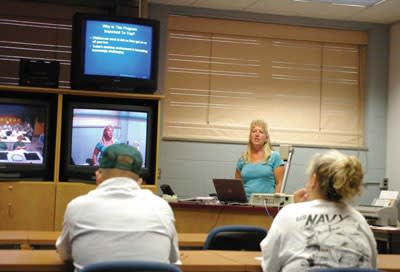
Bridget Muller, the assistant transportation safety and training manager for WSWHE BOCES in Saratoga Springs, N.Y., instructs a school bus driver training course located in the organization’s Distance Learning Lab.
Computer-based technology is substantially affecting the school bus transportation industry. Many school districts around the U.S. use fleet maintenance software, and a growing number are installing GPS systems in their buses.
Drivers are also feeling the impact of computer-based technology. For decades, they have studied and mastered the fundamentals of safe school bus transportation in a classroom, with an instructor present. Today, online courses are emerging as a more convenient way for drivers to complete this portion of their training.
The move toward online instruction
Kathy Furneaux, executive director of the Pupil Transportation Safety Institute (PTSI) in Syracuse, N.Y., believes that technological developments (such as the installation of GPS equipment in buses) and societal pressures (such as the need to remedy the problem of children being left on buses) lead to innovations in the school bus industry. Hence the emergence of online training courses for school bus drivers.
“We’re an industry that’s pretty proactive in terms of implementing measures to keep children safe, but we are also reactive to issues and problems that surface. I think that innovations like the use of online training are born out of trends and problems,” Furneaux says.
The material covered in online courses mirrors that of the material covered in traditional courses. New drivers are taught — among other things — how to load and unload students, effective dispatch behavior, how to transport special-needs students and emergency procedure protocol.
Course formats
Online training courses can be delivered in several ways. Ted Finlayson-Schueler, president of Syracuse, N.Y.-based Safety Rules!, a nonprofit organization dedicated to establishing safe school bus travel for students, says a class can involve a one-on-one virtual interaction between the instructor and a student. In this type of setting, reading and writing assignments are given to the student and questions are addressed via e-mail conversations. As this format is text-based, Finlayson-Schueler says, “This is essentially a correspondence course.”
For this reason, Finlayson-Schueler feels that it may not be the best type of course for bus drivers to take, due to the nature of the material they are required to learn (a portion of the material necessitates hands-on training).
Another format consists of an instructor and a class of students with a set time schedule. In addition to reading and writing assignments, this type of class often includes downloadable video lectures, the ability for students to ask the instructor questions in real-time and class discussion boards. While this type of course is also highly text-based, Finlayson-Schueler says, “There’s a class camaraderie that creates relationships and motivation that might not exist in the one-on-one reading and writing format. The video lectures and electronic communication among class members make it a better format for drivers as long as they have basic computer knowledge.”
A third type of course — interactive computer training — is entirely computer-driven and has no instructor. The content has been programmed into an interactive program or Website and the driver moves through it as he or she answers questions correctly in each training module.
Finlayson-Schueler recommends considering several factors before taking an interactive computer training course. He says one should assess the quality of its images, if it contains images. One should also determine if the course teaches the material through repetition of facts or through a more thorough method. Finally, given the nature of drivers’ work schedules, one should determine if the course enables drivers to take it on their own time.
There is a fourth type of training that involves computers, but its technology allows the instructor to run the course from an actual classroom. It is called distance learning. Multiple classrooms are connected with an audio/video feed that allows not only the instructor to be seen and heard at multiple locations but also for the instructor to see and hear drivers in the other classrooms.
Finlayson-Schueler emphasizes that there are many benefits to taking a distance learning course. Having several students involved can allow insightful conversations to develop. “Plus, if the students or the instructor need to drive in the morning, I’m relieved that they didn’t end the day with a 90-minute commute home from a class at a remote location,” he says.
Distance learning
The Washington-Saratoga-Warren-Hamilton-Essex Board of Cooperative Educational Services (WSWHE BOCES) in Saratoga Springs, N.Y., has developed one such training course for school bus drivers. WSWHE BOCES provides educational programs and services to 31 school districts in five regions within New York state. Its distance learning course is run from the Distance Learning Lab in the organization’s F. Donald Myers Education Center using a two-way audio/video network, which enables the instructor to teach the course to students in two or more locations simultaneously. Schools that have a distance learning lab with an audio/video feed can send drivers to the lab to participate in the course.
Bridget Muller, the assistant transportation safety and training manager for WSWHE BOCES, teaches the bus driver training course. In this 30-hour course, new drivers learn the mechanics of defensive driving, the history of the school bus, first aid protocol and other driving-related skills.
The New York Department of Education approves the curriculum to ensure that all new drivers receive uniform training. Upon completion of the course, the necessary hands-on experience and a driving test, drivers receive certification from the state indicating that they have fulfilled the requirements set forth for school bus drivers.
Drivers’ attitudes toward the distance learning program have changed substantially since it was introduced in 2005. “Initially, a lot of people weren’t too keen on it because they thought it would involve sitting in front of a computer,” Muller says. “This course is not like that — the center’s distance learning lab and each classroom are equipped with monitors, so when I look at the monitor, I see a classroom and the students are looking back at me. There’s a minute lag time.”
{+PAGEBREAK+} Muller’s students perform skits together in order to better understand the material, and she believes that they appreciate the interaction that this type of course offers. “I think they enjoy it because they’re meeting people that they might not meet otherwise,” she says. Finally, she believes another benefit of distance learning is its accessibility. “Drivers work all day and they don’t want to commute a long distance to a class after work,” she says. “This class gives them the opportunity to learn at a facility that’s closer to their homes.”
Customizable courses
Coastal Training Technologies Corp., located in Virginia Beach, Va., produces videos, DVDs and online courses designed to help individuals fulfill training requirements for their occupations. The company’s training courses cover a variety of topics within many industries. School bus transportation is one such industry, and some of the courses include “Pre-Trip for Your School Bus,” “Winter Driving,” “School Bus Held Hostage,” “School Bus Mirror Systems,” “Matter of Survival” and “Evacuating the School Bus.”
Chris Scaglione, the product and marketing manager for Coastal Training, explains that the company developed the content of its school bus courses by consulting with subject matter experts. In the mirror course, for instance, drivers learn how to properly position a bus’ mirrors. Scaglione says that the aforementioned courses, as well as six or seven others, should be available this month in the company’s online format, ClarityNet HD.
Drivers do not receive certification upon completion of a school bus-related course developed by Coastal Training, but Scaglione and Zechariah Boyd, the key account manager for ClarityNet HD, note that there are benefits to taking a course offered by the company.
Coastal Training has designed its online courses in a way that enables drivers to move through them autonomously. “Once a student logs in with their account number and password, the course chapters come up and the student picks a chapter and works through it,” Boyd says. “If they have to leave in the middle of taking the course, the program bookmarks the page so they can return to where they left off when they have time.”
Scaglione says that one of the downsides of taking a module-based course like this is that one loses the instructor-led aspect inherent in a traditional training course. However, this company’s online courses are designed somewhat differently from the interactive computer training course outlined by Finlayson-Schueler. “The beauty of ClarityNet is that drivers can e-mail the instructor if they have questions,” says Scaglione. “The big draw for school districts is that they can save money because the tests are done online, and human resources directors don’t have to organize the courses.”
Since the company’s courses are not tailored to the varied regulations of every school district in the U.S., ClarityNet HD is equipped with features that enable district officials to customize them. Scaglione advocates customization. “In order to get the most out of our courses, it’s important for schools to interact with them and mold them to their policies and procedures,” he says.
Customization is achieved through ClarityNet’s CustomEase feature. In addition to modifying questions in the course modules and tests, district officials can take an existing frame or storyboard within a program and — using a digital camera or a camcorder — capture images, audio and video and change the existing content. “It’s somewhat like building a PowerPoint presentation,” says Boyd.
Training in Texas
Dr. Cliff Blackerby, the director of educational technology services for the Region 4 Education Service Center in Houston, says that Texas is considering converting its driver training material into an online format.
The Region 4 Education Service Center is one of 20 service centers established by the Texas Legislature in 1967. Each center provides school districts with professional development training and technical assistance in order to support statewide goals for school improvement.
Blackerby believes that developing an online training course could prove to be cost-efficient for the state’s school districts in terms of resources and instructor availablity. Districts would not have to hire instructors to teach the course and would not have to allocate funds for the organization of the course. He also sees an advantage for drivers, in that it would enable them to take a certain portion of their training in any location that has a computer with Internet access.
“There’s plenty of precedence for using an online learning course as a tool to train bus drivers, and there are some nice synergies that can be gained if we can make the conversion,” Blackerby says. “It’s just a matter of fully developing the structure of the course, putting it in the proper medium and providing the access.”
When speculating about the format of the course, he says, “It may be structured in a modular form — drivers would be required to work through the modules, and at the end of each one, they would be required to take a test before they would be allowed to proceed to the next module.”
Because the Region 4 Education Service Center works closely with PTSI, the course’s content may be developed jointly by the two organizations. The Texas Department of Safety would then evaluate the content to ensure that it meets the requirements set forth by the state. Blackerby says that drivers would receive certification upon completing the course and a driving test.
Technology and tradition
Does the emergence of online training signal an approaching end to traditional training for school bus drivers? According to Blackerby, it does not. In order to fully complete their training requirements, drivers must take a driving test, and this obviously cannot be completed via an online course.
As Finlayson-Schueler mentioned, there is also a portion of material that drivers must learn out in the field.
To that end, he says that organizations such as WSWHE BOCES hold hands-on sessions for drivers at local bus garages to cover aspects of the course that entail working with a school bus, such as pre- and post-trip inspection procedures.
Furthermore, while Blackerby is aware of the possible benefits of online training for school bus drivers, he acknowledges that it is not for everyone. “There will be a portion of the bus driving community that won’t want to use an online program because it’s not their learning style,” he says. “School districts that provide online training still have to provide traditional, face-to-face training opportunities to make sure that all drivers’ needs are met.”
Interaction is key for effective learning
Ted Finlayson-Schueler, president of Safety Rules!, emphasizes the importance of interaction when it comes to online training. If the course has an instructor, that individual should actively observe and interact with the students in order to monitor their progress. Student interaction is crucial as well. “All learning theories advise students not to sit as passive receptacles for the instructor to fill with factual information,” he says.
He also notes that there is one particular learning theory — Dale’s Cone of Experience — which suggests that people retain more information the more involved they become in the learning process.
Hence, group activities such as skits, debates, games and hands-on practice will help bus drivers obtain a better grasp of the material they are studying.
More Management
How to Build a Better Driver Training Program
Ready to boost up your school bus instructor training? Here’s how to pick the right talent and improve recruitment, retention, and safety.
Read More →
CALSTART and Forth Combine to Form Catalyst Mobility
The new name represents a renewed vision for the nonprofit focused on advancing clean, equitable, and affordable transportation solutions that move people and goods.
Read More →
What Makes a Great School Bus Driver Trainer?
Choosing the right school bus driver trainer takes more than experience. Learn six keys to selecting and developing trainers and evaluating program effectiveness.
Read More →


School Bus Contractors Expand Through New Deals, Acquisitions & Partnerships
STA's Canadian division acquires Ontario-based G&L Stevenson Transport while Durham School Services adds a new district contract in California, First Student adds a New Jersey contract, and Minnesota Coaches acquires Halo Transportation.
Read More →
Logan Bus Company Rolls Out AI Phone System for NYC School Bus Families
A summer pilot found that AI agents could handle most routine calls, freeing up time for customer service staff to focus on emergencies and complex family concerns.
Read More →
From Intent to Impact: What I Learned About Leadership from TAPT
A Texas transportation supervisor shares lessons on self-awareness, accountability, managing stress and building trust — and why investing in leadership development matters at every stage of your career.
Read More →
NAPT Names 2026 Award Recipients, Hall of Fame Inductee
Who earned national recognition for their work in student transportation? This year, NAPT named five recipients of its 2026 awards for service, safety, and leadership, plus its newest Hall of Famer.
Read More →
2026 State of Student Transportation Report
Driver shortages. Rising costs. Growing safety expectations. More data, but not enough time to act on it. The 2026 State of Student Transportation Report reveals what transportation leaders say is putting the most pressure on their operations—and where they’re investing next. See how your priorities compare.
Read More →
How to De-Escalate an Angry Person: 5 Steps for Handling Workplace Conflict
What makes emotions run high, and how should you handle an angry colleague or parent? Follow these steps for staying calm, listening, showing empathy, and resolving conflict.
Read More →
What Readiness Looks Like This School Year
Learn about the challenges shaping the 2026–2027 school year, from persistent driver shortages and budget pressure to technology and readiness gaps. See how school districts are responding and adapting in Zonar’s 2026 Back-to-School Readiness Report.
Read More →