




Do School Buses Need Additional Warning Devices?
The familiar yellow school bus is rightfully touted as being the safest vehicle on the road. But, is it as safe as it should be? Do we, the people who...
The familiar yellow school bus is rightfully touted as being the safest vehicle on the road. But, is it as safe as it should be? Do we, the people who use, maintain and build school buses, create a problem when we stop looking for ways to make it safer? Passengers are protected by a design of steel and padding that is unsurpassed in the level of safety provided. There are always other things that can be added that may improve safety, but, overall, it's a safe environment inside the bus. However, when passengers are outside the bus, particularly when they must cross the street, there are limitations to the safety that can be ensured. Why don't motorists stop?
Transportation supervisors make every effort to route buses to limit the need for students to cross streets. Many make efforts to avoid pick-ups at intersections where a motorist may be less likely to see the red lights, stop arms and crossing gates of a school bus that is loading or unloading. We teach our students about the "danger zones" and the need to use extra caution when crossing streets. But once they are outside the bus, we are in large part relying on students, patrols, monitors, parents and motorists to watch and provide protection. No one in his right mind would intentionally harm children by striking them with a vehicle, but every year several young bus passengers are struck by motorists passing the big yellow bus with all of its warning devices in operation. In some cases, motorists are unconcerned with or ignorant of motor vehicle laws. In other cases, motorists genuinely fail to realize that a bus is stopped to load or unload, often due to inadequate warning systems or blind spots. But wouldn't they see the stop arm as they approach? Typically, yes. But not always.
A blind spot in "the zone"
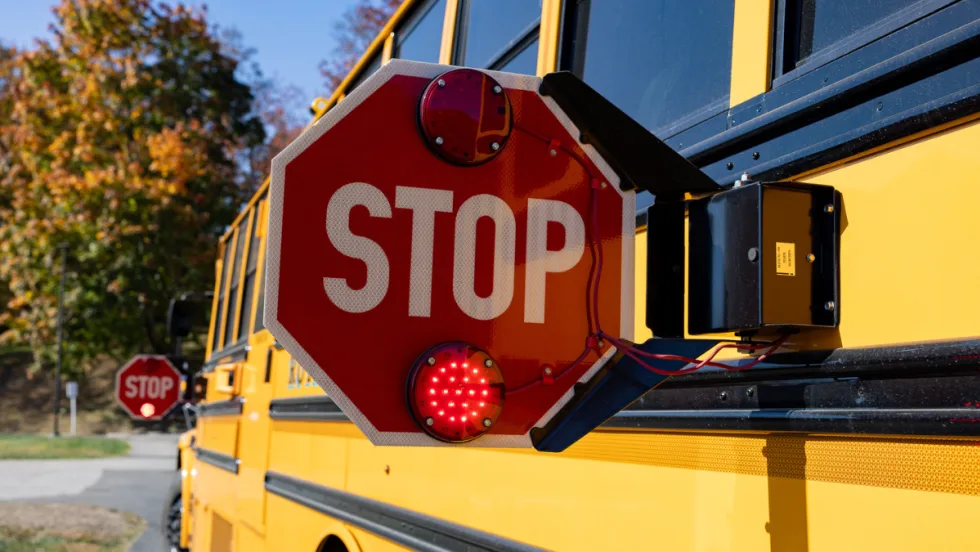
The problem is that current warning devices are principally directed at traffic approaching from the front or rear. Despite efforts to avoid placing bus stops at intersections where traffic approaches from the side, loading and unloading near intersections still happens too frequently. Motorists approaching a bus from the side do not get sufficient warning that the bus is stopped to load or unload passengers. They can see a yellow bus stopped at an intersection, but what tells them that the bus is loading or unloading or that children may be crossing? Buses stop or pause at intersections to check traffic before turning or crossing intersections more frequently than they do to load or unload passengers. To assume that approaching motorists will see a child in their path is dangerous. Bus drivers are protective of their passengers and use signals to tell students when to cross, but this is not sufficient. It's true that many buses have crossing arms that might act as a warning for motorists to stop. We know what a crossing arm means, but will a motorist see it at its low height or understand its meaning? It is crucial that we modify our current warning system components or require something additional that alerts motorists approaching from the side of the need to stop. Existing components like red warning lights, strobes or signs could be re-engineered to catch the eye of a motorist approaching the bus from the right or the left side. The need for improved warning systems is particularly urgent toward the front of the bus, where the vehicle often protrudes into the intersection. One possible solution is to re-engineer existing bus components to make them part of the warning system — marker lights that flash, re-designed warning lights on top of the bus like on emergency vehicles or redesigned stop arms that provide more side illumination. Although electrical systems are already strained, LED technology can reduce the electrical power demands on buses, allowing for additional or improved lights. Police lights set example
Police and fire vehicles started with a single red directional light. This system was increased to two lights, with one aimed to the front and one to the rear. Then a round, multi-directional light was added to the roof for greater visibility. Now that system has evolved into a large, multi-directional bar light for added safety and recognition. School bus lighting systems started much the same way, but have evolved differently - from the single red light to two lights (one aimed to the front and one to the rear), to three and four lights and then finally to eight-lamp systems with both amber and red. When motorists still did not stop, we added stop arms on the side to catch their attention as they started to pass. Some states even began to allow roof-mounted amber or white strobe lights to provide additional visibility in inclement weather or on high-speed highways. Much effort has been made to standardize school bus equipment and make buses universally recognizable for the safety of our children. The distinct and uniform yellow color and lighting systems were major national steps for our industry. True, major lighting system changes could confuse some motorists. Maintenance and procurement costs would increase as well. But we cannot afford to be restricted by the past when change is needed. Whether it is a replacement of the familiar single-direction warning light system with a multi-directional system (as seen on police vehicles) or whether it is a slight modification of what we have now, we must look for what is best for the future of the school bus. Too costly not to act
Should we simply supplement the existing warning system with additional lights aimed to the side, or should we be bolder? Would school buses become more recognizable at bus stops, and would the message for motorists to stop be clearer if the bus was equipped with a multi-directional amber and red bar light instead of our traditional fixed-direction lights? Review your designated bus stop locations, and look where the buses are actually stopping to load or unload on the road. The difference of a few feet can make a big difference in safety. Unless you can avoid having bus stops at intersections, you cannot be silent on this issue. There are blind spots to be fixed and, to avoid putting children at risk, your intervention is needed. Look for solutions and encourage changes as appropriate. There may be simple solutions available. Discuss this with your drivers, garage staff, state inspectors, state directors and manufacturers, and share what you learn.
Industry Input
The following responses were drawn from the Forum at www.schoolbusfleet.com
I don't believe that additional warning lights on school buses are going to stop those persons who run our lights. Some people can't be bothered by stopping for a school bus that is loading or unloading children. You could light the bus up like a Christmas tree and these people wouldn't care.
STEVE LOWER
School Bus Driver
Norman (Okla.) Public Schools
Anything that can make stops safer is welcome. I believe most people who run bus lights simply don't see them. I've honked at drivers who don't slow down and seen them display surprise that I'm there. A good idea would be an audible alarm for cars that approach an unloading school bus too fast — one that's loud enough to wake the dead.
DAVE COBB
School Bus Driver
Austin, Texas
At some point, all kids riding buses need to be trained by the driver how to watch out for themselves and their friends. Training the kids, a daily routine, does not guarantee a child won't make a mistake. Bus drivers and motorists make deadly mistakes, regardless of their training. It would be dumb to think all kids would get it right every time, but equally dumb to use this as an excuse not to train the kids in safe practices.
JAMES KRAEMER
Director
www.2safeschools.org
Rather than adding anything more to school buses, maybe we should start thinking about regulating where a bus stop should be. A corner where motorists will be turning in and out is not very logical. Getting off of the roadway, which would interfere with the directional red light system, does not seem to be a wise decision either. A school bus that remains visible to the public and allows room for motorists to leave or enter side streets without blocking visibility is the first part of a safe stop. Driver training is another important link. The third part would be making sure to have a safe walk plan to and from the stop, with parents made aware of their responsibility to train their children in appropriate behavior.
MERLE JEWETT
Transportation Director
Merced (Calif.) City School District
More Safety
Illegal School Bus Passing Drops 24% in New York Districts
With fewer than 5% of citations involving repeat offenders, Westchester County officials said enforcement, education, and community partnerships are helping change driver behavior.
Read More →
School's Back. Here's What Happened to Traffic, Speeding & Distraction
What happens to traffic when school resumes? New data analysis examines changes in distracted driving, congestion, and speeding around schools.
Read More →
Geotab Expands Fleet Safety Tools With Video Coaching, Risk Insights
New safety and video capabilities aim to help fleet managers assess risk, support drivers, and take targeted action through video coaching, red-light violation detection, and more.
Read More →

How to Build a Better School Bus Driver Training Program
Is it time to strengthen your driver training? Here’s how to pick the right talent and improve recruitment, retention, and safety. This video is brought to you by IC Bus.
Read More →
Recent School Bus Accidents Leave 2 Dead, 2 Injured
Four school bus crashes in Florida, Illinois, and Georgia highlight risks in transportation lots, at bus stops, and during student loading and unloading.
Read More →
When Every Second Matters, Clarity Keeps Routes Moving
From routine delays to urgent incidents, strong communication practices help drivers, dispatchers, schools, and families respond with confidence.
Read More →
What Happens When a School Bus Catches Fire — and What Can Help
School bus fires are rare but can be devastating. Learn how advances in fire suppression and asset protection help fleets detect fires earlier, reduce damage, and improve safety.
Read More →
Geotab Launches Tool to Help Fleets Investigate Road Incidents
Geotab Investigations combines telematics data, video, documents, and other evidence to help fleets reconstruct incidents, resolve claims, and determine what happened.
Read More →
Texas Sixth Grader Wins 2026 National School Bus Safety Poster Contest
Sai Darshana Yekolu of Moseley Middle School in Prosper, Texas, was named the newest winner for her artwork, bringing the theme of “Safe Rides, Everyday Heroes” to life.
Read More →
Doing More With Less: How Transportation Directors Can Prioritize Safety Amid Budget Uncertainty
With diesel prices soaring and nearly one-third of transportation directors expecting budget cuts, maintaining student safety has never been more challenging. Download this guide to learn how leading districts are prioritizing risk, funding critical safety technology, and building stronger budget cases with data.
Read More →