




Control Is Key to Accident-Free Driving
Arlene Felty has driven school buses for more than 35 years. She has witnessed a lot of change in pupil transportation over the years. Here she shares...
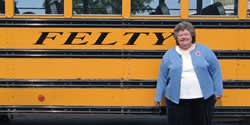
Arlene Felty has driven school buses for more than 35 years. She has witnessed a lot of change in pupil transportation over the years. Here she shares some background on her success as an accident- and citation-free driver.
Backup needed
Felty Transportation is a mom-and-pop operation owned by Felty and her husband, Charles. It began as a one-bus operation and grew to 12 buses and five vans. The staff of 25, which includes members of the Felty family, shares operational duties.
"I have four children, and three of them are boys," says Felty. "They all had to get their licenses and drive school buses, too."
Felty started driving buses at the end of the '60s. Her husband also owns a vegetable farm with a few animals to boot. She noticed that he was running himself ragged trying to be everywhere at once with farming and driving, so she climbed behind the wheel and hasn't looked back since.
"There seemed to be an increase of children in our area," she says. "So we bought another bus and went out together."
Felty Transportation provides service for the Tamaqua, St. Clair and Pottsville school districts, along with several smaller schools in the mostly rural area. In all, the company services about 15 schools.
Mining territory
Native Americans christened the area where Felty Transportation is based Tamaqua, which translates to "Land of the Running Waters," Felty explains.
The region is an anthracite mining territory, and the town began as small mining villages. Anthracite, also known as hard coal, is a dense, shiny coal that has high carbon content with little volatile matter.
Farming hasn't been as profitable for the Feltys, so they supplement the income from farming with that of the bus operation. "The two industries seem to complement one another," says Felty. "When you're busy with the school year, you're not so busy on the farm. When you're done with the farm work, you can concentrate on the buses."
The fleet is made up of 78- and 48-passenger buses manufactured by IC Corp. and Thomas Built Buses. There are also a few Carpenters, but Felty says ICs are her favorite. "I stick with my IC, but my boys, they like the power and visibility of Thomas buses."
{+PAGEBREAK+} Mother hen
Felty appreciates the care necessary for special-needs children and, for more than 20 years, has driven as a substitute driver for Schuylkill Intermediate Unit 29, a county program that provides special-education services for children with special needs.
"When you work with special-needs children, they get so close to you," she says. "It's just a thrill to work with them."
Felty also provides driver training through Schuylkill.
Recognizing excellence
In April of this year, the Pennsylvania School Bus Association held a ceremony to recognize 88 drivers who had driven school buses accident free for five consecutive years or more. Felty was one of three drivers honored for 35 years of safe driving.
"I have been lucky," she says about receiving the award. But she has concrete rules about behavior on the road when transporting children. Her No. 1 rule is to slow down.
"In our area, you don't find very many places where you can even drive 55 miles an hour," she says. "Forty-five miles an hour is almost tops. That's fast enough."
Having your bus under control, she says, is also important. "Know the limits and capabilities of your bus, practice safe driving and be a defensive driver while out on the road."
When Felty began driving for the districts her company serves, there were no local CDL requirements. But she understood the necessity of having a commercial drivers license and pursued the certification without being prompted. Since then, she has passed her expertise of CDL requirements onto hundreds of school bus drivers as a trainer and instructor. She enjoys what she does and makes it her business to stay up on current regulations, new laws and other industry-related issues. She has received training and been recertified approximately eight times in the past 35 years.
Nuts and bolts
Although she enjoys the human interaction more than anything else in transporting students, Felty says some technological advances over the years have made running her small transportation operation much easier. For instance, she enjoys the convenience of two-way radios.
"Drivers feel connected. They feel someone's there if they need help," she says. "We've used some Kenwoods and some Motorolas."
Felty Transportation does its routing manually and depends on the staff's expertise and knowledge of the general area.
"We can get our routes down pretty thorough; we're not overlapping or backtracking too much. I think we've gotten along in all these years," says Felty.
{+PAGEBREAK+} Industry perspective
Looking back, Felty says there have been many changes in pupil transportation — some notable and some not so notable.
Most of the advancements have been technological with a strong emphasis on safety. Many have improved rider comfort as well. There wasn't any padding on bus seats when Felty started driving — only metal bars that could injure children.
Certain technological advances, like the fluorescent markings around exits, really light up Felty's eyes.
"I like the stop arms that come out with blinking lights," she says. "And now they're coming out with the strobe lights. Anything with increased visibility." She says she sits on the fence when it comes to a stance on three-point seat belts.
"Perhaps it'll keep kids in their seats," she says, "But is it really going to be a great help? I've seen studies that tell me the opposite."
The speed with which smoke fills a bus when there's a fire and the difficulty in evacuating children who are buckled up concerns her. She also says that she's seen children hurt themselves and other students with seat belts; children find ways to get around the proper use of them.
"I really have not come to an exact conclusion on their worth," she says. "I'm just not fully in favor of it."
Suffice it to say, Felty trusts compartmentalization. "If children are seated properly, meaning facing forward," she says, "they're safer than they are in seat belts."
Then there is student behavior, which Felty says has worsened over the years.
"I think respect has dropped," she says. "The children, sometimes, they just don't have the fear."
Precious cargo, still
Even with behavioral problems, Felty sees the children she transports as precious cargo with wonderful ideas. A favorite story of hers is about snakes a student carried aboard her bus for show and tell at school.
During her route, students tried to approach her to tell her what little Johnny brought. The children's excitement was almost overwhelming, which aroused Felty's interest in the snakes as well. Still, she told the students to wait until they got to school to look at the serpents, but Johnny opened the container on the bus.
"The children started screaming and crying because the snakes, three snakes to be exact, had been freed from the box," Felty says.
She stopped the bus to look inside the container and saw that the snakes were gone. The bus was close to the school, and Felty got the children off the bus.
A science teacher was called out to collect the serpents, but he exited the bus empty handed. "I called the parent when I got to school," Felty says. "I asked if Johnny really had snakes, and the mother said, 'Yes, garden snakes.' To this day, we have never found any snakes."
More Safety
School's Back. Here's What Happened to Traffic, Speeding & Distraction
What happens to traffic when school resumes? New data analysis examines changes in distracted driving, congestion, and speeding around schools.
Read More →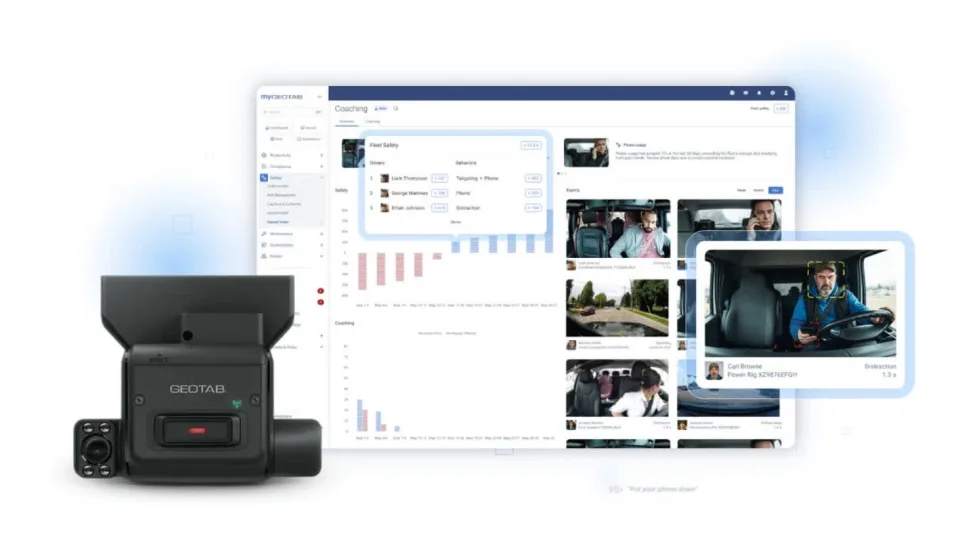
Geotab Expands Fleet Safety Tools With Video Coaching, Risk Insights
New safety and video capabilities aim to help fleet managers assess risk, support drivers, and take targeted action through video coaching, red-light violation detection, and more.
Read More →
How to Build a Better School Bus Driver Training Program
Is it time to strengthen your driver training? Here’s how to pick the right talent and improve recruitment, retention, and safety. This video is brought to you by IC Bus.
Read More →

Recent School Bus Accidents Leave 2 Dead, 2 Injured
Four school bus crashes in Florida, Illinois, and Georgia highlight risks in transportation lots, at bus stops, and during student loading and unloading.
Read More →
When Every Second Matters, Clarity Keeps Routes Moving
From routine delays to urgent incidents, strong communication practices help drivers, dispatchers, schools, and families respond with confidence.
Read More →
What Happens When a School Bus Catches Fire — and What Can Help
School bus fires are rare but can be devastating. Learn how advances in fire suppression and asset protection help fleets detect fires earlier, reduce damage, and improve safety.
Read More →
Geotab Launches Tool to Help Fleets Investigate Road Incidents
Geotab Investigations combines telematics data, video, documents, and other evidence to help fleets reconstruct incidents, resolve claims, and determine what happened.
Read More →
Texas Sixth Grader Wins 2026 National School Bus Safety Poster Contest
Sai Darshana Yekolu of Moseley Middle School in Prosper, Texas, was named the newest winner for her artwork, bringing the theme of “Safe Rides, Everyday Heroes” to life.
Read More →
Doing More With Less: How Transportation Directors Can Prioritize Safety Amid Budget Uncertainty
With diesel prices soaring and nearly one-third of transportation directors expecting budget cuts, maintaining student safety has never been more challenging. Download this guide to learn how leading districts are prioritizing risk, funding critical safety technology, and building stronger budget cases with data.
Read More →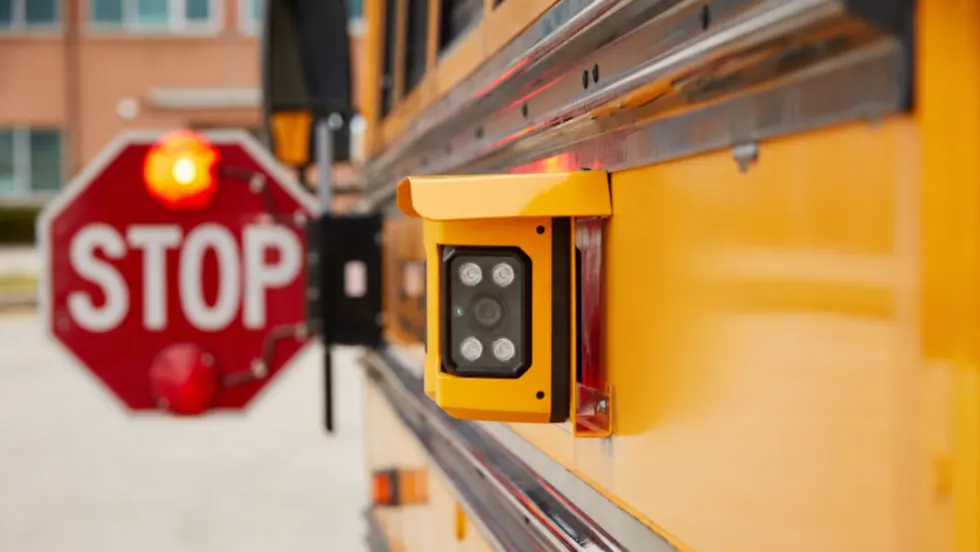
Walton County Schools Adds Gatekeeper Stop-Arm Enforcement System
The Florida district will deploy Gatekeeper’s updated Student Protector technology, which now incorporates AI to improve video evidence.
Read More →