




Dig Deeper: How and When to Buy a Used School Bus
Consider the True Costs of Interstate Travel
The Unified Carrier Registration Board (UCR) affirmed its position in 2017 that a school transportation company must include all school buses in its fleet for purposes of determining UCR fees — even if only one vehicle crosses state lines.
by Maria Battista
October 31, 2018
The Unified Carrier Registration Act of 2005 (49 U.S. Code 14504a), which took effect on Jan. 1, 2007, provides for the UCR Agreement, the UCR Plan, and for a UCR Board of Directors to administer and oversee the UCR program.
Photo: SBF Stock
4 min to read
If you are a for-hire school transportation company that provides some transportation service across state lines, such as bringing students to a school-related activity, be aware of the true costs associated with interstate travel.
The Unified Carrier Registration (UCR) Board affirmed its position in May 2017 that a school transportation company must include all school buses in its fleet for purposes of determining UCR fees — even if only one vehicle crosses state lines.
What Do School Transportation Fleets Need to Know?
For example, if a school transportation company has 105 buses in its fleet with 10 school buses involved in interstate commerce and 95 school buses only involved in intrastate commerce, the company would be required to pay UCR fees for the 105 buses. However, when evaluating what it would cost the company to pay for 105 buses, the fees imposed under the UCR program are determined on a graduating bracket system scale based on the size of the motor carrier fleet (see tables below).
Therefore, in 2018, based on the fleet example of 105 buses, the school transportation company would be required to pay UCR fees in the amount of $6,820, even though only 10 school buses crossed state lines. So, as a for-hire school transportation company, you need to determine if it is worthwhile to do interstate travel that involves one or two school buses considering the cost of UCR registration fees for the entire fleet.
For-hire school transportation carriers across the nation are currently receiving letters from the 41 participating state agencies related to this issue. Many for-hire school transportation carriers are confused as to how this happened when for years such carriers only paid for those school buses that traveled in interstate commerce.
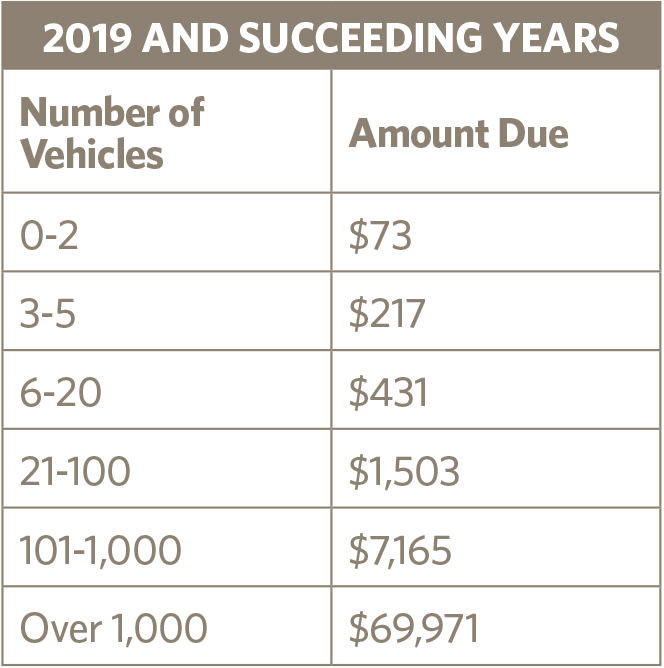
Source: Unified Carrier Registration (UCR)
The Unified Carrier Registration Act of 2005 (49 U.S. Code 14504a), which took effect on Jan. 1, 2007, provides for the UCR Agreement, the UCR Plan, and for a UCR Board of Directors to administer and oversee the UCR program. While the UCR Act provides exemptions for property carriers, it does not exempt passenger motor carriers from the general rule.
Thus, under the UCR Act, effective Jan. 1, 2007, school transportation contractors were not permitted to subtract from their fleet school buses that do not cross state lines. In May 2017, the UCR Board reaffirmed the federal law when it noted that “the Act does not allow for exclusion of vehicles used in the intrastate transportation of passengers” (emphasis added).
The reason for-hire school transportation carriers are only now being made aware of this issue is because the federal law has only recently been enforced by the participating states. Therefore, many school transportation contractors have not been in compliance with the general rule for more than a decade. Yet, an exemption under the law is permitted for intrastate motor carriers that transport property, waste, or recyclables — i.e., trucks.
What can be done? There are only two possible avenues of relief. First, the UCR Board has the authority to provide for an exemption for school buses. In 2017, two requests were made by a law firm on behalf of various school bus companies. In each instance, there were not enough members of the UCR Board in support of an exemption, so the exemption requests were denied.
The second option is to have Congress change the law. Either method to achieve an exemption for school bus contractors is difficult. The disparity is even more glaring when you factor in that public school districts that own their own school buses do not pay for any of their school buses to cross state lines because their vehicles are not “for-hire.”
What can you do as a for-hire school transportation company? Contact your U.S. senator and U.S. representative. Share with them the disparity in the law between for-hire property carriers as compared to for-hire passenger carriers as well as the disparity between public school buses and for-hire private contractor school buses.
Other arguments can be found in a recent comment (see schoolbusfleet.com/Nov18d) submitted to the U.S. Department of Transportation by the National School Transportation Association (NSTA). If you want to support the efforts of NSTA on this important topic, please call the NSTA office at (703) 684-3200 or info@yellowbuses.org.
The more private school bus contractors who support this effort, the greater the chance of a change in the law to bring more parity with property carriers and public school transportation carriers.
Subscribe to Our Newsletter
More Management

How to Build a Better Driver Training Program
Ready to boost up your school bus instructor training? Here’s how to pick the right talent and improve recruitment, retention, and safety.
Read More →
CALSTART and Forth Combine to Form Catalyst Mobility
The new name represents a renewed vision for the nonprofit focused on advancing clean, equitable, and affordable transportation solutions that move people and goods.
Read More →
What Makes a Great School Bus Driver Trainer?
Choosing the right school bus driver trainer takes more than experience. Learn six keys to selecting and developing trainers and evaluating program effectiveness.
Read More →


School Bus Contractors Expand Through New Deals, Acquisitions & Partnerships
STA's Canadian division acquires Ontario-based G&L Stevenson Transport while Durham School Services adds a new district contract in California, First Student adds a New Jersey contract, and Minnesota Coaches acquires Halo Transportation.
Read More →
Logan Bus Company Rolls Out AI Phone System for NYC School Bus Families
A summer pilot found that AI agents could handle most routine calls, freeing up time for customer service staff to focus on emergencies and complex family concerns.
Read More →
From Intent to Impact: What I Learned About Leadership from TAPT
A Texas transportation supervisor shares lessons on self-awareness, accountability, managing stress and building trust — and why investing in leadership development matters at every stage of your career.
Read More →
NAPT Names 2026 Award Recipients, Hall of Fame Inductee
Who earned national recognition for their work in student transportation? This year, NAPT named five recipients of its 2026 awards for service, safety, and leadership, plus its newest Hall of Famer.
Read More →
Sponsored•September 2, 2026
2026 State of Student Transportation Report
Driver shortages. Rising costs. Growing safety expectations. More data, but not enough time to act on it. The 2026 State of Student Transportation Report reveals what transportation leaders say is putting the most pressure on their operations—and where they’re investing next. See how your priorities compare.
Read More →
How to De-Escalate an Angry Person: 5 Steps for Handling Workplace Conflict
What makes emotions run high, and how should you handle an angry colleague or parent? Follow these steps for staying calm, listening, showing empathy, and resolving conflict.
Read More →
Sponsored•September 1, 2026
What Readiness Looks Like This School Year
Learn about the challenges shaping the 2026–2027 school year, from persistent driver shortages and budget pressure to technology and readiness gaps. See how school districts are responding and adapting in Zonar’s 2026 Back-to-School Readiness Report.
Read More →