




California District's Transportation Staff Embraces Change
The 29 employees in Westminster (Calif.) School District’s (WSD) transportation department possess an inherent understanding of what it takes to t...
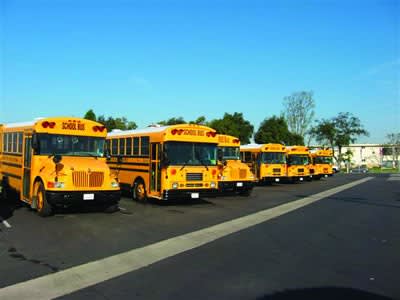
The 29 employees in Westminster (Calif.) School District’s (WSD) transportation department possess an inherent understanding of what it takes to transport children safely to and from school. They have welcomed the transformation the department has undergone over the past several years to provide them with the means to more effectively serve the district’s students and are enthusiastic about future innovations.
“We’re all in this business because we care about the safety and security of the students,” Transportation Supervisor Donna Rivard says.
Rivard has served as the driving force behind many of the department’s changes and has spearheaded practices that have improved its efficiency and productivity, thanks to her strong belief in the motto “Out with the old, in with the new.”
A family affair
Rivard began working at WSD over a decade
ago as a school bus driver. She became
a certified behind-the-wheel trainer in 2002
and applied for the transportation supervisor
position shortly thereafter.
When Rivard became transportation supervisor, the department’s driver trainer position was eliminated, causing her to wear many hats — she not only served as transportation supervisor and driver trainer, but as cover driver and dispatcher as well. She says she juggled these roles for three years but ultimately realized that she needed help and pushed to have additional staff hired.
Luanne Duus, school bus driver and driver trainer, was hired a year and a half ago to lighten Rivard’s load.
Like many of her bus drivers, Rivard grew up in the Westminster area (she attended WSD schools), which she says has helped foster a spirit of community within the department.
“I practice an open-door policy,” Rivard says. “The staff knows they can come to me whenever they have a problem or need help with something. We’re like a family.”
Dedication to students, fellow
pupil transporters
This sense of family is an asset to
the department, as it has bolstered the
staff’s ability to work as a unit to provide
the best service possible to WSD’s
students and to form a good rapport
with students and parents.
For instance, the district transports 15 students to and from school under the McKinney-Vento Homeless Assistance Act, and Rivard expects this number to increase in the near future.
To make certain that homeless students receive the same educational rights as their peers, the act requires that school districts provide service to these children even if their place of residence changes. Rivard says this occurs frequently with these students. (The drivers pick up the students from their place of residence or at a nearby bus stop.)
While keeping tabs on their living arrangements can be difficult, the department’s staff readily accommodates these students’ needs and has taken an active role in ensuring their wellbeing.
“I’ve heard very sad stories from these kids,” Rivard says. “It’s hard to listen, but we’re not going to turn them away.”
The department provides service to more than 250 regular-ed students and 280 special-needs students on 16 routes throughout the school year. The 16 regular bus drivers and two substitute drivers transport regular- and special-ed students together to offer the least-restrictive environment possible for the students with special needs. They also transport students for summer school.
In addition, like other districts in the area, WSD has made a mutual agreement with the Orange County Department of Education wherein it has committed to helping other districts transport students so that they do not have to contract out to vendors and can, therefore, save money. If, for example, a district has to transport students to a large event and it does not have enough buses, WSD will send its drivers and buses to the district to provide aid.
WSD’s fleet is composed of 17 school buses and 30 white fleet vehicles. All of the district’s school buses are equipped with SafeGuard seats, and eight buses are equipped with wheelchair lifts.
{+PAGEBREAK+}
Improved communication with
the special-ed department
Many of the students that WSD transports
have special needs, and Rivard says that one of her biggest challenges
is working with the students’ parents.
Soon after taking the position, Rivard began to notice that some parents expected someone from the department to call and let them know that the drivers were on their way to drop off the children; otherwise, the parents would not be home or waiting outside for the bus when it arrived. “The parents depended on us a bit too much in that respect,” Rivard says, “and it created a lot of confusion and extra work for us.”
To remedy this problem, Rivard began having the drivers take the students back to school if the parents were not outside waiting for the bus. She says this practice has helped to improve communication between the transportation department and the special-ed department because officials at the special-ed department are now held accountable for the whereabouts of students if they have to be brought back to school.
Rivard says the practice has also forced the district’s schools to update their student contact information more frequently.
The increased level of communication between WSD’s transportation and special-ed departments is part of Rivard’s overall mission to get everyone within the district on board with the transportation staff’s goals and to help district administrators recognize the essential role transportation plays in the students’ education.
Another of Rivard’s challenges stems from parents requesting that the transportation department provide a one-on- one aide for their child. Rivard approaches these types of situations with a fair but practical attitude.
“I’m usually willing to give things a chance, and I don’t say ‘no’ very often,” she says. “My feeling is that if the special-education department can provide a one-on-one aide, we can assign him or her to a student and see how it works out.”
Rivard says a tight budget prevents the transportation department from providing an aide for each special-needs student. The department employs eight student transportation aides and three substitute aides. One of Rivard’s ultimate goals is to hire an aide for each bus, but she put this plan on hold last year due to budget cuts.
Innovative practices for
special-needs training
Working with the special-needs students
themselves is a challenge for the
department. Many of the students are
autistic, so she is providing more training
for the bus drivers and bus aides so
that they can better understand how to
work with these students.
Rivard is utilizing the knowledge of the district’s psychologists, nurses and teachers to offer this training for her staff. “Each school has a psychologist on staff, and I am finding that they have the training and a wealth of information,” she says. “Also, of course, the teachers are highly trained in these areas. If I have any questions, I go there. The district’s special-ed department has resources as well, and they often send me in the right direction.”
Rivard plans to work on recruiting outside specialists for more training in the future.
One of the most valuable pieces of information Rivard and her staff have learned from the additional training is that autistic children generally learn better visually (as opposed to verbally), and WSD’s schools use laminated cards with pictures on them to help teach these students. The cards depict happy faces as well as images to convey such instructions as “sit down” and “no talking.”
The transportation department was given a set of these cards and hopes to be able to distribute them throughout its buses to assist the aides and drivers in working and communicating with the students.
Additionally, Duus has enhanced the school bus drivers’ skills by getting them involved in school bus roadeos. Rivard says Duus regularly competes in roadeos, and in February 2008, she encouraged the drivers to participate in a special-needs roadeo at the department’s facility.
Emergency preparedness is a
key priority
Traditional training for her school
bus drivers is of equal importance to Rivard.
WSD’s drivers often receive much
more than their required 10 hours of
in-service training, and the staff holds
safety meetings twice a month.
Rivard says she also recruits people to speak to the drivers on specialized topics. She had a school nurse from the district come in to train the drivers on how to handle seizures, and she had local SWAT team members come in to train on emergency evacuation procedures.
Moreover, in March 2008, the drivers participated in a partial evacuation drill of special-needs buses at one of the district’s schools. In May, the department plans to participate in a full-scale intruder response drill that will be held at one of the district’s schools, with local fire, SWAT and police officials participating.
The transportation staff’s participation in the drills is one of the requirements it has had to fulfill since WSD received a federal emergency preparedness grant several years ago.
Rivard included two requests while she and other district staff were applying for the grant: funding for a GPS system so that she could track her buses in the event of an emergency, and the means for emergency responders or law enforcement officials traveling via helicopter to identify her buses.
Her reasoning behind the second request was that if one of the district’s buses was hijacked and helicopters were trying to track it from the air, they would have a difficult time distinguishing it from other school buses on the road.
Rivard’s requests were met. District and bus number information (WSD4, for example) is now painted on the roof of each bus, making them identifiable from the air.
Furthermore, the WSD transportation staff uses Zonar Systems’ GPS technology to track the buses while they are en route and is currently receiving training on Transfinder Corp.’s routing software.
Bus, facility upgrades
Rivard recognizes that operating
well-maintained and environmentally-friendly
buses is another component of
providing a safe ride for the bus drivers
and students as they travel to and
from school. A bus wash system was
installed at the facility in 2002, and each
bus is detailed every summer.
Moreover, WSD was recently awarded a grant from the South Coast Air Quality Management District (AQMD) for three compressed natural gas buses and funding to install a refueling station at the facility. WSD has also received funding to retrofit 10 buses with diesel particulate filters.
However, in December, Rivard received a notice from South Coast AQMD officials indicating that funding for school bus replacement and retrofit projects would be delayed until further notice, due to the state’s budget crisis.
The letter went on to say that the South Coast AQMD would notify WSD when the state can proceed with the distribution of funds for these projects.
Ensuring the security of the department’s employees and equipment inside the transportation facility is another priority for Rivard. Security gates have been installed around the facility, and she has implemented a policy that requires the drivers to bring in the bus keys and lock the buses whenever they are not in use.
“We’re also planning to use money from Measure O [a bond that passed in the November election] to have security cameras installed in our facility,” Rivard says.
More Special Needs Transportation
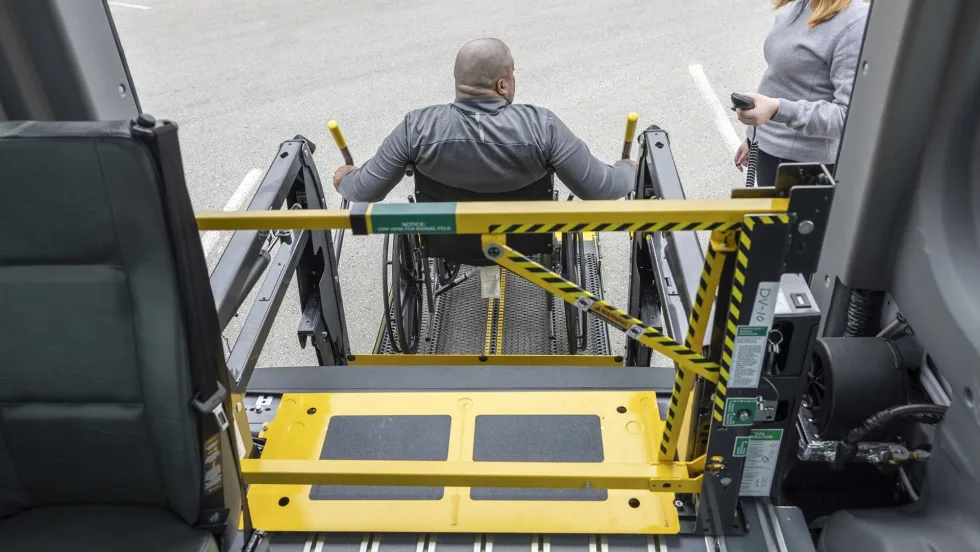
BraunAbility Introduces New Safety Barrier for Wheelchair Lifts
LiftSentinel is designed to add another layer of protection during wheelchair loading and unloading and can be retrofitted to many existing commercial lift installations.
Read More →
HopSkipDrive Launches New Safety, Driver Consistency Features for 2026-27 School Year
The company’s free ride recording, live ride tracking, and consistent driver assignments aim to improve safety and continuity for diverse student transportation needs.
Read More →
The Most Common Wheelchair Securement Mistakes on School Buses (and How to Fix Them)
Small missteps in wheelchair securement can have serious consequences. Here are 32 tips from experts to reduce risk and increase student safety on the bus.
Read More →
Inside AMF Bruns’ New Showroom: School Bus Securement Solutions Explained
Go inside AMF Bruns America’s new Ohio showroom with Maritza Valentin to see its FutureSafe technology, driver training tools, securement systems, and seating innovations.
Read More →
What AMF Bruns’ New Facility Means for Customers [Video]
Inside AMF Bruns’ new Stow, Ohio, operations: See how expanded space and innovation will enhance customer support and operations.
Read More →
AMF Bruns Expands in Ohio, Investing in Growth and Community
With expanded production space, local investment, and a growing workforce, AMF Bruns is scaling its U.S. presence. Here’s an exclusive first look inside the new Stow, Ohio, HQ.
Read More →
Inside AMF Bruns of America’s New Ohio Manufacturing Facility [Photos]
Take a behind-the-scenes look at AMF Bruns of America’s new 41,000-square-foot Stow, Ohio, headquarters, featuring advanced manufacturing, expanded space, and future-ready mobility solutions.
Read More →
First Student Boosts Student Support in Wichita & Texas
First Student and Wichita Public Schools are using behavioral support strategies to improve student ride experiences, while a separate initiative expands access to after-school programs through a bus donation.
Read More →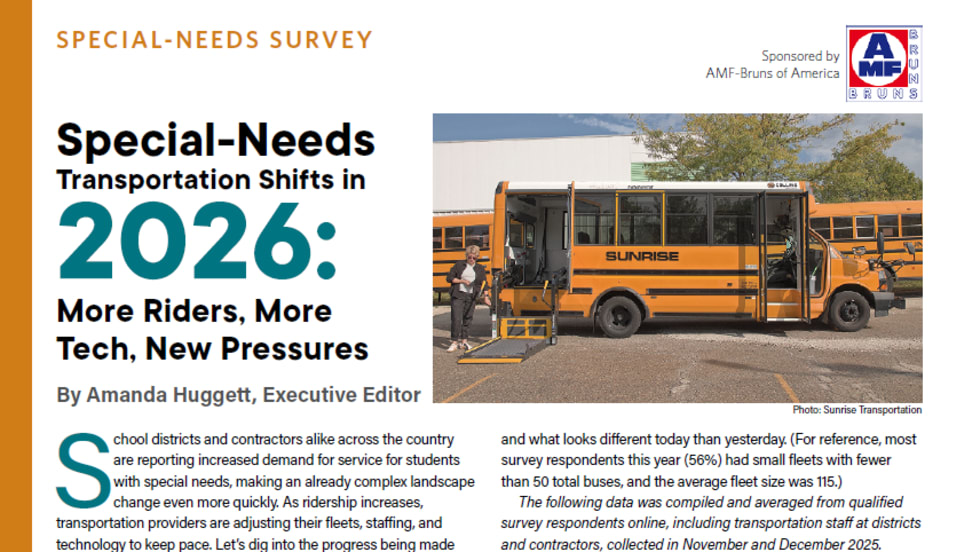
2026 Special-Needs Transportation Survey
What’s changing in special-needs transportation? This year, student transportation operators report a rising need, easing driver shortages, growing tech adoption, and evolving challenges. Sponsored by AMF Bruns of America.
Read More →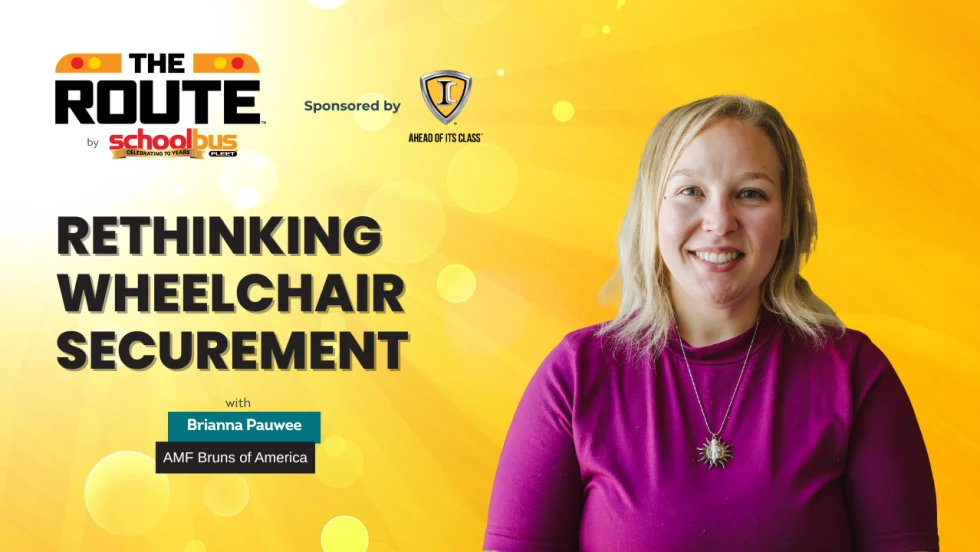
The Lived-Experience Gap in Mobility Tech: An Expert Take on Safe Student Transportation
Brianna Pauwee, a product application specialist at AMF Bruns of America and a wheelchair user, drops in to The Route to share practical securement and training insights, plus the story behind the new “Beyond Mobility” podcast. The Route is sponsored by IC Bus.
Read More →