




Best Practices in Parts Procurement
Thanks to the Internet, consumers can buy virtually anything from the comfort of their desks with a few mouse clicks and keystrokes; no human interact...

Heavy Duty Bus Parts recently expanded its warehouse by 8,500 square feet to increase its seat cover and seat foam manufacturing operation.
Thanks to the Internet, consumers can buy virtually anything from the comfort of their desks with a few mouse clicks and keystrokes; no human interaction required.
Companies of all kinds are going online in a race to capture the ever-growing market of Web shoppers.
In light of these trends, the school bus parts industry may seem at first glance to be behind the times. The parts ordering process has changed very little over the years, and most transactions are still being conducted over the phone rather than through the Internet.
But it’s not because these companies are lacking technological savvy; they all have Websites and most have online ordering capability. Phone ordering is the method of choice for school bus operators and technicians, and companies want to stick with what works best for them. The companies have, however, implemented other improvements in their operations for more efficient, accurate and speedy order processing and shipment.
The following discussion involves independent parts distributors rather than bus and chassis manufacturers and dealers, which, of course, offer sophisticated parts-fulfillment capabilities.
That personal touch
Unity School Bus Parts of Marine City, Mich., receives more than 95 percent of its orders by phone, and has been doing so for the past 22 years. The company’s Website has an online ordering feature, but many school bus garages have restricted Internet access or no access at all.
Ed Mastry, Unity’s president and owner, says that even with the Internet, school bus technicians seem to prefer the phone.
“I’m finding that a lot of our technicians are still ‘old school’ and want that parts catalog in front of them,” Mastry says. “The phone just seems to be a better vehicle for communication. It’s that personal touch.”
Larry Brown, president of School Bus Parts in Plumsteadville, Pa., agrees. “Customers generally tend to like speaking to people,” he says. “E-mail or Websites are very impersonal, and they don’t always work the way you want. When you speak to someone directly, you get the answer right away and know what’s going on. It’s a lot more personal, and this is a personal business, really.”
Having experienced and knowledgeable salespeople taking calls is a main reason why phone orders are so effective. Many of the customer service representatives who have been in the business for years are experienced in taking these calls and, most importantly, are trained to ask the right questions to fill gaps or correct mistakes in the order.
A common mistake technicians or operators will make when ordering is giving the wrong part number. This might happen because they assume that one part is universal to all makes and chassis. Other times an employee unfamiliar with parts might phone in the order for the technician and the right information might get lost in translation.
To reduce errors, Shelle Johnson, inside sales manager at Bus Parts Warehouse in Manlius, N.Y., recommends having as much information on hand when ordering and making it clear when you’re not sure of something. That way, the sales representative can ask the right questions to zero in on the correct part. “Employees get a lot of technical training to cut down on returns,” Johnson says. She also encourages customers to have the parts catalog on hand when ordering so that both customers and sales reps can make sure they are literally on the same page.
Inventory offers depth
The parts company service reps are also reliable resources in your search for out-of-stock or hard-to-find parts. Because many of the non-OEM parts companies have been selling parts for different makes and models of buses for decades, they will often have the older parts on hand.
“We have stock that goes back into the 1960s, and we have knowledge of what they used back then,” says Brown of School Bus Parts.
If they don’t have the parts available, company reps can probably refer you to a bus manufacturer or even a competing parts company that has the part in stock.
“We’re in a very tight-knit industry, and almost everyone shares the same passion for safe pupil transportation,” says Brandon Billingsley, vice president of Willis, Texas-based Heavy Duty Bus Parts. “Most everyone is willing to help out; we speak with our competitors on a consistent basis, locating parts for one another.” He also recommends going to the Professional Garage section of SCHOOL BUS FLEET’s online forum to find and share parts information with pupil transportation peers around the country.
Internet offers benefits
According to Billingsley, Heavy Duty’s online catalog has served as a useful extension of its hard-copy catalog. “They work together along with the salesperson and technician for added product information and complement one another to facilitate a more informed decision,” he says.
While the catalog comes out every so often, the company is able to update the online listings regularly so that customers can find the most current information and detailed images. It also has plans to include videos of installations, PDFs of instruction manuals and virtual tours of different buses and their parts on its Website.
Johnson of Bus Parts Warehouse anticipates that online ordering will become more common with the next generation of technicians. “We’re hoping that in the future, as old mechanics retire and new mechanics come in, the online ordering system will be much more valuable than it is now,” she says.
Efficiency on the rise
Companies have been making improvements that ultimately lead to faster and more efficient delivery of parts to school bus garages.
Bus Parts Warehouse had an outside consultant reorganize the inventory setup and shipping area of its warehouse to maximize efficiency in the order-filling process.
Unity School Bus Parts added a third method of shipping — using a trucking company — to reduce delivery costs. Mastry has found that it is sometimes cheaper to ship bulkier items by truck than to ship by regular ground transportation such as FedEx or UPS.
Heavy Duty Bus Parts recently expanded its warehouse by 8,500 square feet to increase its seat cover and seat foam manufacturing operation. “Manufacturing these items in-house allows us to carry inventory in the form of raw goods, which can go into production to replace finished goods on the shelf where needed,” Billingsley explains.
Having a lot of inventory on hand has become more critical in serving garages because of school districts’ trend toward reducing inventory and ordering on a just-in-time basis. Parts company representatives agree that this has become the norm due to budget crunches.
“Fleet garages tie up less operating capital in the way of parts on the shelf and are less likely to end up writing off obsolete parts,” Billingsley observes. “In order for just-in-time to work, OEM and aftermarket parts distributors must carry more on-hand inventory. This can be used to the distributor’s advantage through volume purchasing, which helps reduce unit cost.”
Not only do parts companies need more parts on hand to support garages, but they also need the right inventory. This can be achieved by analyzing order history reports, especially on products with seasonal demand, according to Billingsley. For example, he has found that lights, lenses and mirrors are more consumable in early fall while heater motors and cores are popular in the winter.
“Responding to these purchasing patterns, distributors can cut expenses by reducing their inventory carrying cost and still meet their customers’ needs in a timely manner,” Billingsley says.
Joan Shim is a freelance writer in Tustin, Calif.
More Maintenance
The Essential Guide to School Bus Maintenance and Student Safety
Your district's buses carry students to school every day. This guide shows how predictive maintenance powered by fleet data helps keep buses reliable, drivers accountable and students safer from the first bell to the last stop.
Read More →
Kerry Brothers Grows Michigan School Bus Repair Network
The acquisition of Downriver Truck and Bus expands Kerry Brothers’ school bus maintenance footprint across southeast Michigan, adding repair capacity, diagnostic resources, and state inspection support.
Read More →
Noregon Introduces CAN Bus Diagnostic Tool, Expands JPRO Features
CAN Mentor and the latest JPRO update aim to simplify vehicle network diagnostics and improve repair efficiency for technicians of all experience levels.
Read More →
Cummins on Smarter, Simpler Engine Innovation
Cummins discusses its first-ever gasoline engine for school buses, EPA 2027, and why bus fleets still want durable, simpler internal combustion options.
Read More →
Report: 72% of Diesel School Buses Now Use Advanced Low-Emission Engines
New data shows advanced low-emission diesel technology continues expanding across school bus fleets, even as electric bus adoption gains momentum.
Read More →
Vampire Tools' CAIMAN 7.5-Inch Multi-Purpose Screw Extractor Long-Nose Pliers with Crimper
Vampire Tools introduced the VAMPLIERS Caiman 7.5-inch multi-purpose pliers, combining screw extraction, cutting, crimping, and gripping functions into a single tool designed for fleet maintenance professionals.
Read More →
How Advanced Diagnostics Helps Bus Fleets Stay Ahead of Repairs
Chat with Noregon’s Kevin Smallhorn at ACT Expo about bus diagnostic tools, telematics integration, CNG maintenance support, and strategies to help reduce downtime and improve uptime.
Read More →
How School Bus Fleets are Getting Ahead of Breakdowns
Don’t let bus downtime wear you down. Here’s how bus operators are shifting from manual processes to AI-powered, data-driven maintenance systems for improved reliability and safety.
Read More →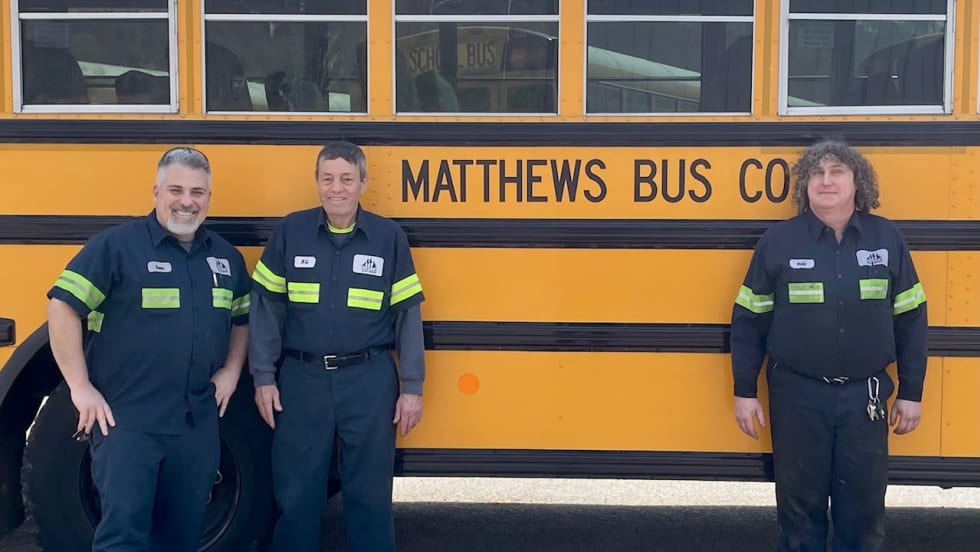
Pennsylvania School Bus Maintenance Team Praised for Dedication to Safety
Matthews Bus Company’s West Jefferson received a letter of commendation from the Pennsylvania State Police for their fleet inspections.
Read More →
From Chaos to Clarity: How School Districts Are Running Leaner Transportation Operations
Covering 38 routes on a Friday afternoon. Buses idling while routes overlap. Parents calling nonstop about late arrivals. Sound familiar? This whitepaper explores how district transportation leaders solved these exact problems — and what measurable results followed.
Read More →