




Behavior Support Program Bolsters Bus Environment, Relationships
Oregon district staff members help adapt Positive Behavioral Interventions and Supports to the school bus. Incidents decline, and relationships strengthen between school staff and drivers as well as drivers and students.

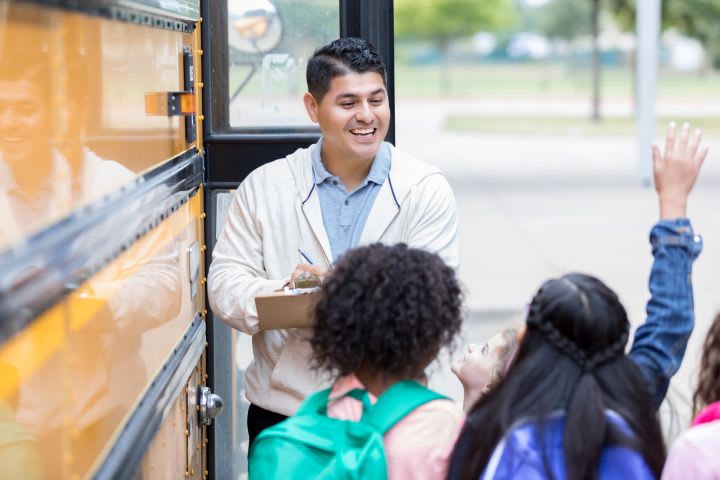
Not all PBIS principles carry over from the classroom to the school bus. A pilot project in Oregon sought to change that.
Getty Images/asiseeit
Improving student behavior on the school bus can be a challenging task, but by using different applications of Positive Behavioral Interventions and Supports (PBIS) in a pilot, a Salem, Oregon, school district and its transportation department did just that and enhanced relationships as well.
PBIS Basics
PBIS, which emphasizes recognizing desired rather than problematic behavior, has provided useful tools to improve the classroom environment. It is applied using three tiers: I, II, and III.
Tier I often covers about 80% of students, those who don’t typically demonstrate significant behavior issues. This tier provides the foundation for a positive, supportive climate for the students.
Tiers II and III are additional interventions for students who need more behavior support. These tiers rely on functional behavior assessment to identify the student’s needs and the type of intervention that will support them. Both result in the development of a behavior intervention plan.
Tier II interventions are for students who need a little support and can benefit from standard interventions that will be beneficial for multiple students, explains Teri Lewis, a consultant for Salem-Keizer Public Schools who helped coordinate the PBIS pilot for school buses. Tier III involves intensive interventions for students who have complex and unique needs.
The difference between Tiers II and III is the intensity of the assessment and resulting intervention, Lewis adds.
When Salem-Keizer Public Schools implemented PBIS in its schools, Michael Shields, the director of transportation and auxiliary services for the district, asked for his department to be included in the training. He was impressed with the difference the program made at the school.
“Kids walking down the hallway were quiet, lined up, respectful,” he says. “The behavior was markedly different. We want to see that translate to the buses.”
However, some core PBIS practices for monitoring behavior, such as observing students and walking around the classroom, and talking to students privately about negative behavior, are difficult to bring to the bus.
That was noted by one of Shields’ staff members who attended the district’s PBIS training. Although the information was valuable, he told Shields, the techniques were not applicable to the school bus.
Shields then asked a team of three school staff members, who are knowledgeable in PBIS and support the transportation department’s implementation of the program, to ride some buses so they could see the differences in the bus and the classroom environments, and advise on how some PBIS strategies could work on the school bus.
“For example, when you want to talk with a student by themselves, so they’re not embarrassed, where do you do that on a school bus?” Shields asks.
Michelle Massar, one of the PBIS coaches who worked on the pilot, contends that PBIS research and practice is often taken from the school and adapted for the bus without much consideration for what it means for drivers.
The PBIS team members each rode three different routes, carrying elementary, middle, and high school students, to get a sense of the issues drivers face every day and their options, Lewis says.
“We looked at it as our opportunity to learn from the people who are doing the job,” she adds.
Adapting to the School Bus
The coaches saw firsthand the differences between a classroom with 30 students versus a school bus with 70 kids, and the resulting challenges and limitations drivers have with behavior management, Massar says.
“There’s a lot of noise and movement [on the bus]: hands flying around, and kids turning around in their seats,” Lewis says. “Just minor problem behaviors, but the driver can’t use proximity and movement and a lot of the things we use in a classroom to manage behavior.”
The PBIS team noticed that the main difference between applying PBIS in a classroom and on the bus is that in a classroom, the teacher’s main focus is what the students are doing. On a bus, the driver’s main focus is the road, says Charisse Elliott, one of the PBIS coaches.
“Some of PBIS can be tweaked [for] the bus, but it’s a different setting, so it has to have its own practices,” she adds.
Elliott says that one PBIS classroom management strategy is active supervision — stop, look, and wander around — to decrease problem behavior. That’s hard to do on a school bus when you also have to drive, she notes. However, active supervision can be applied when students load and unload the bus to decrease problem behavior.
To boost her interaction with students, one bus driver asked them a “question of the day.” As they were unloading, students told her their guesses for the answer. Sometimes the questions were about her, so they got to know her through the game. Another question was about trains, since she knew that one student on the bus liked them. That gave him a chance to get attention from his peers in a positive way, Elliott says.
Another challenge drivers have is line of sight. High seat backs can prevent them from seeing many of the students, whereas in the classroom, teachers can usually see what every student is doing. To solve that problem, one school worked with the transportation department on assigned seating for students, placing those who got along together.
A bigger challenge is adapting consequences. It is difficult to give those on the bus while driving, so drivers “have to go to the positive side to build relationships,” Elliott says.
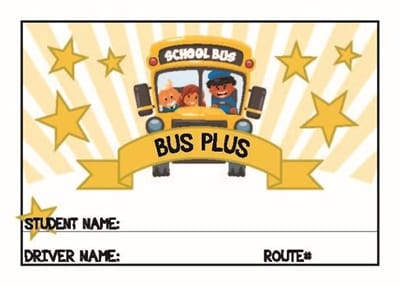
As extra incentive for students to improve their behavior on the bus, one Bus Plus ticket is worth twice as much as the tickets students earn in school.
The Pilot
The transportation department and the PBIS team developed a PBIS program specifically for the school bus, and connected with a school struggling with some behavior issues on its buses and the district’s behavior specialist to conduct a pilot.
The pilot ran for about four weeks in spring 2018 with Tier I on two buses at the school, and expanded to include Tier II. Two drivers took part.
For Tier I, the transportation department and PBIS team created “Bus Plus” tickets for the drivers to give students when they followed what the department and PBIS team established as the bus values: be respectful, be safe, and be kind. For example, if a student stays in their seat during the ride when they normally don’t, the drivers can give them a Bus Plus ticket. The student can submit it to a school drawing for a prize. Students are encouraged to suggest prize ideas that focus on activities and building relationships, such as extra recess time or lunch with a favorite staff member.
The PBIS team and transportation department designed a “Ride Card” for Tier II, giving extra feedback on students’ behavior and increasing communication as it circulates between the school, driver, and home. (Only five students were identified as needing the ride card.) Feedback is offered in the form of a zero-to-two scale for the values of respect, safety, and kindness. The bus driver circles the numbers in those categories for the a.m. and the p.m. rides. At school, the card then goes to the behavior specialist, who talks to the student about their progress.
“As students get frequent feedback, they adapt and change their behavior, rather than [us] approaching it with all these consequences,” Elliott says. “You are teaching students the right behavior.”
The district will expand the pilot for the 2018-19 school year to three to five schools. The team has created a handbook for Tier I and II and will train drivers in August on PBIS for the bus.
Each school gives out incentive tickets based on different values, such as being safe, showing respect, and making good decisions. That meant some bus drivers initially had five different packets of tickets to distribute to students. Shields and the team worked with schools to integrate Bus Plus tickets into their rewards system, so that they will replace all school tickets awarded on the bus.
As extra incentive for students to improve their behavior on the bus, one Bus Plus ticket is worth twice as much as the tickets students earn in school.
Better Behavior, Relationships
After the pilot, the two drivers reported that the students’ behavior improved, they felt like they had better management tools, and the bus ride in general got better, Lewis says.
Drivers also said that students were excited to get the Bus Plus tickets and Ride Cards, and that they liked handing them out.
One of the unanticipated benefits of the pilot has been strengthening the relationships between the drivers and the other school staff members.
The bus driver’s feedback on student behavior not only helps build the relationship between the student and the driver, but the driver and school staff as well, because they are communicating on how the student is doing.
A partnership between the schools and the transportation department is a must for a successful PBIS program, Massar says.
“It gives schools a broader perspective of the challenges that bus drivers have with managing student behavior, and how they can partner so students see the value of the bus environment,” she adds.
A couple schools have invited bus drivers to their trainings, and some have also included drivers in PBIS ticket drawings every Friday to announce the names of students who win prizes.
The transportation department wants to introduce PBIS to more drivers so they understand that being positive in student interactions will reduce negative behavior, and can affect students’ lives in a meaningful way, Shields adds.
A letter from a middle school student to her bus driver illustrated that. She wrote that he was her favorite bus driver because he took the time to remember the name of each student and because of his response when students acted out.
“The next day, when they walk onto the bus, you still greet them with a smile. Even if they are complete jerks to you,” she added in the letter.
“He was demonstrating to them that he cared,” Shields says. “PBIS [can] infuse into kids’ lives that kind approach, so when you have to have that tough conversation, it’s more likely that the student is going to hear you.”
More Management

How to Build a Better Driver Training Program
Ready to boost up your school bus instructor training? Here’s how to pick the right talent and improve recruitment, retention, and safety.
Read More →
CALSTART and Forth Combine to Form Catalyst Mobility
The new name represents a renewed vision for the nonprofit focused on advancing clean, equitable, and affordable transportation solutions that move people and goods.
Read More →
What Makes a Great School Bus Driver Trainer?
Choosing the right school bus driver trainer takes more than experience. Learn six keys to selecting and developing trainers and evaluating program effectiveness.
Read More →

School Bus Contractors Expand Through New Deals, Acquisitions & Partnerships
STA's Canadian division acquires Ontario-based G&L Stevenson Transport while Durham School Services adds a new district contract in California, First Student adds a New Jersey contract, and Minnesota Coaches acquires Halo Transportation.
Read More →
Logan Bus Company Rolls Out AI Phone System for NYC School Bus Families
A summer pilot found that AI agents could handle most routine calls, freeing up time for customer service staff to focus on emergencies and complex family concerns.
Read More →
From Intent to Impact: What I Learned About Leadership from TAPT
A Texas transportation supervisor shares lessons on self-awareness, accountability, managing stress and building trust — and why investing in leadership development matters at every stage of your career.
Read More →
NAPT Names 2026 Award Recipients, Hall of Fame Inductee
Who earned national recognition for their work in student transportation? This year, NAPT named five recipients of its 2026 awards for service, safety, and leadership, plus its newest Hall of Famer.
Read More →
2026 State of Student Transportation Report
Driver shortages. Rising costs. Growing safety expectations. More data, but not enough time to act on it. The 2026 State of Student Transportation Report reveals what transportation leaders say is putting the most pressure on their operations—and where they’re investing next. See how your priorities compare.
Read More →
How to De-Escalate an Angry Person: 5 Steps for Handling Workplace Conflict
What makes emotions run high, and how should you handle an angry colleague or parent? Follow these steps for staying calm, listening, showing empathy, and resolving conflict.
Read More →
What Readiness Looks Like This School Year
Learn about the challenges shaping the 2026–2027 school year, from persistent driver shortages and budget pressure to technology and readiness gaps. See how school districts are responding and adapting in Zonar’s 2026 Back-to-School Readiness Report.
Read More →