




Related - Message Received: Best Practices for Effective Radio Communication
Assessment Tool Helps Hire Top-Notch Dispatchers
Designed to determine a candidate’s knowledge of technology that is increasingly being used in dispatching, the tool includes tests on familiarity with web-based and software programs, typing and proofreading, and using office equipment for basic, everyday tasks.
by Stuart Vogelman
May 4, 20205 min to read

Photo by sturti via iStock Getty Images
How does a school district hire the best-qualified candidates as dispatchers in our world of rapidly changing technology?
Dispatcher skills for tomorrow are not the same as they were even five years ago. The necessary skills for dispatch work today are shifting from memory; paper and pencil record keeping; and seat-of-the-pants judgments and practices, to knowledge of integrated, online, technology-based, and cloud-based documentation, which is shared among department staff and pushed out to key administrators as needed in real time. The capability to share operational information in real time is a major game-changer.
This shift, which is causing dispatchers to take a different approach to transportation management, takes time, planning, and training.
Here, I have outlined an assessment tool that can help ascertain skill levels and acuity in areas important for today’s and tomorrow’s school transportation dispatchers during the hiring process. We used this tool to hire a new dispatcher recently, and it provided a clear picture of which candidate had appropriate skills for the job.
Assessment Tool
Acumen for the skills of a future-oriented dispatcher candidate can be evaluated without too much effort in the hiring process. This assessment tool can be used as one component in the hiring process to help rank candidates. (Keep in mind that the process needs to be thought through and implemented carefully with management support.)
Various methods can be used, but a combination of online and written assessment content has worked well for me. The candidates sit at a predetermined and configured desktop computer. It can be any workstation where icons are in the middle of the screen and there is printer access.
The assessment includes several components, such as questions that test familiarity with web-based and software programs, tests of typing and proofreading skills, and using office equipment for basic everyday tasks. All sections are timed and scored.
A packet for the candidate provides an overview of the assessment and step-by-step instructions. The assessment includes the following skill sets areas:
Online questionnaire: This questionnaire is administered in the form of a desktop link to a Google Sheets web input form designed to assess the candidate’s ability to use various online tools such as Google Maps and web-based tools like routing software.
Activity 1: This section links the candidate to an online typing test that provides a score by which candidates can be compared. The candidate must record the score in a specific format and save in a specific place; this assesses the candidate’s computer skills. I recommend a free test, such as typingtest.com.
Activity 2: This task asks the candidate to use office equipment in ways typically used in transportation. For example, ask a candidate to make a copy of a document and scan it to a specific email address.
Activity 3: This component involves the candidate reading several paragraphs of a document. It is plagued with several spelling errors. The candidate must mark all errors. This evaluates their ability to quickly review and proofread a document.
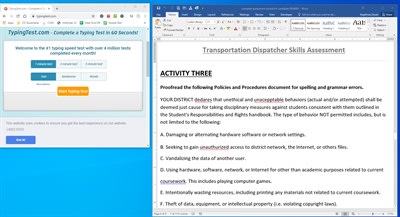
Assessment tool activities 1 and 3 test the dispatcher candidate’s typing and proofreading skills. Screenshot courtesy Stuart Vogelman
Activity 4: To assess the candidate’s understanding of department software programs and processes, the candidate is asked some simple questions about the basic functions of the primary programs we use.
Activity 5: Ask the candidate to build a simple Excel three-by-three matrix with numbers and to use the Autosum function to get the total. This is essential to determine whether the candidate has basic knowledge of spreadsheets, which are often used in transportation operations and in Google Sheets.
Activity 6: This final activity presents the candidate with a common transportation dispatch scenario. They must write out how they think they would respond. Their response offers unique perspective on how the candidate handles problem solving, stress, and prioritizing within a transportation environment.
If needed, the entire assessment can be done on paper except for the typing test. However, having part of the test in an online format also provides an opportunity for the department to assess a candidate’s comfort with the online component. This can be an early indicator in the assessment process. Some of the questions must be modified to a specific district’s situation, including mapping software, weather, laws, and department processes.
Evaluation
After the candidate completes the assessment, tabulate the scores for each component and place it in a spreadsheet with graphics-supporting results. The graphics provide comparative scores in each section by candidate. While this should not be the only component used in the hiring process, it does provide a highly valuable and very visible comparison of candidates in key areas for mandatory performance indicators.
It is important to note that each district will have to tune some of the questions to its own procedures, terrain, weather, software, and other factors. The specific scoring methodology is not the critical part; being consistent when scoring candidates is essential.
Helping Hiring Decisions
This approach to hiring skilled dispatchers proved highly valuable to us; it helped us clearly, confidently, and justifiably make the best hire for the position. This quantified data is also valuable if there are questions about the hiring decision later.
At the end of the day, if a transportation department is moving to more electronic systems, assessing dispatcher candidates appropriately is vital. It is not productive to hire individuals that do not possess the skill sets needed to work in ways consistent with where transportation operations are going. Often the biggest challenge to ensuring that a new hire has the requisite skills is the understaffed, busy nature of school transportation work, and finding a staff member with the time and skills to make this assessment.
For a copy of the documents that serve as a guide for this process, email stuvogelman@gmail.com.
Stuart Vogelman is a dispatcher for a school district in eastern Washington. He has also worked as an emergency management systems dispatcher, motorcoach and school bus driver, senior executive, international business consultant, pastor, and chaplain for a state police agency.
Subscribe to Our Newsletter
More Management

How to Build a Better Driver Training Program
Ready to boost up your school bus instructor training? Here’s how to pick the right talent and improve recruitment, retention, and safety.
Read More →
CALSTART and Forth Combine to Form Catalyst Mobility
The new name represents a renewed vision for the nonprofit focused on advancing clean, equitable, and affordable transportation solutions that move people and goods.
Read More →
What Makes a Great School Bus Driver Trainer?
Choosing the right school bus driver trainer takes more than experience. Learn six keys to selecting and developing trainers and evaluating program effectiveness.
Read More →


School Bus Contractors Expand Through New Deals, Acquisitions & Partnerships
STA's Canadian division acquires Ontario-based G&L Stevenson Transport while Durham School Services adds a new district contract in California, First Student adds a New Jersey contract, and Minnesota Coaches acquires Halo Transportation.
Read More →
Logan Bus Company Rolls Out AI Phone System for NYC School Bus Families
A summer pilot found that AI agents could handle most routine calls, freeing up time for customer service staff to focus on emergencies and complex family concerns.
Read More →
From Intent to Impact: What I Learned About Leadership from TAPT
A Texas transportation supervisor shares lessons on self-awareness, accountability, managing stress and building trust — and why investing in leadership development matters at every stage of your career.
Read More →
NAPT Names 2026 Award Recipients, Hall of Fame Inductee
Who earned national recognition for their work in student transportation? This year, NAPT named five recipients of its 2026 awards for service, safety, and leadership, plus its newest Hall of Famer.
Read More →
Sponsored•September 2, 2026
2026 State of Student Transportation Report
Driver shortages. Rising costs. Growing safety expectations. More data, but not enough time to act on it. The 2026 State of Student Transportation Report reveals what transportation leaders say is putting the most pressure on their operations—and where they’re investing next. See how your priorities compare.
Read More →
How to De-Escalate an Angry Person: 5 Steps for Handling Workplace Conflict
What makes emotions run high, and how should you handle an angry colleague or parent? Follow these steps for staying calm, listening, showing empathy, and resolving conflict.
Read More →
Sponsored•September 1, 2026
What Readiness Looks Like This School Year
Learn about the challenges shaping the 2026–2027 school year, from persistent driver shortages and budget pressure to technology and readiness gaps. See how school districts are responding and adapting in Zonar’s 2026 Back-to-School Readiness Report.
Read More →