




Accentuate the Positive to Curtail Misbehavior, Distractions
Bus drivers and teachers are trying something new to promote safety and improve student behavior: positive labels. And it’s working — name calling and...

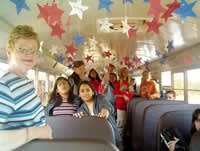
Bus drivers and teachers are trying something new to promote safety and improve student behavior: positive labels. And it’s working — name calling and distractions decrease by more than 50 percent and awareness, kindness and cooperation doubles. Most drivers report significant increases in job satisfaction and directors are benefiting from happier drivers.
The KC3 Positive Label Program, created by Margaret Ross and offered through the Kamaron Institute, is designed to teach children that words are powerful tools that can have either a positive or negative effect.
Badge of courage
KC3 stands for Kamaron Concept Three, which states “Labels Change Lives” as a motto. The heart of the program centers on the first of Ross’ three “Casey” books, “Casey and the Amazing, Giant, Green Shirt.” In the book, a youngster named Casey finds an old Army jacket with a missing badge. He decides to replace the badge and experiments with a number of words.
Through his journey to find the perfect word for his badge, he experiences the joy of positive words and the pain of unkind ones. Ross wrote the first Casey story in response to the terrorist attacks of Sept. 11, 2001, with the goal of providing it as a thank-you gift to military families.
Ross says the program is unique because it exists and has expanded by request.
“It’s grown to become an elementary, middle school, bus safety and after-school program because visionary, solution-focused leaders have asked for a program to meet their needs,” explains Ross.
Each KC3 program is developed in coordination with the operation using it. Ross says the results have been so impressive that it has spread by word of mouth. “We have experience, effective training and a flexible program tool set, but it’s the drivers and teachers who deserve all the credit and thanks for the wonderful programs they build,” she says.
Positive process
Pre-surveys are conducted to establish baseline attitudes and behaviors. During the four-week certification process, drivers conduct a minimum of two activities a week using program tools and training. Drivers log their activities on a simple form so best practices and standards are developed for each county.
The program culminates with a celebration in which drivers receive their achievement seal and certificate. Student and school celebrations are customized. A post-survey measures attitude and behavior change.
The bus program starts by having parents and students work together to write positive word descriptions of the student on cards sent home by the bus drivers. The cards come back with words such as “kind,” “clever,” “helpful” and “hard worker.”
The drivers then attach the cards to the positive displays on each bus to remind the students of their positive character qualities and to encourage them to always use positive labels. Student-to-student interaction visibly improves, but the influence goes beyond students.
Edna Mintz, a driver for Gwinnett County Public Schools in Lawrenceville, Ga., says the program has an impact on the adults involved as well. “I have found that doing positive things with students encourages them more. I’ve also learned to be more positive and to use more positive labels myself,” she says.
Down with negativity
Pam Holt, transportation coordinator at Fayette (Ga.) County Schools, rolled out the first KC3 Positive Label Bus Certification Program last fall. Other school systems that have participated in the program have reported name-calling and negativity decreasing up to 69 percent and kind words and cooperation increasing up to 67 percent.
One year later, all drivers are continuing the program. Why? Explains Fayette driver Johnnie Lewis, “It makes children feel good about themselves and eliminates name-calling.”
The old saying “sticks and stones will break my bones but words will never hurt me” couldn’t be further from the truth. With that in mind, five more Georgia counties have rolled out the KC3 Positive Label Program.
Up with safety
Research shows that many student discipline problems start at the bus stop, with name-calling often at the heart of the problem. Transportation directors also link discipline problems to bus safety.
“Up to 60 percent of bus accidents are caused by distractions,” says Carroll Pitts, director of transportation for the Cobb County School District in Marietta, Ga.
Grant Reppert, transportation director at Gwinnett County, says that cutting distractions and increasing civility not only improve bus safety but also help set the tone for a child’s entire school day.
“School bus safety is an important objective for anyone in the transportation business. It has to be a partnership among schools, students, parents, drivers and the transportation department,” says Reppert.
Pitts and Reppert envision the program becoming a new safety standard for all school bus riders. In an innovative outreach, they brought the program and vision to schools in their districts.
Pitts chose a middle school focus for Cobb County. “Our drivers volunteered for training and the school leaders hit the ground running, using the Casey middle school book in the classroom,” he says.
Favorable results
Pitts’ drivers reported an 80 percent increase in positive words, kindness and cooperation with the middle school students and a 70 percent decrease in distractions due to name-calling and other negative statements. Their opportunities to positively reinforce students grew 49 percent, and all of them plan to continue the program on their buses. The average increase in driver satisfaction with the positive impact on their working environment was 80 percent.
Gwinnett driver Jerry Howard says that this project has made a tremendous difference for the students on his bus. “I challenge them almost daily to try different things — smile at everyone you meet, say something nice to the people around you, pay a nice compliment to someone and give me a report when you board the bus in the afternoon. If you could see the smiles of joy on their faces as they report about their day, it would make your heart burst with pride,” he says.
Gwinnett driver Sharrall Phillips also reports a significant improvement during bus rides. “The Casey connection has helped strengthen the bond between the school and the school bus, creating a better school bus environment. I feel that students see the school bus more as an extension of the school,” she says.
Partnership is at the core of the KC3 program. It involves everyone who is connected to working with students, from teachers and administrator to parents, drivers and staff. School staff members report that good behavior is spilling over into the school environment, improving the atmosphere for learning by cutting classroom distraction minutes by an estimated 55 percent.
“These bright yellow buses are becoming mobile positive word zones, where the same character education lessons taught in the classroom — citizenship and kindness — are brought to life on the school bus environment,” explains Joan Akin, educational adviser for Gwinnett County Public Schools.
“It’s built a trust with my middle school students,” reports driver Marie McGowan of Cobb County.
“It gives them a way to positively handle a negative situation and still be considered cool,” adds Richard Krider, another Cobb driver.
Drivers are teaching kids how using positive labels can have a powerful effect on themselves and their peers.
The KC3 Positive Label Program is included in the official character education resources of the National Museum of Patriotism. KC3 is set to be featured at the museum in a special “Casey Citizenship” exhibit, which will feature all schools across the country that have participated in the program along with the school system’s transportation department.
For more information on the program, visit www.kamaron.org and click on “Info” under “School Programs.”
More Management

How to Build a Better Driver Training Program
Ready to boost up your school bus instructor training? Here’s how to pick the right talent and improve recruitment, retention, and safety.
Read More →
CALSTART and Forth Combine to Form Catalyst Mobility
The new name represents a renewed vision for the nonprofit focused on advancing clean, equitable, and affordable transportation solutions that move people and goods.
Read More →
What Makes a Great School Bus Driver Trainer?
Choosing the right school bus driver trainer takes more than experience. Learn six keys to selecting and developing trainers and evaluating program effectiveness.
Read More →

School Bus Contractors Expand Through New Deals, Acquisitions & Partnerships
STA's Canadian division acquires Ontario-based G&L Stevenson Transport while Durham School Services adds a new district contract in California, First Student adds a New Jersey contract, and Minnesota Coaches acquires Halo Transportation.
Read More →
Logan Bus Company Rolls Out AI Phone System for NYC School Bus Families
A summer pilot found that AI agents could handle most routine calls, freeing up time for customer service staff to focus on emergencies and complex family concerns.
Read More →
From Intent to Impact: What I Learned About Leadership from TAPT
A Texas transportation supervisor shares lessons on self-awareness, accountability, managing stress and building trust — and why investing in leadership development matters at every stage of your career.
Read More →
NAPT Names 2026 Award Recipients, Hall of Fame Inductee
Who earned national recognition for their work in student transportation? This year, NAPT named five recipients of its 2026 awards for service, safety, and leadership, plus its newest Hall of Famer.
Read More →
2026 State of Student Transportation Report
Driver shortages. Rising costs. Growing safety expectations. More data, but not enough time to act on it. The 2026 State of Student Transportation Report reveals what transportation leaders say is putting the most pressure on their operations—and where they’re investing next. See how your priorities compare.
Read More →
How to De-Escalate an Angry Person: 5 Steps for Handling Workplace Conflict
What makes emotions run high, and how should you handle an angry colleague or parent? Follow these steps for staying calm, listening, showing empathy, and resolving conflict.
Read More →
What Readiness Looks Like This School Year
Learn about the challenges shaping the 2026–2027 school year, from persistent driver shortages and budget pressure to technology and readiness gaps. See how school districts are responding and adapting in Zonar’s 2026 Back-to-School Readiness Report.
Read More →