




A day in the life of a transportation director
At Shelby County Schools, enhanced driver training and partnerships with school staff have led to drastic improvements in student behavior on the bus. Here, we spend a day with Director of Transportation Debbie Rike to see how she steers the operation toward success.

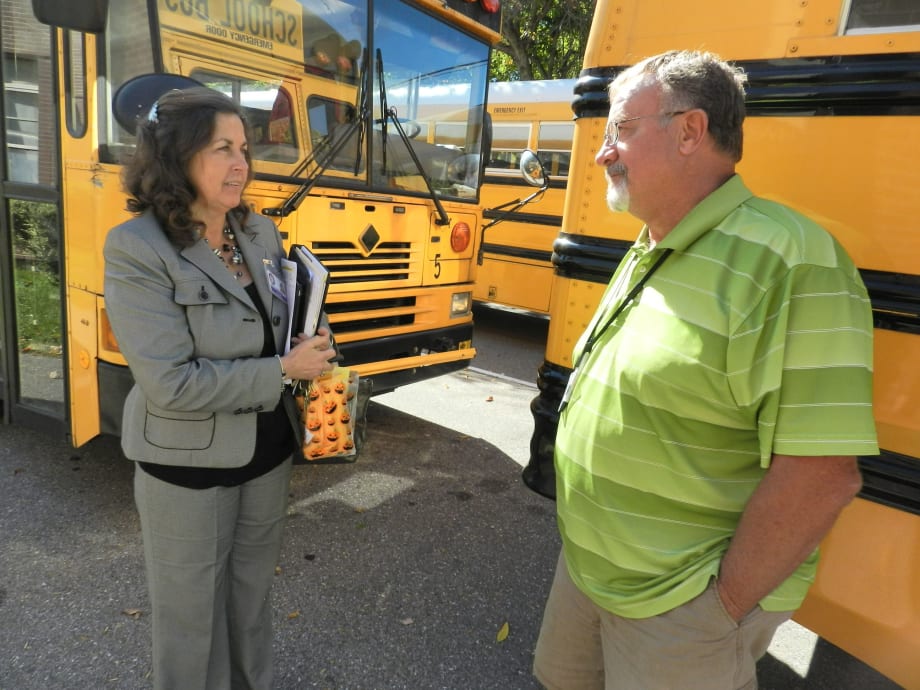
Debbie Rike, director of transportation for Shelby County Schools, talks with bus driver Curby White outside of Shadowlawn Middle School.
WEB EXTRAS
• Photo gallery: inside Shelby County Schools' 'Elite Fleet'
• Handout: school bus rules
• Handouts: student management tips/breaking up fights
5:15 a.m.: Early morning monitoring
Before dawn in Shelby County, Tenn., Debbie Rike wakes up and turns on her two-way radio. With the first wave of transportation staff members reporting to work at 5:30 a.m., Rike monitors early radio activity from home to make sure the operation is running smoothly. The morning gets off to a quiet start.
7:15 a.m.: At the office
Outside, the mid-October air is cool and crisp, the ground is wet and the leaves boast their autumn shades of red, orange and yellow. The night before brought torrential rain, lightning and even a tornado warning in the region.
Rike, a longtime Shelby County Schools educator and administrator who began serving as director of transportation about three years ago, arrives at the office. As one of her first orders of business, she’s given a list of school bus drivers who are to undergo a random drug test. Rike calls her lot managers and tells them to have those drivers come in for the test immediately after their morning runs.
Shelby County Schools has four school bus lots. Each lot has its own manager, and three of them also have an assistant manager. Two of the managers are also licensed trainers.
The district’s biggest lot, in the south of the county, houses 100 of the 304 total buses.
Next, Rike goes over the morning schedule. If a bus has a mechanical problem or is otherwise running late, the transportation office informs the schools so they can give updated information to any parents who call.
This morning is “pretty calm,” by Rike’s assessment.
8 a.m.: Radio address
After a long ride from downtown Memphis (where I’m staying for the pupil transportation association conferences), I arrive at Rike’s office, at the district’s Grays Creek facility in Arlington.
Rike, who describes herself as “one of the most positive people you’ll meet,” has waited until I arrived to deliver her morning announcement over the radio. These typically consist of safety messages and words of encouragement. The district is celebrating School Bus Safety Week, so Rike thanks her drivers for their dedicated efforts in safely transporting the district’s students.
Rike introduces me to her office staff members — and there aren’t many for such a large operation. For example, even with a fleet of more than 300 buses, there is only one dispatcher. But, as Rike observes several times during the day, the radio is strikingly calm.
8:45 a.m.: On-site drug-testing
Rike takes the list of bus drivers to be drug-tested and walks out to the testing facility, which is onsite and is used for other Shelby County Schools departments as well as transportation.
The drug tests are quick — usually just 15 to 20 minutes, which is a big improvement over the previous arrangement.
“We used to have to send them out to a clinic, and sometimes they’d be stuck there all day,” Rike says. “The district recognized the need to have our own [testing] facility.”
8:50 a.m.: Phone and e-mail
Back in her office, Rike makes a call regarding a pay issue, clarifying a staff member’s hours. After catching up on e-mail, she discusses one of her department’s challenges.
“We have a driver shortage, but we’re dealing with it,” she says. “Not everyone is waiting in line to be a school bus driver.”
To recruit more candidates, the transportation department has sent out notes through the PTA and has posted signs at the bus lots and school offices.
“I’m getting the applications we need, but it’s a four-week process. Background check, DOT [Department of Transportation] physical. ... We just need time,” Rike says.
9:15 a.m.: Accident-free treat
Rike walks over to the building that houses the drivers’ lounge and the lot manager’s office. As drivers return from their morning runs, they are greeted with treats — chicken biscuits and pastries — for achieving an accident-free September.
Rike makes her way around the lounge, hugging and thanking the drivers. When she wishes someone a “happy Friday eve” (it’s Thursday), another driver momentarily thinks that the weekend is closer.
“At first, I just heard ‘Friday,’” the driver says.
“You still have to come to work tomorrow,” Rike says with a laugh.
In the garage, Rike talks with Mechanic Foreman Ken Mauney about a GPS system issue.
9:30 a.m.: In the garage
Rike heads over to the garage to talk with her mechanic foreman, Ken Mauney, about an issue with the operation’s GPS system.
On the way back to her office, talk turns to driver training. There are about 46,000 students enrolled in Shelby County Schools, and Rike’s department transports half of them — about 23,000. Dealing with student behavior is a key focus in training.
“We have to teach them how to handle the kids while they’re driving,” she says. “That’s the biggest challenge for our drivers.”
The district’s drivers aren’t unionized, but Rike says that she wanted to make sure that they “have a voice.” Accordingly, she holds monthly roundtables for each bus lot. Food is provided for the voluntary, off-the-clock meetings, and drivers can share any concerns they have.
“Everybody wants to have a voice and have their concerns heard,” Rike says. “I try to keep an open-door policy. We really are a family, and the drivers feel comfortable to have personal relationships with all of us administrators.”
[PAGEBREAK]
9:45 a.m.: De-escalating tension
Rike makes a phone call, and then her secretary, Karen Moxley, comes in with a question.
Rike notes that when there’s an angry parent, she prefers to be the one to talk to him or her.
“I think I’ve devised a way that’s pretty effective in de-escalating those situations. They could nearly forgive anything if you’re just listening — ‘I can’t fix what already happened, but what can I do right now?’” she explains. “Ninety percent of my job is PR — communication and relationship development.”

Rike and two of her transportation supervisors, Michelle Beasley (center) and Veronica Norfleet (far right), hold a meeting with a group of new drivers.
10 a.m.: Guidance for new drivers
Rike and two of her transportation supervisors, Michelle Beasley and Veronica Norfleet, hold a meeting with a group of new drivers in which they get to know each other and explain policies and expectations.
As Rike addresses the group, she stresses three points:
1. No cell phone use while operating the bus.
2. Check the bus every time to make sure no children are left behind. (“That won’t happen here, because you’re going to follow the rules,” Rike says firmly.)
3. Make sure that the children wait for your signal before they cross the road.
Combined, Rike, Beasley and Norfleet have more than 80 years of experience with Shelby County Schools, and not just in transportation. Rike and Beasley have both taught special-ed. Beasley and Norfleet have both served as assistant principals. Their backgrounds seem to have prepared them particularly well to equip their drivers for behavior management. Beasley hands out to the new drivers a sheet with tips on behavior management.
Beasley then passes out the bus rules.
“We revise them every year,” she says. “Our mantra is that the school bus is an extension of the school day. ... If you can’t do it in the classroom, you can’t do it on the bus.”
All drivers get a logbook, and Beasley emphasizes the importance of writing down and reporting any problems that come up — “Billy had a bloody nose,” for example.
The meeting continues with more talk of student discipline and questions from the new drivers. They get another handout on the topic of how to respond to fights on the bus.
11:30 a.m.: Routing review
Rike meets with her two routers to review bus counts and updates to routes. In one case, they discuss changes that could be made to make sure a student gets to school on time. In another case, a driver has reported a stop where students hadn’t been boarding, so that stop is being eliminated.
Rike says that she keeps up-to-date on these types of details because “I need to understand the changes that are made in case a parent or a school is unhappy.”
She notes that she loves her job, although she does miss working more closely with the students, as she did when she was a teacher.
“I’ve been an administrator for more than 20 years. I miss the kids,” she says, noting that she does occasionally get to interact with them by riding a bus or operating Buster the School Bus for training. “But I have to be proud of what I do. I make a difference for 23,000 kids.”
11:57 a.m: More e-mail
Rike stops back into her office to answer some e-mails before heading out to lunch after noon.
[PAGEBREAK]

At Shadowlawn Middle School, the staff holds an appreciation event with food, goodie bags and T-shirts for the bus drivers
1 p.m.: Improving bus behavior
Rike drives in her district car to Shadowlawn Middle School in Bartlett, where the staff is holding an appreciation event with food, goodie bags and T-shirts for the drivers as part of School Bus Safety Week.
The gesture is particularly meaningful considering that Shadowlawn “used to be a school that drivers begged to leave” because of rampant student behavior problems, says Beasley, who is in attendance at the event. But she says that a new administration, including Principal John McDonald, turned the situation around.
“They let parents know that they would follow through and students [who misbehave] would be off the bus,” Beasley says.
McDonald is modest about the improvements and gives credit to the “good people around me,” including Cam Alexander, the school’s assistant principal and transportation coordinator.
“We take bus discipline very seriously,” says McDonald, who has also served as a transportation coordinator at another school in the past. “We don’t want students to feel like there’s a different set of expectations on the bus — it’s an extension of the school. ... The bus culture affects the school culture.”
Rike holds a quick meeting with McDonald to go over some route changes.
2 p.m.: On the road again
On the way back to the transportation office, Rike speaks proudly of the staff at her operation, which she has dubbed “The Elite Fleet.”
A prime example is Lula Curry, a special-needs route driver who has been with the district for 35 years and has missed “maybe three days total,” Rike says.
“You could set your watch by her — she’s that precise. One day, her bus broke down. Every parent on her route called, not to complain, but because they were worried about her.”
Curry mops her bus every day, and, according to Rike, state inspectors have said that she has the cleanest bus in Tennessee.
Curry is also known to bring in cold bottles of water or food to hand out.
“I know that’s amazing, but I could probably tell you that about 15 to 20 other people,” Rike says. “One driver had a kid who fell into mud. … She went and bought her clothes. Truly amazing people.”
Rike then shares one of her philosophies in driver management and retention.
“If we can get them through the first year or two, we’ll have them for life. We have to support them through the difficulties in the beginning.”
Rike and Mike Simpson, chief of operations for Shelby County Schools, meet over the phone with Larry Riggsbee, executive director of the Tennessee Association of Pupil Transportation.
2:30 p.m.: Meeting with the chief
Rike goes to a meeting next door at the office of her boss, Mike Simpson, the chief of operations for Shelby County Schools. Before moving into that position, Simpson was the director of transportation for the district for about 19 years. With the exception of maybe one person, he hired everyone who currently works in the main transportation office.
When asked about his transition to the operations role, Simpson says that “the learning curve was pretty steep” considering the variety of areas he began overseeing in addition to transportation: facility maintenance, capital projects, technology support, risk management, school zones.
“Having the good people sitting there next door [in the transportation office] allowed me to learn these other parts of the business,” Simpson says. “I’m very fortunate.”
Today, Simpson and Rike are meeting over the phone with Larry Riggsbee, the executive director of the Tennessee Association of Pupil Transportation. They discuss the agenda for an upcoming board meeting, the possibility of electing an association secretary and educational topics for a regional conference.
[PAGEBREAK]
Third-grade teacher Brianna Gould keeps bus passengers on their best behavior as part of the Rough Riders program.
3:15 p.m.: Ensuring a smooth ride
After returning to her office and checking e-mail, Rike heads out to Southwind Elementary, another school that had bus discipline problems but came up with an innovative solution: the Rough Riders program, which was implemented in the previous school year.
As Assistant Principal Elissa Stratton explains, the Rough Riders are a group of teachers who volunteer their time after school to ride the buses, making sure the kids get in their assigned seats and maintain good behavior. While the teachers aren’t paid for that time, they do get incentives, like being allowed to wear jeans, having a reserved parking spot right in front of the school and occasionally getting a free lunch.
“There has been a drastic decline in discipline problems in the afternoon” since the program started, Stratton says. “The kids look forward to it. They’ll say, ‘Which Rough Rider is riding with us today?’”
After a wave of elementary students file out and board their buses, Rike and I hop on bus 91 with one of the Rough Riders, third-grade teacher Brianna Gould.
Despite being nearly full with children, the bus is almost eerily quiet. Every once in a while, Gould has to gently shush a youngster or remind another to stay in his seat and out of the aisle.
After all the children have been dropped off, the bus heads back to Southwind Elementary to pick up another round of students for a second run.
Gould serves as a Rough Rider usually four and sometimes five days a week. She says that the extra work is tiring but has clearly made a difference.
“It was a big change,” Gould says. “The kids expected to be able to talk and play. At first, they were having a bit of trouble with it, but now they expect it. It’s better for the bus drivers, because now they’re not having to deal with those [misbehavior] situations on the bus.”
4:25 p.m.: A quiet ending
As Rike drives me back to downtown Memphis, she reflects on her career.
“I’ve been with Shelby County Schools all of my adult life — 33 years,” she says. “We do have that family commitment here. After college, this is what you do. How great is that?”
The district’s buses will continue to run until around 5:30 p.m. Rike’s radio, which she still has with her in the car, remains mostly quiet.
“We had a pretty great day today,” Rike says. “We usually have good days, but we try to prepare in case things happen.”
More Management

How to Build a Better Driver Training Program
Ready to boost up your school bus instructor training? Here’s how to pick the right talent and improve recruitment, retention, and safety.
Read More →
CALSTART and Forth Combine to Form Catalyst Mobility
The new name represents a renewed vision for the nonprofit focused on advancing clean, equitable, and affordable transportation solutions that move people and goods.
Read More →
What Makes a Great School Bus Driver Trainer?
Choosing the right school bus driver trainer takes more than experience. Learn six keys to selecting and developing trainers and evaluating program effectiveness.
Read More →

School Bus Contractors Expand Through New Deals, Acquisitions & Partnerships
STA's Canadian division acquires Ontario-based G&L Stevenson Transport while Durham School Services adds a new district contract in California, First Student adds a New Jersey contract, and Minnesota Coaches acquires Halo Transportation.
Read More →
Logan Bus Company Rolls Out AI Phone System for NYC School Bus Families
A summer pilot found that AI agents could handle most routine calls, freeing up time for customer service staff to focus on emergencies and complex family concerns.
Read More →
From Intent to Impact: What I Learned About Leadership from TAPT
A Texas transportation supervisor shares lessons on self-awareness, accountability, managing stress and building trust — and why investing in leadership development matters at every stage of your career.
Read More →
NAPT Names 2026 Award Recipients, Hall of Fame Inductee
Who earned national recognition for their work in student transportation? This year, NAPT named five recipients of its 2026 awards for service, safety, and leadership, plus its newest Hall of Famer.
Read More →
2026 State of Student Transportation Report
Driver shortages. Rising costs. Growing safety expectations. More data, but not enough time to act on it. The 2026 State of Student Transportation Report reveals what transportation leaders say is putting the most pressure on their operations—and where they’re investing next. See how your priorities compare.
Read More →
How to De-Escalate an Angry Person: 5 Steps for Handling Workplace Conflict
What makes emotions run high, and how should you handle an angry colleague or parent? Follow these steps for staying calm, listening, showing empathy, and resolving conflict.
Read More →
What Readiness Looks Like This School Year
Learn about the challenges shaping the 2026–2027 school year, from persistent driver shortages and budget pressure to technology and readiness gaps. See how school districts are responding and adapting in Zonar’s 2026 Back-to-School Readiness Report.
Read More →