School transportation managers are focusing on driver training, route planning, bus maintenance, and the safety of children everywhere.
by Steve Hirano, Executive Editor
August 1, 1997School transportation managers are focusing on driver training, route planning, bus maintenance and the dozens of other details that must be handled before children head back to school.
The editors at SCHOOL BUS FLEET would like to add a few items to the checklist that could prevent injury accidents and, possibly, save lives.
And, while most safety tips will always stand the test of time, check out this updated list of "21 Tips for Preventing School Bus Accidents."
8 Tips to Save Lives
Even if all eight of these tips are already inked into your day planner, you might want to read on. Perhaps we'll provide you with the motivation to find a ninth tip that you can share with us for next year's safety issue.
1. Work Closely with Local Law Enforcement
Law enforcement agencies can provide more than emergency response services - if school bus operators know what kind of assistance is available. For the past two years, law enforcement agencies across the state of New York have taken part in Operation Safe Stop, which deters motorists from passing school buses stopped for loading or unloading of passengers.
More than 850 law officers - drawn from 276 agencies - participated in last year's Safe Stop. During the one-day event, the officers followed school buses for a day and issued citations to motorists who illegally passed a stopped bus.
In 1996, more than 450 tickets were handed out. According to statistics compiled annually by the Kansas State Board of Education, 10 children were killed by passing motorists during the 1995-96 school year.
"We knew if we didn't do something, the problem was going to keep getting worse," says Jim Brown, the organizer of the New York event and transportation safety coordinator at the Madison-Oneida Board of Cooperative Educational Services (BOCES). "That's something that we don't want the kids to have to go through."
Brown tested the program on the local level for two years before organizing a statewide event two years ago. He obtained funding from the Governor's Traffic Safety Committee, which is sponsored by the State Education Department and administered by the BOCES. Brown believes the program has a strong impact on public awareness.
The citations, which carry a possible $250 fine, ensure that the lesson won't be forgotten soon.
"We know that when we enforce these infractions, the violations go down," he says. One of the unexpected benefits of the program is the extra attention that participating police officers have given school buses. "Now the police know where the buses are," Brown says. "So if they have a few minutes between assignments, they just drop by."
As a result, motorists are seeing more police cars in the vicinity of school buses and are taking greater care to obey school bus safety laws. "To me, that's as big a payoff as the event itself," Brown says. School transportation officials interested in organizing an Operation Safe Stop event should contact local law enforcement agencies. After the event is scheduled, media outlets should be contacted for publicity purposes.
2. Learn to Lobby Effectively
In Michigan, budget-makers considered cutting back on the school bus inspection program by the state police. They wanted to require inspections once every two years instead of annually.
"We said, 'That's not going to work,'" says Kim Hooper, president of the Michigan Association for Pupil Transportation (MAPT) and transportation director at Monroe Public Schools.
Hooper contacted the MAPT's legislative liaison, Matt Losch, who started spreading the word throughout the state. Although the budget for the state police is tight, the efforts of the transportation officials thwarted the proposed change. As in many political situations, however, compromise was necessary to obtain the desired goal.
Hooper says the MAPT will work with the state police to revamp the bus inspections to make them more cost effective. For example, inspections of the first-aid kit could be less rigorous without jeopardizing the health and safety of the passengers and driver.
"Currently, there are over 140 items in the first-aid kit that the state police inspect," Hooper says. "Maybe they don't have to count every band aid."
Hooper says it's rumored that lawmakers are considering an inspection fee to recoup costs. But that's a future battle. The important point, he says, is to stay abreast of any proposed changes and be ready to mobilize quickly if necessary.
3. Keep Striving for Innovation
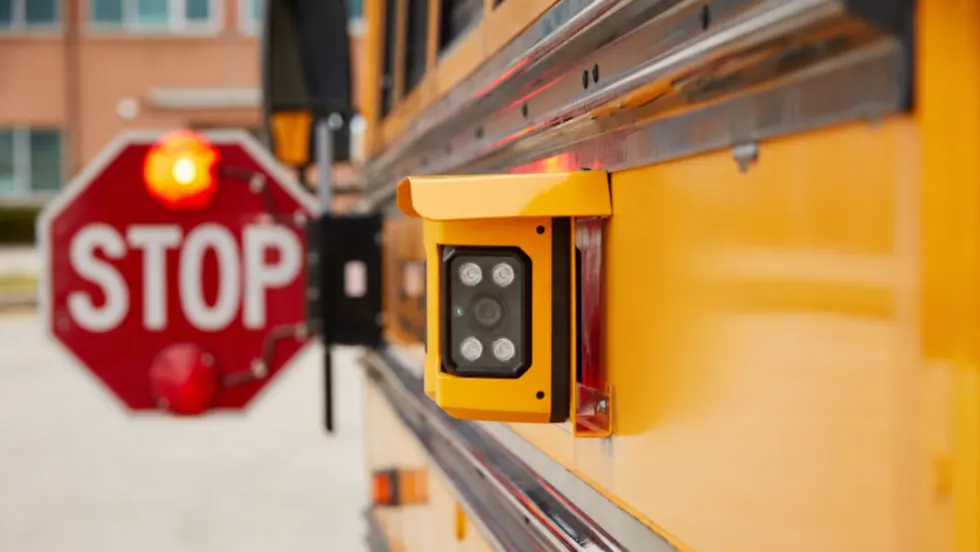
Although its appearance hasn't changed greatly in the past several decades, the school bus continues to be a source of innovation, especially where it concerns safety equipment. The stop arm and crossing-control arm are examples of innovations that have improved safety around the bus.
In addition, electronic motion sensors have been developed that detect objects in the danger zones of school buses. All of these devices can help to save lives.
But we don't have to stop there. We should not assume that school buses are as safe as they can be because we know that simply isn't true.
Since 1991 eight children have died in handrail accidents, despite several high-profile recall campaigns by the National Highway Traffic Safety Administration. As much as we'd like to believe that dangerous handrails - those that can snag a child's clothing or backpacks - have been safely modified by school bus operators, we know that thousands of buses still haven't had the necessary repairs.
Let's face it, even those handrails that have been "fixed" can still snag a drawstring. Maybe we need to go further. Fred Fibiger, an inventor and school bus enthusiast, has designed a non-snag handrail that would eliminate the possibility of a snagging incident. His design has no open rail, so it can't entangle a drawstring or backpack strap. It may not be a perfect design, but it represents a concept that should be explored.
4. Park Your Non-Confirming Vans
Using vans to transport students is more dangerous than transporting them in school buses. No one disputes this. Vans are not constructed to the same rigorous standards as buses. Nor do their drivers have to meet the same licensing and training standards as school bus drivers.
But vans are cheaper. Many cash-strapped school districts factor in price when trying to meet transportation needs.
In Arizona, some superintendents of small, rural school districts chafed when Hank Grates, president of the Transportation Administrators of Arizona and transportation director at Kyrene Elementary School District in Tempe, recommended during state budget hearings that no funding be made available for vans to transport students to and from school.
"They weren't too happy with me or my testimony," Grates says. "But if you're transporting students, they need to be in a yellow school bus."
The superintendents complained that they needed vans because licensed school bus drivers were unavailable. Their dilemma was understandable, but Grates believes the risk of using non-conforming vans is too high.
"When you really look at it, you're talking about a huge liability," he says.
The liability issue was recently illustrated by a settlement in Columbia, S.C., over the death of 6-year-old Jacob Strebler, who was killed in a school van accident two years ago.
According to the lawyer for the boy's family, the settlement, reached in June, was the largest in the history of South Carolina for the death of a child. The attorney would not disclose the total amount, but the truck driver and his employer paid a $1 million settlement, while the school, Heathwood Hall Episcopal School, and the van dealer, Pulliam Ford Co., paid an undisclosed sum.
5. Maintain High Driver Morale
Some studies indicate that training is less of a factor in a driver's safety record than morale. According to the Insurance Institute for Highway Safety, poor vehicle operation more often reflects a driver's attitude than driving skills or knowledge.
Certainly, school bus drivers require intensive training before and after they get behind the wheel, but they also need to feel like they're a valued member of the transportation team. If a driver seems to be involved in an unusually high number of accidents, more training may not be the best solution.
Consider talking to the driver about his or her job satisfaction. If you sense a problem, find out exactly why the driver is dissatisfied. Communication is the key. Drivers need to know that management is supportive and is willing to consider the needs of its employees.
6. Turn Down the Volume
One of the key findings of the National Transportation Safety Board (NTSB) in the school bus-train collision in Fox River Grove, Ill., is that the driver couldn't hear the approaching train because the bus was too noisy. Among the recommendations of the NTSB were two that addressed the placement of radio speakers:
Develop guidelines for the appropriate placement of radio speakers and the use of radios on school buses and disseminate these guidelines to your members.
Advise your members to check their school buses and disable any radio speakers located immediately adjacent to the drivers' heads.
Maintaining a reasonably quiet bus is important for two reasons: the driver must be able to hear the sirens of approaching emergency vehicles and must be able to focus on the safe operation of the bus.
To address the noise issue, Thomas Built Buses of High Point, N.C., no longer offers the option of placing radio speakers near the driver's head.
Ron Marion, a sales engineer for Thomas Built, says the company also is advising that the speakers be disabled in the school buses that already have driver-adjacent speakers. Marion estimates that fewer than half of Thomas Built buses on the road have this option.
Another strong reason why a driver must not be distracted by noise is that it affects his ability to respond to children's shouts. In more than one handrail "snag-and-drag" fatality, drivers were unaware of the victims' predicaments despite the screams of the students and, in some cases, the passengers as well.
7. Follow Accepted Best Bus Safety Practices
A fatality earlier this year illustrates the danger of ignoring accepted practices. In this case, the driver allowed a disembarked student to cross the street behind the bus. One afternoon, the student's bookbag snagged in the door as he was exiting.
Because the driver was distracted by a commotion at the rear of the vehicle, he was unaware that the child was caught in the door. Despite cries from students to stop the bus, the driver drove away, running over and killing the youngster. Had the driver followed standard procedure and required the student to cross in front of the bus, the accident likely would not have occurred.
"My recommendation to other school districts is to strongly recommend that students cross in front of the bus," said the transportation director at the school district. "If that had been practiced, this would never have happened because the driver would have seen the student clear the doorway and cross the street before he proceeded."
8. Never Let Your Safety Guard Down
Complacency can be deadly. Even though school buses are one of the safest forms of transportation, you cannot afford to relax, not even for a moment. Just because your operation has been spared a major accident doesn't mean tragedy will never strike.
During the 1995-96 school year, 25 children were killed in the loading/unloading zones of the school bus. That represents a 25% increase from the previous year. Unless increased vigilance is taken during the coming school year, there's no reason to believe that the fatality rate will decline. Each year we learn a little more about how to safeguard our passengers.
We add extra safety equipment to our vehicles. We provide more sophisticated training. We ask drivers to be more careful. Still, children will be killed. Sometimes there's no preventing it. But we must continue to remind everyone in the transportation department to be vigilant.
Here's one trick that might help: Pretend that the child you're transporting is your own.
Have more to add? Comment and let us know!