




5 Tips for Effective Driver Retraining
Taking a personal approach, avoiding a punitive tone, and providing handouts in a well-documented retraining program can help get struggling school bus drivers on track.

After retiring as a transportation director and becoming a consultant, Judith Clarke (right) formalized a program for retraining school bus drivers and attendants. She is seen here with Ashley Bednarz, a bus aide at Hannibal (N.Y.) Central School District.

After retiring as a transportation director and becoming a consultant, Judith Clarke (right) formalized a program for retraining school bus drivers and attendants. She is seen here with Ashley Bednarz, a bus aide at Hannibal (N.Y.) Central School District.
For all school bus drivers, training is an ongoing endeavor. They undergo initial instruction, annual in-service hours, and often safety-centered meetings throughout the school year.
But in some cases, a need arises for more targeted training to get an individual driver on the right track. Although retraining may carry a stigma for some, if done right it can prove to be a positive experience and even a job saver.
As a longtime transportation supervisor and director in upstate New York, retraining school bus drivers and attendants was a part of Judith Clarke’s wheelhouse. But it wasn’t until she retired and became a consultant that she saw the need for a formal retraining program.
Experience at the Wheel
Like many veteran pupil transportation directors, Clarke came up through the ranks. She started her career as a school bus driver at the Skaneateles, New York, location of Ryder Student Transportation (which was later acquired by FirstGroup and became First Student).
After driving for about a dozen years, Clarke was promoted to supervisor. She served in that position for 10 years before becoming director of transportation at Syracuse City School District.
At the helm of Syracuse’s sizable school bus operation, Clarke missed working closely with drivers and trainers on a regular basis. After a couple of years there, she decided to move to the much smaller Fayetteville-Manlius School District, where she served as transportation director until retiring in 2011.
Even in retirement, Clarke felt the call to contribute to pupil transportation. She took some interim roles as a supervisor or director, eventually landing at Hannibal Central School District.
The interim assignments, Clarke says, “gave me exposure to what’s going on.” In other words, she was doing more hands-on work with school bus drivers and became more attuned to common safety issues and training needs.
When her interim role at Hannibal ended, Clarke continued to work for the district as a consultant. Serving in that capacity spurred her to develop a retraining format that would be more formal and well-documented, but still customizable for each trainee.
“As a consultant, I needed to formalize what I was doing,” she says. “The district is paying me to do this, so they should have the information [that the trainee is getting].”
Clarke, who remains certified as a New York State master instructor, shares her insights here on how to conduct effective retraining for school bus drivers and attendants.
1. Keep it Small
While new driver and in-service training can be conducive to group settings, driver retraining often requires an individualized approach. Since the purpose is to address a specific issue, the training will typically need to be one-on-one or in a small group. Focus on making individual connections.
As Clarke puts it, the training should “target areas where a bus attendant or driver specifically needs help. They can’t get that in a group setting.”
2. Don’t Make it Punitive
Driver retraining may be corrective in nature, and in many cases the recipient of the training is on a last-chance agreement. Even so, Clarke says it’s important to avoid giving the impression that the training is a punishment. Instead, pitch it as an opportunity to get them on a positive path.
“A lot of times, [driver retraining] is looked at as punitive,” Clarke says, “but it really should be to help — to do whatever you can to bring awareness to that employee [as to] why they’re not being successful.”
3. Utilize Video Footage
In some cases, the recipient of retraining might be under the impression that they’re not doing anything wrong. In any case, they can better understand the issue if they see themselves in action. That’s where video surveillance comes into play.
Clarke has found that drivers or attendants who are involved in an incident are often not given a chance to see video footage that was recorded on the bus. When she provides retraining as a consultant, she seeks the school district’s permission for the employee to watch video of the incident.
“That’s really helpful in them recognizing what’s going on,” Clarke says. “They watch the video and evaluate their own performance.”
4. Keep it Focused
For each retraining session with a school bus driver or attendant, tailor the agenda to the specific issues that they need help with. While there are many topics that could potentially be the subject of retraining, Clarke has found that there are some commonly recurring trouble areas.
“A lot of it is student management — underreacting [or] overreacting,” she says.
Here are some other key areas that Clarke has covered in retraining sessions:
• Defensive driving
• Loading and unloading safety
• Sharing the road with emergency vehicles and personnel
• Workplace bullying
“It’s customized to whatever the issue is,” Clarke says, adding that it’s not always an issue on the bus. “It can even be behavior in the driver’s room. [In that case], talk about what’s appropriate in the workplace.”
5. Make the Most of Materials
Along with providing an agenda for the retraining session, consider preparing a presentation to serve as a guide and to emphasize important points.
“Don’t overwhelm them with PowerPoint,” Clarke cautions, but focus on using the platform to “identify the key objectives you’re trying to accomplish.”
Other materials, such as handouts and quizzes, can help in the retraining process and then serve as documentation of what was covered with the employee.
Capping off the documentation, Clarke provides a final letter to the school district and a sign-off from the school bus driver or attendant.
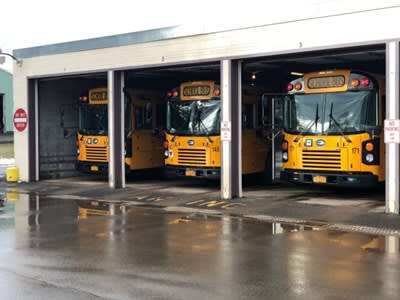
Clarke’s one-on-one sessions have been “extremely effective and beneficial not only to that driver, but to our students they transport and our community,” says Robert Pakish, Hannibal CSD’s director of transportation.
Feeling the Benefits
Hannibal Central School District’s transportation department is one of the operations that has benefited from Clarke’s personalized approach to retraining.
“For a student, it would be similar to going to school and having each subject taught by one person, and taught only to you,” says Robert Pakish, Hannibal’s director of transportation. The one-on-one sessions, he adds, have been “extremely effective and beneficial not only to that driver, but to our students they transport and our community.”
Clarke’s targeted retraining model has even prompted changes in Hannibal’s broader training program. With a staff of 35 school bus drivers, monitors, and mechanics, the transportation department had been conducting sessions with everyone at one time. Now, Pakish has begun limiting class sizes to 10 to 12 for some trainings, with three separate sessions to bring the whole staff through.
The impact of that change can be seen in “increased retention of topics being covered to more participation and involvement during the trainings,” Pakish says.
In light of the challenges posed by school bus driver shortages, an effective retraining program can provide a well-documented path for a struggling driver to stay on the job. At the same time, it can give the transportation director more confidence in giving that driver another shot.
Retraining is “a protection … for the district, liability-wise,” Clarke says. “It helps make you feel better about sending a driver or attendant out on a daily work assignment, knowing that you’ve done what you can to help this person.”
Thomas McMahon is a contributing writer who has been covering pupil transportation for more than 16 years. He previously served as an editor at School Bus Fleet. He can be reached atthomcmahon@gmail.com.
For more information about Judy Clarke’s retraining program, email her atjudyclarke29@gmail.com.
More Management

How to Build a Better Driver Training Program
Ready to boost up your school bus instructor training? Here’s how to pick the right talent and improve recruitment, retention, and safety.
Read More →
CALSTART and Forth Combine to Form Catalyst Mobility
The new name represents a renewed vision for the nonprofit focused on advancing clean, equitable, and affordable transportation solutions that move people and goods.
Read More →
What Makes a Great School Bus Driver Trainer?
Choosing the right school bus driver trainer takes more than experience. Learn six keys to selecting and developing trainers and evaluating program effectiveness.
Read More →


School Bus Contractors Expand Through New Deals, Acquisitions & Partnerships
STA's Canadian division acquires Ontario-based G&L Stevenson Transport while Durham School Services adds a new district contract in California, First Student adds a New Jersey contract, and Minnesota Coaches acquires Halo Transportation.
Read More →
Logan Bus Company Rolls Out AI Phone System for NYC School Bus Families
A summer pilot found that AI agents could handle most routine calls, freeing up time for customer service staff to focus on emergencies and complex family concerns.
Read More →
From Intent to Impact: What I Learned About Leadership from TAPT
A Texas transportation supervisor shares lessons on self-awareness, accountability, managing stress and building trust — and why investing in leadership development matters at every stage of your career.
Read More →
NAPT Names 2026 Award Recipients, Hall of Fame Inductee
Who earned national recognition for their work in student transportation? This year, NAPT named five recipients of its 2026 awards for service, safety, and leadership, plus its newest Hall of Famer.
Read More →
2026 State of Student Transportation Report
Driver shortages. Rising costs. Growing safety expectations. More data, but not enough time to act on it. The 2026 State of Student Transportation Report reveals what transportation leaders say is putting the most pressure on their operations—and where they’re investing next. See how your priorities compare.
Read More →
How to De-Escalate an Angry Person: 5 Steps for Handling Workplace Conflict
What makes emotions run high, and how should you handle an angry colleague or parent? Follow these steps for staying calm, listening, showing empathy, and resolving conflict.
Read More →
What Readiness Looks Like This School Year
Learn about the challenges shaping the 2026–2027 school year, from persistent driver shortages and budget pressure to technology and readiness gaps. See how school districts are responding and adapting in Zonar’s 2026 Back-to-School Readiness Report.
Read More →