




Training Bus Drivers to Effectively Prevent Student Misbehavior
Drivers can use a few simple strategies to increase student compliance. However, focusing on adult behavior is just as important as that of the students.
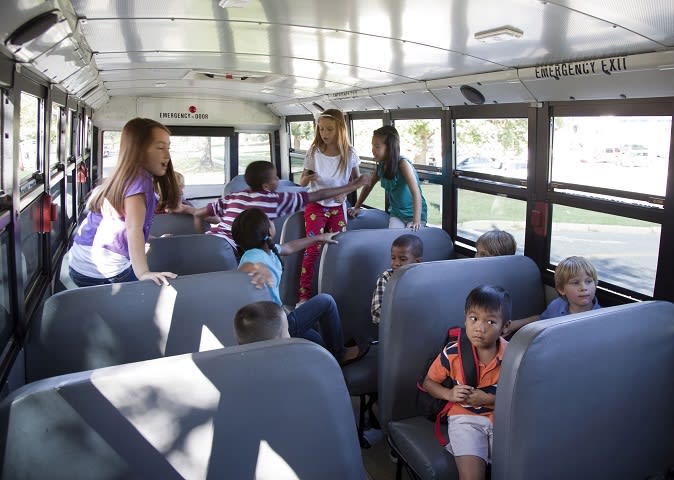
Photo: National Highway Traffic Safety Administration
Ask any adult who works in or around schools and they will likely tell you that student misbehaviors are a daily problem. It seems like students don’t have the self-discipline or respect for others that we all experienced in our own youth. While there are a variety of factors influencing student behavior, there is strong evidence that adults can affect the probability of positive behavior with a set of fairly basic actions.
Evidence clearly shows that student behavior in the classroom can be predicted by three broad teacher behaviors. The first is active supervision, which simply means that the teacher communicates expectations and maintains consistent eye contact with the students. The second involves verbally engaging students in a positive manner. This can be done with personal greetings, questions, comments, and even small tasks that keep the students’ minds focused on positive behavior. The third is simply the delivery of positive verbal feedback — just letting students know that they are acting appropriately.
Recent research summarizing 12,000 classroom observations has shown that teachers not using these behaviors have students that are 67% more likely to be disruptive during class. These same teacher behaviors can be adapted for drivers to use on the bus.
Changing student misbehavior requires change in adult behavior
Of course, the school bus presents some challenges that are different from the classroom, the first being that the driver’s first job is to navigate traffic and keep all students safe. Because of this, drivers cannot move about the bus, make constant eye contact, or hold prolonged conversations. However, there are some simple strategies that can help drivers to effectively increase the chances of student compliance with the rules.
A new set of five video-based driver training modules from the Educators Media Resource Group provides descriptions of how drivers can use these strategies as part of their normal routine, with realistic video examples. The EMRG group talked with bus drivers and then created video vignettes of the most common bus problems — things like students placing their hands outside the window, getting out of their seat, disrespect, bullying, and blatant noncompliance.
Across the modules, there is a continuous focus on the driver’s responsibility and professionalism as a foundation for considering effective strategies for student behavior. A big part of this is the ability to control one’s emotions and remain calm in the face of challenging student behavior. We know that as adults get mad, raise their voice, or threaten students, students who are prone to misbehavior are likely to respond in kind, with their own yelling, threatening, and increased refusal to comply.

A new set of five video-based driver training modules from the Educators Media Resource Group provides descriptions of how drivers can use simple strategies to improve behavior as part of their normal routine, with realistic examples.
Because drivers said that they also had similar escalations from parents on their route, examples of both student and parent behavior are included to consider and discuss during training. Drivers get a chance to see what it looks like to maintain a business-like demeanor with a student who is threatening, refusing to comply, or otherwise escalating behavior.
Active supervision is trained by showing drivers how to use their mirror and to seat students in a manner that allows for viewing of those who need the most supervision.
Engagement is presented as a simple set of interactions that can be initiated by the drivers as students board and leave the bus, during the ride, and at other opportune times. This is done with a range of examples and the case is made that the driver does not have to be the students’ best friend, but some simple personal interaction goes a long way toward prevention of many misbehaviors.
In a related sense, the idea of positive feedback is presented as a part of normal interaction. There’s no need to make a big deal about a student following the rules, but the research is very clear on this point: the more times a student hears that he or she is doing the right thing, the more likely they are to keep doing it.
Change in adult behavior requires engaging training
Although these effective strategies aren’t particularly difficult or complex, training adults to change their behavior is often as big a challenge as changing student behavior. Research is clear that convincing adults to change their old habits out for new behavior requires that training to involve some very specific strategies.

Dr. Terrance M. Scott is a Professor and Distinguished University Scholar at the University of Louisville (Ky.).
First, simply having drivers sit through a presentation is unlikely to result in any change at all. Similarly, just watching videos or hearing testimonials from other drivers are equally as ineffective.
Spurring adults to change requires three key training components. First, drivers must understand the logic or need for change. Hearing, “Because it’s the new policy” is as unconvincing to drivers as “Because I said so” is to students. Second, drivers must have a chance to see models and demonstrations, but the key is in considering how those examples would have to be tweaked to work on each individual driver’s bus, with their unique kids and route. Finally, it is critical that training include time for discussion among fellow drivers. This allows for drivers to talk through strategies that might be more challenging to implement or concepts that are harder to accept.
These components are built into the EMRG modules in that each begins with a clear and logical rationale, each provide real examples via video scenarios, and each provides discussion prompts to help drivers think through how these strategies would have to be applied on their own bus.
There’s no sure thing when it comes to strategies to decrease misbehavior on the school bus — or anywhere else. But we do know that some things work better than others, and it’s just logical that we would want our drivers to use those strategies that provide the best chances for success.
About the Author: Dr. Terrance M. Scott is a Professor and Distinguished University Scholar at the University of Louisville (Ky.). He is also the director of the Center for Instructional and Behavioral Research in Schools and content developer at EMRG.
More Management

How to Build a Better Driver Training Program
Ready to boost up your school bus instructor training? Here’s how to pick the right talent and improve recruitment, retention, and safety.
Read More →
CALSTART and Forth Combine to Form Catalyst Mobility
The new name represents a renewed vision for the nonprofit focused on advancing clean, equitable, and affordable transportation solutions that move people and goods.
Read More →
What Makes a Great School Bus Driver Trainer?
Choosing the right school bus driver trainer takes more than experience. Learn six keys to selecting and developing trainers and evaluating program effectiveness.
Read More →


School Bus Contractors Expand Through New Deals, Acquisitions & Partnerships
STA's Canadian division acquires Ontario-based G&L Stevenson Transport while Durham School Services adds a new district contract in California, First Student adds a New Jersey contract, and Minnesota Coaches acquires Halo Transportation.
Read More →
Logan Bus Company Rolls Out AI Phone System for NYC School Bus Families
A summer pilot found that AI agents could handle most routine calls, freeing up time for customer service staff to focus on emergencies and complex family concerns.
Read More →
From Intent to Impact: What I Learned About Leadership from TAPT
A Texas transportation supervisor shares lessons on self-awareness, accountability, managing stress and building trust — and why investing in leadership development matters at every stage of your career.
Read More →
NAPT Names 2026 Award Recipients, Hall of Fame Inductee
Who earned national recognition for their work in student transportation? This year, NAPT named five recipients of its 2026 awards for service, safety, and leadership, plus its newest Hall of Famer.
Read More →
2026 State of Student Transportation Report
Driver shortages. Rising costs. Growing safety expectations. More data, but not enough time to act on it. The 2026 State of Student Transportation Report reveals what transportation leaders say is putting the most pressure on their operations—and where they’re investing next. See how your priorities compare.
Read More →
How to De-Escalate an Angry Person: 5 Steps for Handling Workplace Conflict
What makes emotions run high, and how should you handle an angry colleague or parent? Follow these steps for staying calm, listening, showing empathy, and resolving conflict.
Read More →
What Readiness Looks Like This School Year
Learn about the challenges shaping the 2026–2027 school year, from persistent driver shortages and budget pressure to technology and readiness gaps. See how school districts are responding and adapting in Zonar’s 2026 Back-to-School Readiness Report.
Read More →