




5 Tips for Delivering School Bus Wi-Fi During the Pandemic
As many school districts use buses as mobile hotspots in communities where a significant number of students are without reliable connectivity, suppliers and school district officials share best practices for optimal service delivery.

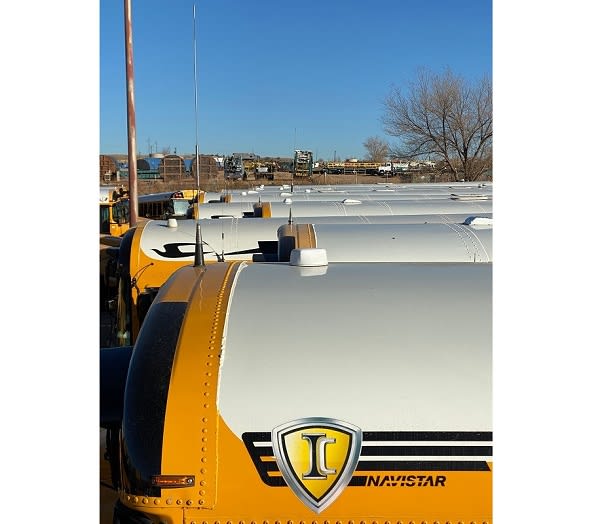
As many school districts use buses as mobile hotspots, suppliers and school district officials share best practices for optimal service delivery, including parking buses in convenient locations and having a flexible data plan.
Photo courtesy Kajeet
Since the start of the pandemic almost a year ago, the need for providing accessible and reliable internet connectivity to students has been pushed into the spotlight. As schools have shifted course to allow more flexibility for online learning, many school districts’ transportation departments have sought to equip most, if not all, of their school buses with Wi-Fi.
Along the way, some Wi-Fi suppliers and school district officials have noted best practices for ensuring continuous connectivity during the pandemic — and even afterward when students return to in-person learning. Here, they share those tips with School Bus Fleet:
1. Assess the Need for Access.
One of the most important steps in deploying Wi-Fi on the yellow bus, suppliers say, is finding out how many students actually need internet access and what neighborhoods those students live in. From there, the transportation department can make informed decisions on where those buses should be stationed in the community and/or what routes the buses should be assigned to.
Edward Dubose, the transportation director for Choctaw County (Ala.) Schools, says at the start of the 2020-21 school year his district sent out informational packets to students and their families informing them about the district’s plans to install AngelTrax’s Wi-Fi Hotspot Package on 32 of its regular route buses. The packet also included a survey to find out how many students would be participating in virtual learning at that time.
“When we have in-person and virtual learning students, this is one of the reasons why we want to have internet services on all of our buses,” Dubose says. “We are located in a rural area, and we need to see how many students are in need and where exactly, especially in those farther, hard to reach areas.”
2. Choose Ideal Hotspot Locations.
When parking Wi-Fi-enabled school buses in the community, Richie Howard, president and CEO of AngelTrax, says school districts should select centralized locations people are familiar with and feel safe at.
One example of this, he says, is stationing a school bus in a local parking lot that allows families to stay inside their cars — for social distancing purposes — while still being able to access the network.
Other examples of prime hotspot locations include shopping malls, apartment complexes, and mobile home communities.
3. Set Up Content Filters.
All mobile connectivity solutions used by school districts should have content filtering abilities that meet the standards of the Children’s Internet Protection Act (CIPA), according to Jacqueline Leclerc, marketing communications manager for school bus at Safe Fleet, another Wi-Fi provider. CIPA-compliant solutions can help establish a peace of mind for districts and parents as they are able to set filtering guidelines based on their specific needs. The main advantage, Leclerc says, is reducing students’ exposure to any harmful or inappropriate content.
4. Keep a Flexible Data Plan.
Having an adaptable data plan gives school districts the opportunity to create a truly customized connectivity solution that best fits with the district’s current learning plan — whether that’s going remote, introducing hybrid learning, or returning to the classroom, according to Gene Ballard, Kajeet’s director of strategy.
Under Kajeet’s SmartBus solution, school districts can purchase data plans in bulk for sharing across all connected buses as needed, eliminating overage costs, Ballard says. Customers can also roll over data from month to month, ensuring it is never wasted.
With Safe Fleet’s Smart Reach Hotspot, users can receive high usage alerts and reports, granting them the ability to manage data usage parameters for each user session and an annual data package per bus, Leclerc says. These features, she adds, can keep districts updated on their current data status, and allow them enough time to decide whether they should suspend a service or purchase more data.
If a school district prefers to use their own data plan, Safe Fleet recommends finding a carrier that has pre-established rates.
5. Find Alternative Uses.
The connected school bus extends far beyond assisting students in completing their homework tasks, says AngelTrax’s Howard. Wi-Fi-equipped school buses can be used to service many community needs — from opening more communication channels to helping districts coordinate meal deliveries to families in need.
This past summer, in the midst of the COVID-19 pandemic, Farmington (N.M.) Municipal Schools used two of its Wi-Fi-enabled school buses to help a local hospital after the medical building’s internet connection went down. The district parked the Kajeet SmartBus vehicles directly outside the hospital’s business offices so that staff could connect their devices and continue operations until their onsite connectivity was restored, according to Billy Huish, the district’s transportation director.
“We’re learning and experimenting with our buses,” he says. “It’s not just about having Wi-Fi on the buses; it’s about seeing how we can use them for the safety and well being of our community. As transportation staff, we need to ask ourselves ‘How can we use our vehicles for a greater benefit, especially in the case of an emergency?’”
In addition to helping its local hospital, Huish says Farmington Municipal Schools is also working to use its connected fleet of 33 buses to assist emergency preparedness plans in schools, specifically in providing connectivity during reunification efforts.
More Management

School Bus Contractors Expand Through New Deals, Acquisitions & Partnerships
STA's Canadian division acquires Ontario-based G&L Stevenson Transport while Durham School Services adds a new district contract in California, First Student adds a New Jersey contract, and Minnesota Coaches acquires Halo Transportation.
Read More →
Logan Bus Company Rolls Out AI Phone System for NYC School Bus Families
A summer pilot found that AI agents could handle most routine calls, freeing up time for customer service staff to focus on emergencies and complex family concerns.
Read More →
From Intent to Impact: What I Learned About Leadership from TAPT
A Texas transportation supervisor shares lessons on self-awareness, accountability, managing stress and building trust — and why investing in leadership development matters at every stage of your career.
Read More →


NAPT Names 2026 Award Recipients
Who earned national recognition for their work in student transportation? This year, NAPT named five recipients of its 2026 awards for service, safety, and leadership.
Read More →
2026 State of Student Transportation Report
Driver shortages. Rising costs. Growing safety expectations. More data, but not enough time to act on it. The 2026 State of Student Transportation Report reveals what transportation leaders say is putting the most pressure on their operations—and where they’re investing next. See how your priorities compare.
Read More →
How to De-Escalate an Angry Person: 5 Steps for Handling Workplace Conflict
What makes emotions run high, and how should you handle an angry colleague or parent? Follow these steps for staying calm, listening, showing empathy, and resolving conflict.
Read More →
What Readiness Looks Like This School Year
Learn about the challenges shaping the 2026–2027 school year, from persistent driver shortages and budget pressure to technology and readiness gaps. See how school districts are responding and adapting in Zonar’s 2026 Back-to-School Readiness Report.
Read More →
Changing Lanes: Executive Moves at Summit School Services, Zum, STA, Cummins, Transit Technologies, Driventic, & Cadex
See who's been hired, promoted, and appointed to leadership positions at various school transportation industry suppliers and private contractors.
Read More →
Industry Moves: Companies Expand Fleet Service & EV Infrastructure Footprints
The new facilities and regional hubs could mean faster access to shop equipment, charging support, and transportation technology for fleet operators.
Read More →
Doing More With Less: How Transportation Directors Can Prioritize Safety Amid Budget Uncertainty
With diesel prices soaring and nearly one-third of transportation directors expecting budget cuts, maintaining student safety has never been more challenging. Download this guide to learn how leading districts are prioritizing risk, funding critical safety technology, and building stronger budget cases with data.
Read More →