




5 tips for connecting with special-needs students
Using visuals and short, simple statements are key changes drivers and aides can make in their communication style to better connect with students who have hearing, vision and cognitive impairments, and physical endurance issues. Meanwhile, transportation directors should build a solid communication plan between drivers and aides, teachers, nurses and parents to ensure everyone involved has the information needed to serve the students.

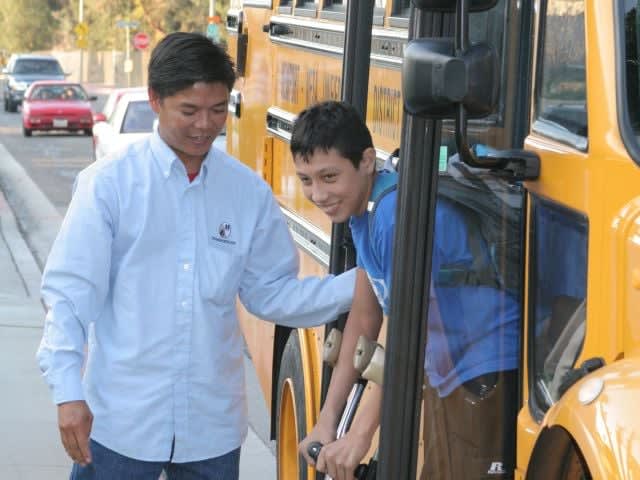
Creating a communication plan that brings everyone involved in the student’s well-being together allows each party to be better prepared in their setting and make sure the student is safe.
Bus drivers need to communicate differently when transporting special-needs students. What they say, the way they say it, and how they convey instructions must all be done in a way that gets through to students with hearing, vision and cognitive impairments, and physical endurance issues. A driver can’t simply adjust the volume or tone of his or her voice when urging a child to stay in his or her seat if that child has trouble processing language or is hearing impaired. Additionally, children with physical endurance issues may not be able to call out in a noisy bus to an aide or driver if they need help.
However, drivers can make simple changes in their communication methods and connect better with special-needs students. Since getting ongoing training can be a challenge with tight budgets, we offer tips from experts on what small, but effective adjustments drivers can make in communicating, and what transportation directors can do to make the transportation experience easier for everyone involved.
1. Get on their level. Often, adults will talk down to special-needs children, even if they do not have a cognitive disability, Cheryl Wolf, an Indiana-based consultant who conducts training at school districts, says.
The natural tendency is for an adult to stand up with the students beneath them, she says, but if a driver kneels and talks to them, especially a student in a wheelchair or a small child in a safety restraint, he or she can maintain eye contact and be more effective.
Susan Shutrump, supervisor, occupational and physical therapy services, Trumbull County Educational Service Center, in Niles, Ohio, agrees. “Often, adults will stand over kids and talk at them and not with them, giving the nonverbal cue that they’re the boss and you better listen, versus trying to [discuss something] or answer questions.”
2. However, don’t expect eye contact from some students, particularly those with autism, Shutrump says. She explains that this is often misunderstood as the child “not getting it.”
“We say to people in transportation, use pictures, cues, and graphics and present it wherever they are looking,” she says. “Don’t make them look at you. That’s not the way they learn best.”
3. Use visual communication. Sometimes autistic students or students with cognitive disabilities have trouble understanding language, but respond well to images and gestures. Instead of posting a list of rules at the front of the bus, Costa Mesa, Calif.’s Newport-Mesa Unified School District (USD) uses pictures duplicated from one of the school’s classes for students with autism, Pete Meslin, director of transportation, says. If a student’s behavior needs correcting, the driver or aide can point to the appropriate image.
Michael Benedict Jr., bus attendant, Provo (Utah) City School District, says that parents of students in his district also use pictures on cards showing images of what students might need, such as a restroom or a glass of water, that they can point to.
The images also help students who have physical endurance problems because they don’t have to struggle to muster up the vocal volume to yell to a driver or aide at the other end of the bus, Shutrump says. Trumbull puts picture strips on a ring and attaches them to the student’s belt loops and fastens them with Velcro on the seat back in front of them for evacuation procedures.
Newport-Mesa USD also teaches a ew key sign language phrases to bus drivers to communicate with hearing-impaired students.
[PAGEBREAK]4. Speak simply. Keep it short. Drivers must be careful with the words they use. Don’t talk too much. Use simple statements. Give multi-step directions one step at a time, and if possible, a picture of what each step looks like.
Students who have autism often are very literal in their understanding of language and don’t understand idioms, Shutrump says. For example, don’t say to a student who seems agitated, “You look like you have a bee in your bonnet.” Instead, ask, “Are you upset?” Many students with autism and auditory sensitivities also don’t pick up on vocal nuances, such as changing tone of voice, she adds.
Additionally, drivers should speak at a moderate volume when communicating with students who are hearing impaired, Shutrump says, because simply talking louder doesn’t clarify what you’re saying. Supplement instructions with pictures and gestures and use short, simple sentences.
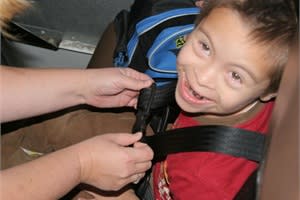
When securing a wheelchair, respect the child’s space. If the child can help fasten securement systems, he or she should be allowed to do so.
5. Respect the student’s space when securing a wheelchair or restraint. If the child can help, he or she should be allowed to do so. Often bus drivers and attendants get too “close and personal” because there’s not much space in a wheelchair station, Wolf says.
Benedict Jr. adds that drivers and aides should remember that there is a person in that wheelchair and not hurry through securing it.
Building a communication plan with teachers, nurses and parents
Meanwhile, transportation directors should encourage communication through every channel — parents, teachers, bus drivers and attendants, and the nurse’s office.
Meslin, who has given presentations for the past 20 years on building these partnerships, says that bringing everyone involved in the students’ well-being together is beneficial because a child who has a problem on the bus brings that to the classroom and vice versa. This allows each party to be better prepared in their setting and make sure the student is safe.
As part of its bus support plan, Newport-Mesa USD designed three-part forms that allow the driver and aide, teachers, school nurse and parents to track the child’s condition and behavior. The forms address the a.m. and p.m. bus rides, the home and the classroom. “It takes all of us to serve that student properly,” Meslin says.
Additionally, Benedict Jr. says that teachers and parents use notebooks and planners to tracks whats going on with special-needs students, which helps keep the transportation staff apprised of any problems to watch for.
“In districts where that partnership doesn’t exist, counterparts don’t share timely information about a student’s condition. Instead of communicating to help a team mate, it’s frequently thought of as, ‘My job is done. I’m going home. Now, it’s their job,’” Meslin adds. “That’s unfortunate, because we can all serve students more effectively if we are kept current.”
Benedict Jr. agrees. “Good communication between all parties [means] it isn’t going to be an uphill battle to provide excellent transportation service,” he says.
To ensure trust among all parties, drivers and attendants must be reminded every year that medical and behavioral information they receive must be kept confidential, Wolf adds.
Information on helping special-needs students should be presented the same way to drivers, attendants and teachers, Shutrump advises.
Newport-Mesa USD has its behavior specialist, who trains teachers on issues such as de-escalation techniques, train the drivers on them as well.
More Management

How to Build a Better Driver Training Program
Ready to boost up your school bus instructor training? Here’s how to pick the right talent and improve recruitment, retention, and safety.
Read More →
CALSTART and Forth Combine to Form Catalyst Mobility
The new name represents a renewed vision for the nonprofit focused on advancing clean, equitable, and affordable transportation solutions that move people and goods.
Read More →
What Makes a Great School Bus Driver Trainer?
Choosing the right school bus driver trainer takes more than experience. Learn six keys to selecting and developing trainers and evaluating program effectiveness.
Read More →

School Bus Contractors Expand Through New Deals, Acquisitions & Partnerships
STA's Canadian division acquires Ontario-based G&L Stevenson Transport; Durham School Services adds a new district in California; First Student expands in New Jersey; and Minnesota Coaches rebrands and acquires Halo Transportation.
Read More →
Logan Bus Company Rolls Out AI Phone System for NYC School Bus Families
A summer pilot found that AI agents could handle most routine calls, freeing up time for customer service staff to focus on emergencies and complex family concerns.
Read More →
From Intent to Impact: What I Learned About Leadership from TAPT
A Texas transportation supervisor shares lessons on self-awareness, accountability, managing stress and building trust — and why investing in leadership development matters at every stage of your career.
Read More →
NAPT Names 2026 Award Recipients, Hall of Fame Inductee
Who earned national recognition for their work in student transportation? This year, NAPT named five recipients of its 2026 awards for service, safety, and leadership, plus its newest Hall of Famer.
Read More →
2026 State of Student Transportation Report
Driver shortages. Rising costs. Growing safety expectations. More data, but not enough time to act on it. The 2026 State of Student Transportation Report reveals what transportation leaders say is putting the most pressure on their operations—and where they’re investing next. See how your priorities compare.
Read More →
How to De-Escalate an Angry Person: 5 Steps for Handling Workplace Conflict
What makes emotions run high, and how should you handle an angry colleague or parent? Follow these steps for staying calm, listening, showing empathy, and resolving conflict.
Read More →
What Readiness Looks Like This School Year
Learn about the challenges shaping the 2026–2027 school year, from persistent driver shortages and budget pressure to technology and readiness gaps. See how school districts are responding and adapting in Zonar’s 2026 Back-to-School Readiness Report.
Read More →