





Check Out: Rider Tracking Apps Ensure Safety, Transparency, & Peace of Mind
5 Questions: HopSkipDrive's Joanna McFarland on Modernizing Student Transportation
HopSkipDrive now provides alternative student transportation in 21 markets in 12 states, and continues to grow.
October 3, 2022
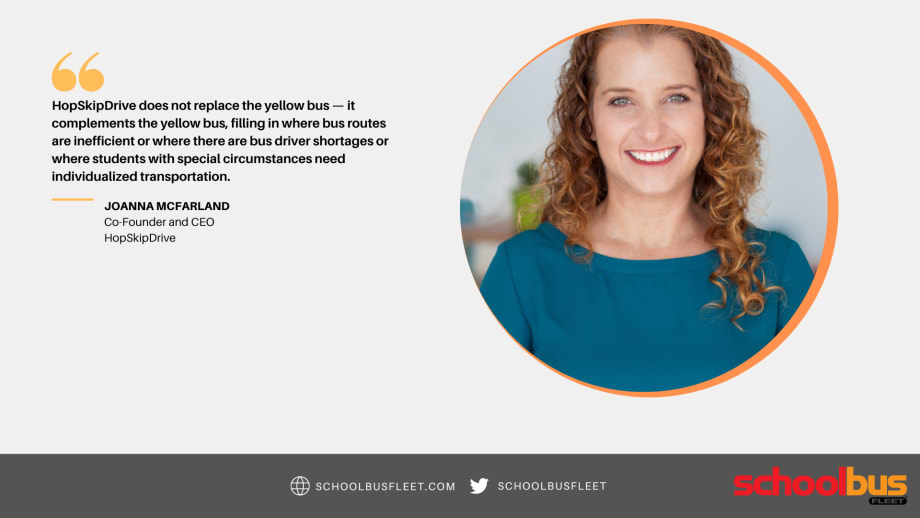
In this interview with School Bus Fleet, Joanna McFarland discusses the importance of safety, the growth of HopSkipDrive, and her company’s efforts to modernize student transportation as a complement to the familiar yellow school bus.
Image: HopSkipDrive, SBF
6 min to read
In 2014, Joanna McFarland and two other moms sought a solution to get their children to school without compromising their careers or sacrificing the needs of their kids due to busy schedules.
“Pretty quickly, we realized the solution we built for families was also an important solution for schools that manage varied transportation needs,” McFarland says. “Starting with a pilot partnering with Los Angeles County enabling transportation for youth in foster care, our district and county partnerships rapidly expanded.”
HopSkipDrive now spans 21 major markets in 12 states and continues to grow.
“To date, we’ve saved tens of thousands of busy families 34 combined years of drive time, we’ve partnered with over 400 schools and districts, and HopSkipDrive CareDrivers have driven over 20 million safe miles,” McFarland says.
In her spare time, the Denver-born McFarland hikes, reads, walks her dog Liza, and enjoys her family and friends.
In this interview with School Bus Fleet, she discusses the importance of safety, the growth of HopSkipDrive, and her company’s efforts to modernize student transportation as a complement to the familiar yellow school bus.
1. How has HopSkipDrive been affected by the nationwide driver shortage? Do you find a lot of retired school bus drivers making the shift to working as CareDrivers?
HopSkipDrive’s model is truly unique. What sets us apart is that we solve the driver shortage problem by creating new driver supply to safely solve school transportation challenges. CareDrivers are people in the community who have caregiving experience and want flexibility. They are not looking for full-time employment and do not want to obtain a CDL to drive a bus, but are still fully vetted and fully available to get kids to school safely in small vehicles. We do see CareDrivers with school bus driving experience. We also see school lunch aides, substitute teachers, nannies, home health aides and others who bring their caregiving experience and empathy to being CareDrivers.
2. The company recently landed $37M in Series D funding. How will that be applied to the growth of HopSkipDrive in the coming years?
HopSkipDrive is on a mission to modernize school transportation. We plan to use this funding to further our growth, bringing our solutions to more districts, and to continue to build our RideIQ platform. RideIQ helps districts optimize transportation plans, determining the right vehicle for each route (and each stop), whether that’s a bus, a sedan, or an SUV. HopSkipDrive does not replace the yellow bus — it complements the yellow bus, filling in where bus routes are inefficient or where there are bus driver shortages or where students with special circumstances need individualized transportation. HopSkipDrive makes school transportation smarter.
3. How does HopSkipDrive save money for school districts?
HopSkipDrive helps districts save money in a few ways, from introducing dynamic driver supply that can be flexed up or down so districts only pay for rides actually taken, to optimizing transportation plans. But saving money is only one of the ways HopSkipDrive helps districts.
HopSkipDrive reduces inefficiencies by acting as a complement to the yellow bus, filling in for underutilized bus routes or where students with special circumstance need individualized transportation. Our RideIQ technology recommends the right vehicle for each route and each stop so districts can then match rides to actual ridership.
HopSkipDrive drives opportunity and equity by decreasing commute times, in turn reducing tardiness, absenteeism and stress. In Los Angeles, HopSkipDrive helps cut commute times by more than 50% — giving students back an hour a day. We also enable transportation for school of choice, implementing small-vehicle solutions and more efficiently mapped routes. This makes choice more of an actual choice for all.
Children experiencing homelessness or in the foster care system also benefit from our flexible, dynamic driver supply. If a student in foster care moves to a new home placement at 10:30 at night, the school district can’t route a bus specifically for that student overnight — but a HopSkipDrive ride can ensure that child gets to their school the next morning.
HopSkipDrive continually innovates on safety, proactively and strategically implementing new technology and processes. For instance, HopSkipDrive utilizes GPS technology to track all rides, offering real-time visibility to parents and districts at each stage of the ride. Another tech-enabled safety measure is the use of mobile telematics to record any events of risky driving behavior, so that CareDrivers can continually improve on their safe driving.
Finally, HopSkipDrive reduces school transportation’s carbon footprint by replacing underutilized bus routes with small-vehicle solutions. Districts can then accelerate their fleet electrification, while using cleaner small-vehicle options to fill in for inefficient bus routes.
4. What’s been the most impactful accomplishment for the company since its launch?
Every day we hear amazing stories of the impact we have on kids as we help create equitable access to education.
One example is Georgina, an 18-year-old in foster care who had fallen behind in her credits due to frequently changing schools. Since her freshman year in high school, she had been to four schools, making it hard for her to find stability.
During her senior year, she was able to stay at her school of origin utilizing HopSkipDrive’s transportation solution to get to and from school. She could get to school at 7 a.m. to take credit recovery classes and stay after school for extra help. Through safe, reliable transportation, Georginia finished high school on time, with honors and received a Principal’s Award and a Citizenship Award.
Another example is a student who needed a behavioral aide to ride with her during any sort of transportation. After a few weeks of HopSkipDrive rides, the consistency of the rides and empathy shown by CareDrivers were so beneficial that she no longer needed a behavioral aide during HopSkipDrive rides.
5. What changes do you envision in the student transportation industry in the next five years?
I believe we’ll see a modernization of school transportation. Currently less than 30% of students ride a bus to school. Most districts route buses based on student transportation eligibility, not on actual ridership. Many districts don’t collect ridership data, so they are planning for riders that may never ride the bus. Districts don’t actually have a bus driver shortage problem; they have a utilization problem.
In the next five years, districts will embrace a multi-modal approach to transportation planning, using small-vehicle solutions like HopSkipDrive to better complement the school bus and make the whole system more efficient. They’ll use technology like RideIQ to match the right vehicle for each route (and each stop), whether that’s a bus, an SUV, or a sedan. Districts will match rides to actual ridership.
More efficiency will lead to districts being able to offer more equitable transportation services, reducing commute times and enabling students to take advantage of more opportunities both in and after school. Transportation should and can be an enabler of opportunity, not a barrier.
Subscribe to Our Newsletter
More Management
How to Build a Better Driver Training Program
Ready to boost up your school bus instructor training? Here’s how to pick the right talent and improve recruitment, retention, and safety.
Read More →
CALSTART and Forth Combine to Form Catalyst Mobility
The new name represents a renewed vision for the nonprofit focused on advancing clean, equitable, and affordable transportation solutions that move people and goods.
Read More →
What Makes a Great School Bus Driver Trainer?
Choosing the right school bus driver trainer takes more than experience. Learn six keys to selecting and developing trainers and evaluating program effectiveness.
Read More →


School Bus Contractors Expand Through New Deals, Acquisitions & Partnerships
STA's Canadian division acquires Ontario-based G&L Stevenson Transport while Durham School Services adds a new district contract in California, First Student adds a New Jersey contract, and Minnesota Coaches acquires Halo Transportation.
Read More →
Logan Bus Company Rolls Out AI Phone System for NYC School Bus Families
A summer pilot found that AI agents could handle most routine calls, freeing up time for customer service staff to focus on emergencies and complex family concerns.
Read More →
From Intent to Impact: What I Learned About Leadership from TAPT
A Texas transportation supervisor shares lessons on self-awareness, accountability, managing stress and building trust — and why investing in leadership development matters at every stage of your career.
Read More →
NAPT Names 2026 Award Recipients, Hall of Fame Inductee
Who earned national recognition for their work in student transportation? This year, NAPT named five recipients of its 2026 awards for service, safety, and leadership, plus its newest Hall of Famer.
Read More →
Sponsored•September 2, 2026
2026 State of Student Transportation Report
Driver shortages. Rising costs. Growing safety expectations. More data, but not enough time to act on it. The 2026 State of Student Transportation Report reveals what transportation leaders say is putting the most pressure on their operations—and where they’re investing next. See how your priorities compare.
Read More →
How to De-Escalate an Angry Person: 5 Steps for Handling Workplace Conflict
What makes emotions run high, and how should you handle an angry colleague or parent? Follow these steps for staying calm, listening, showing empathy, and resolving conflict.
Read More →
Sponsored•September 1, 2026
What Readiness Looks Like This School Year
Learn about the challenges shaping the 2026–2027 school year, from persistent driver shortages and budget pressure to technology and readiness gaps. See how school districts are responding and adapting in Zonar’s 2026 Back-to-School Readiness Report.
Read More →