




3 Ways Routing Software Can Simplify Planning for School Reopening
The latest solutions include features that gather additional variables — such as social distancing — introduced by the pandemic, quickly cover “what-if” scenarios, and enhance communication efforts, suppliers say.

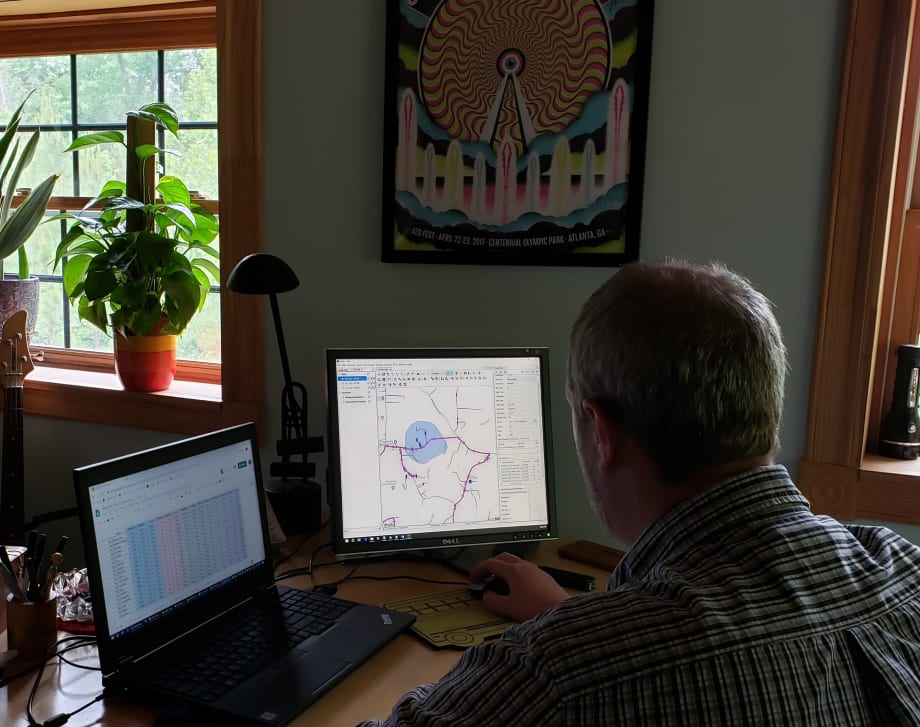
Shown here, Kevin Hart at the Institute for Transportation Research and Education at North Carolina State University works with school districts using Edulog’s routing software to plan for both a “regular” school reopening and a “what if?” analysis in response to COVID-19-based impacts.
Photo courtesy Kelly Hart
The COVID-19 pandemic has brought about several additional factors to further complicate school bus route planning, already a very intricate and fluid process.
Currently, the overarching goal is to accommodate social distancing. The Centers for Disease Control and Prevention recently recommended seating one student per row and skipping rows, which would mean only about a dozen or so students aboard a Type C (conventional) bus. Given a persistent driver shortage potentially worsened by the pandemic due to some drivers falling into a susceptible age group for contracting coronavirus and not feeling safe on a bus, and tight budgets not allowing for the purchase of several more buses, making routing adjustments to meet these guidelines is challenging.
Measures being considered include tiered routing and additional tiers; restricting which students are eligible to ride the bus by increasing walk zones and assigning some to be transported, at least temporarily, by parents; and changing bell times to accommodate multiple sessions.
Derek Graham, a consultant and former state director of pupil transportation in North Carolina, says that transportation departments need to have used this odd spring season to get fall planning for a "normal" school opening in place earlier than usual.
“As school start gets closer,” he adds, “they will need to be even more flexible than usual to react with routing plans as districts develop and refine policies to implement social distancing.”
When accounting for all the other variables transportation departments have to factor into those plans — multiple addresses for one student, daycare drop-offs, transfer locations, driver callouts, breakdowns, parent requests — social distancing adds a very complicated logistical layer, says Ted Thien, vice president and general manager of Tyler Technologies.
Luckily, transportation departments are filled with people who have mastered the art of putting a complex puzzle together and updating it as things inevitably change each day, he notes.
Additionally, says Jason Corbally, president of Education Logistics (Edulog), districts with a reliable routing software system and accurate data are well-positioned to respond to changing scenarios and provide policymakers with the answers they need to prepare for the new school year.
Here, School Bus Fleet shares some of the changes routing software suppliers expect to see when schools reopen and a few ways their solutions can help pupil transporters respond to the resulting routing challenges.Predictions
All the routing software suppliers SBF spoke to for this story said that it remains to be seen how the next school year will play out, and that plans will vary from state to state based on when they enter different reopening stages.
Bryan Mitchell, a spokesperson for Synovia, a subsidiary of technology solutions provider CalAmp, says that virtual learning will probably grow and drastically change the way many districts conduct their school day.
Tyler’s Thien agrees. He foresees districts limiting the number of students in a classroom, for example, half the students are distance learning while the other half are at school. Educators would likely set up a system such as day variant school attendance (some students attending on even days of the month, and others attending on odd days.)
Where this gets tricky, he adds, is that routes are planned by geography, and school attendance will probably be planned by student needs, including grade, program, building, Individualized Education Program, and class size. So, while day variant attendance may reduce the number of students riding the bus, it likely won’t do it evenly.
Thien predicts several very short runs — possibly five or six tiers, compared to the typical two or three.
Corbally agrees.
“Undoubtedly more runs or trips will be required if the limit is one student per bus seat and only half the students go to school each day,” he says.
Richard Papa, general manager of TripSpark Technologies, points out that parental concern could also mean fewer students on buses for some time. More parents may opt to drive their children to school, which could increase congestion during pickup and drop-off times, especially if the school does not have the necessary space to accommodate the additional vehicles.
Antonio Civitella, president and CEO of Transfinder, and Diego Crespo, CEO of Viafy, both note that transportation departments will also need to revisit how bus stops are created to allow for students to social distance at those locations.

Viafy is now offering a platform that helps districts develop and enforce biosecurity practices. Shown here is the supplier's live map view feature.
Photo courtesy Viafy
1. “What-If” Scenario Planning
These possibilities mean that even more variables need to be applied to bus routing in “what-if” scenario planning.
Traversa, Tyler Technologies’s routing software, is designed to help users manage multiple addresses and different days of the week for student pickups and drop-offs, input various bell times for the same school and/or different sets of students, and enter unlimited custom fields to track and manage data for students, drivers, and vehicles. Most importantly, route planners can modify student records, runs, and other information in unlimited what-if scenarios without affecting plans in the live environment, Thien says, allowing for additional flexibility.
Recent releases of Traversa include the Auto-Route feature in Traversa’s Advanced Routing mode, which can create a group of runs automatically based on parameters such as total load and total time.
TripSpark’s VEO Transportation solution lets users create multiple “what-if” scenarios that show how any change could affect a current route. The scenario functionality allows users to reschedule existing stops/students on existing buses or new buses with changed capacities.
For example, in response to the recommendation of fewer students on a bus to accommodate social distancing, the user could reset the bus capacity to the appropriate number and the software would re-route accordingly, Papa says.
However, he notes, changes to bell times, walk zones, tiering schemes would need to be done in a separate database or using another school semester.
Transfinder’s Routefinder PLUS allows route planners to quickly view many different scenarios and respond to new district policies based on factors such as the number of students per seat. For example, if only 11 students are allowed on a 66-passenger bus, Routefinder Plus’s optimization tool will determine how many more trips and vehicles may be needed, Civitella says. It will also assist route planners who opt for a multi-tier approach or alternating student in-person school days.
“Routefinder is built specifically to deal with ‘what if’ scenarios so routers can adjust to a changing landscape,” he adds.
With Edulog’s “what-if” optimization capabilities and frequencies (scheduling different trips on different days), school districts can model alternatives and accurately predict how many buses and drivers will be needed, Corbally says.
Meanwhile, Synovia recently launched a new version of Here Comes the Bus, its bus tracking and fleet management software, which helps school districts create unique stops without routing software, allowing for more planning flexibility.
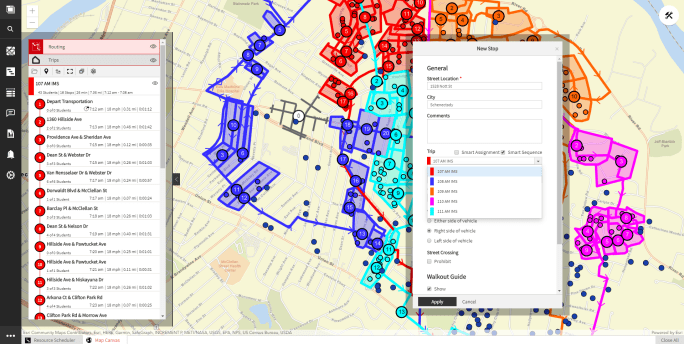
Transfinder’s Routefinder PLUS allows routers to quickly view multiple scenarios and respond to new district policies based on factors such as the number of students per seat.
Photo courtesy Transfinder
2. Integrating New Variables
Routefinder Plus also offers trip optimization functionality that will incorporate new district policies related to walk-to-stop distances or students-per-seat by grade. That includes tracking how long it takes to load a bus by grade, which could change if students are required to use hand sanitizer as they enter the bus, Civitella says.
In addition to its Route Suggester feature, which can automatically identify routes certain buses are covering and link them to students and stops to build new, dynamic routes, Viafy is also now offering a platform that helps districts develop and enforce biosecurity practices, such as taking drivers’ and students’ temperatures before they enter the bus. Districts and transportation companies will need to feel confident that their processes are appropriate and assure safe transportation, Crespo says.
“This, in turn, will be useful in a case where a district needs to be able to ‘prove’ that everything was handled as it should be, as well as giving districts and transportation companies a tool to help [instill] confidence in parents when sending their kids back to school on a school bus,” he adds.
3. Enhancing Communication Efforts
Educators and transportation departments need to work together to decide whether to deploy staggered bell times or introduce day variance based on factors such as learning needs and geography. Traversa can assist by importing any field, such as homeroom teacher or special programs, from a student information system, Thien says.
Additionally, a routing software solution integrated with onboard technology will be critical to ensure student safety. Bus and student tracking apps and driver tablets will be invaluable tools, Papa says, to help drivers and pupil transporters provide accurate real-time information to parents.
“That will help maintain a trusting relationship during this uncertain time,” he adds.
Edulog also provides a parent notification app, which is especially helpful when schedules are constantly changing, Corbally says.
Civitella also recommends that districts consider starting an opt-in registration process for parents who want school bus transportation for their children. Then, route planners can focus on those students.
“You can make it part of your process to require 72-hour notice before utilizing bus service, giving your routers time to make adjustments,” he explains.
Users can survey parents and guardians with the Stopfinder Communication app, which is available for free to any North American school district for the remainder of the 2020 calendar year, Civitella says.
More Management
How to Build a Better Driver Training Program
Ready to boost up your school bus instructor training? Here’s how to pick the right talent and improve recruitment, retention, and safety.
Read More →
CALSTART and Forth Combine to Form Catalyst Mobility
The new name represents a renewed vision for the nonprofit focused on advancing clean, equitable, and affordable transportation solutions that move people and goods.
Read More →
What Makes a Great School Bus Driver Trainer?
Choosing the right school bus driver trainer takes more than experience. Learn six keys to selecting and developing trainers and evaluating program effectiveness.
Read More →


School Bus Contractors Expand Through New Deals, Acquisitions & Partnerships
STA's Canadian division acquires Ontario-based G&L Stevenson Transport while Durham School Services adds a new district contract in California, First Student adds a New Jersey contract, and Minnesota Coaches acquires Halo Transportation.
Read More →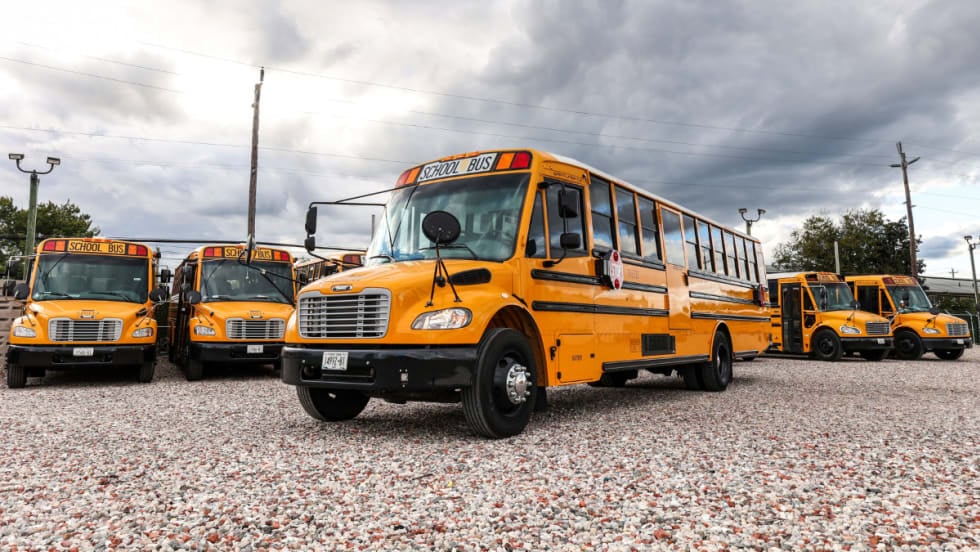
Logan Bus Company Rolls Out AI Phone System for NYC School Bus Families
A summer pilot found that AI agents could handle most routine calls, freeing up time for customer service staff to focus on emergencies and complex family concerns.
Read More →
From Intent to Impact: What I Learned About Leadership from TAPT
A Texas transportation supervisor shares lessons on self-awareness, accountability, managing stress and building trust — and why investing in leadership development matters at every stage of your career.
Read More →
NAPT Names 2026 Award Recipients, Hall of Fame Inductee
Who earned national recognition for their work in student transportation? This year, NAPT named five recipients of its 2026 awards for service, safety, and leadership, plus its newest Hall of Famer.
Read More →
2026 State of Student Transportation Report
Driver shortages. Rising costs. Growing safety expectations. More data, but not enough time to act on it. The 2026 State of Student Transportation Report reveals what transportation leaders say is putting the most pressure on their operations—and where they’re investing next. See how your priorities compare.
Read More →
How to De-Escalate an Angry Person: 5 Steps for Handling Workplace Conflict
What makes emotions run high, and how should you handle an angry colleague or parent? Follow these steps for staying calm, listening, showing empathy, and resolving conflict.
Read More →
What Readiness Looks Like This School Year
Learn about the challenges shaping the 2026–2027 school year, from persistent driver shortages and budget pressure to technology and readiness gaps. See how school districts are responding and adapting in Zonar’s 2026 Back-to-School Readiness Report.
Read More →