




17 projects tabbed for ‘Clean School Bus’ grants
WASHINGTON, D.C. — The Environmental Protection Agency (EPA) will fund 17 projects to help reduce pollution, mainly by replacing older school ...

WASHINGTON, D.C. — The Environmental Protection Agency (EPA) will fund 17 projects to help reduce pollution, mainly by replacing older school buses and retrofitting newer ones with particulate filters and oxidation catalysts.
The $5 million program was announced by acting EPA Administrator Marianne Horinko. “Our goal is that by 2010, every school bus in America will be a ‘clean bus,’ emitting less pollution,” she said.
EPA officials said they received 120 applications for projects, with 17 chosen for grant funding.
Among the grantees are school districts, local and regional air quality management programs and the National School Transportation Association (NSTA). The NSTA received $500,000 in grant funding for a two-year demonstration program. Executive Director Jeff Kulick said the funding will be parceled out to member companies for the purchase of clean diesel buses or emissions-reduction technology. It could also be used to subsidize the purchase of ultra-low sulfur diesel fuel, he said.
Here is a list of several other EPA grants recipients and how they plan to use the funding:
North Allegheny School District, Pittsburgh — The suburban district will retrofit its fleet of 84 buses with diesel oxidation catalysts and work to bring ultra-low sulfur diesel into an area where it is not currently available.
Texas State Energy Conservation Office — The office will assist three large school districts (Dallas/Ft. Worth, Austin and Houston) in retrofitting about 73 buses with particulate filters, purchasing new buses and fueling the fleet with ultra-low sulfur diesel.
Clovis (Calif.) Unified School District — The large suburban district will retrofit 53 buses with diesel oxidation catalysts and evaluate their performance running on emulsified diesel fuel in addition to retrofitting nine buses with particulate filters and fueling them with ultra-low sulfur diesel fuel.
Columbus (Miss.) Municipal School District — The small, rural district will retrofit 47 of its 59 buses with diesel oxidation catalysts.
Salt Lake Clean Cities Coalition, Salt Lake City — The coalition will assist a large urban district that is already using some CNG buses in acquiring 10 new buses that run on compressed natural gas to replace the district’s oldest diesel-fueled buses.
Joint tracking, routing systems launched
SALT LAKE CITY — Two major routing software suppliers, Edulog and Trapeze Software, unveiled their integrated tracking and routing applications at the National Association for Pupil Transportation’s (NAPT) annual conference and trade show in November.
Using Everyday Wireless’ Real-Time Tracking, the systems allow transportation operations to know both where their buses should be and where they actually are in one application.
The applications are designed to save school districts significant operating costs by improving driver performance, optimizing routes using real-world conditions, responding to developing situations quickly and generally increasing control over transportation operations.
Grant Reppert, director of transportation for Gwinnett County Public Schools in Lawrenceville, Ga., spoke to attendees at the NAPT conference on his department’s experience with integrated tracking and routing. In a workshop titled “Case Study: How to Create an ‘Intelligent Bus’ System,” Reppert described the district’s vision to improve its fleet by incorporating vehicle tracking, student tracking, routing/tracking software and onboard processing power in each bus.
Gwinnett County began running a 15-bus pilot of Everyday Wireless hardware and the integrated Trapeze software. “With over 1,100 buses performing 6,000 daily routes, we wanted to pinpoint the exact location of our buses in case of an emergency and to make sure safety restrictions were being followed by our drivers,” said Reppert.
Reppert described an incident that prompted the district to take action. A student came on the radio one day saying that his bus had been hit by a train and he was the only survivor. Then the radio cut out. Not knowing where the bus was, district and emergency personnel scrambled to cover any railroad crossing where it could have been.
The “accident” turned out to be a prank, but it raised legitimate concerns. In the case of such a hoax, the integrated tracking/routing program would have allowed the transportation department to immediately determine that the bus was not at a rail crossing and was moving along the route as scheduled.
In addition to the safety benefits, Gwinnett County figures it can save 5 to 10 percent of labor costs. Reppert said the application significantly increases efficiency by managing route factors such as load size, time and design as well as increasing effectiveness of dispatching.
Oregon contractor killed in plane crash
PENDLETON, Ore. — Doug Flatt, CEO of Mid Columbia Bus Co., died on Oct. 22 after his plane went down near Seaside, Ore.
“This is a devastating loss to his family and to the Mid Columbia communities we serve,” said Tony Barnhart, CFO of Mid Columbia. “Doug built a successful school transportation business.”
Flatt, an experienced pilot with more than 4,500 hours of flying time, was attempting to land his single-engine plane in heavy rain and gusting winds. The crash occurred on private property about 1,000 feet from the Seaside airport.
Mid Columbia, which was founded in 1964 by Flatt’s father, Bill, operates more than 600 buses and transports approximately 16,000 students each day. Earlier this year it was named one of the “Great Fleets Across America” by SCHOOL BUS FLEET.
Flatt was an active member of the National School Transportation Association and the Oregon Pupil Transportation Association. He was named Contractor of the Year in 1999 by SBF. Flatt was also an active member of Associated Oregon Industries (AOI), the state’s largest business association, for more than 15 years. At the time of his death, he was serving on the board of directors and executive committee. He was also a founding member of the association’s political action committee.
“Doug was a statesman,” said AOI President Richard M. Butrick. “He always shared the rural perspective with other representatives of Oregon’s business community and worked diligently to improve the state as a whole. The Oregon business community has lost a leader.”
Flatt is survived by Cindy, his wife of 30 years; their son Lloyd; his dad Bill; brothers Kevin, Bruce and Jeff; and sister Laurie. His mother, Peggie, and daughter, Stephanie, preceded him in death.
New Laidlaw CEO sees singular growth options
SALT LAKE CITY — Three months into his tenure as the new president and CEO of Laidlaw Education Services, Hugh MacDiarmid is impressed by what he sees in the school transportation industry.
“It has a great value system,” MacDiarmid told SCHOOL BUS FLEET Editor Steve Hirano during an interview at the National Association for Pupil Transportation’s annual conference in Salt Lake City in November. “To our people it’s more than a job, it’s a higher calling. Two million children ride a Laidlaw bus to school each morning and we take that responsibility very seriously.”
MacDiarmid, who took over the reins from John Grainger in early August, focused his energy in his first 90 days on “getting out into the field,” visiting approximately 30 branch operations and a half-dozen customers.
He has previous experience in the transportation field, but in a very different environment. From 1995 to 2001 he was an executive vice president in charge of marketing and sales at Canadian Pacific Railway, one of the six major North American freight railroads.
But MacDiarmid sees some overlap with school transportation: “The importance of managing assets; hiring, training and retaining a top-caliber workforce; effective operating and information systems and safety as the guiding principle,” he said.
Before taking the job at Laidlaw, MacDiarmid was president of Killin Management Corp., a private equity investment firm in Ottawa, Canada, that focuses on the technology sector. His resume also includes a stint as president of SC Stormont Corp., a financial advisory firm that negotiated the initial financing of the National Hockey League’s Ottawa Senators.
MacDiarmid said one of Laidlaw’s key initiatives is searching for growth opportunities, which is difficult given the limited number of conversion opportunities in the school transportation market. “Today we are basically competing against one another for the same pool of contracts for districts that have made the decision to outsource,” he said, adding that this circumstance had led to aggressive pricing. “We’re all competing for the same business. It’s a zero-sum game.”
To expand the opportunity for growth, MacDiarmid says Laidlaw will target school districts that are not necessarily interested in converting to private operation — but may be interested in contracting with Laidlaw for related services, such as safety training programs. These “unbundled” services require a smaller investment of time and energy on both sides of the table, contractor and school board.
“I think we need to rethink the product that we’re trying to sell,” MacDiarmid said. “As an industry we might need to reshape our product offering to be more in line with what our customers want rather than what we’re selling.”
Although Laidlaw led the contractor consolidation movement in the 1990s, MacDiarmid said he’s not inclined to grow market share through acquisition, unless it occurs naturally. “A higher priority for our organization is to achieve all of the efficiencies and advantages from what we’ve already created,” he said. “We’re more inclined to take our existing operation and make it as effective as possible.”
Video makes a difference
SYRACUSE, N.Y. — The Pupil Transportation Safety Institute (PTSI) has released the second training video in its Best Practice Series — “Someone Who Made a Difference: The Key Role of Bus Attendants.” The 16-minute video sells for $89 plus $5 shipping and handling. It includes instructional tips on the effective use of training videos and group discussion questions.
“Someone Who Made a Difference” examines the powerful influence bus attendants and bus drivers can have on children in today’s troubled world.
“The video takes place in the not too distant future, as a high school senior works on her college application,” said Jim Ellis, script writer and curriculum development specialist at PTSI. “As part of the application package, she has to write an essay about ‘Someone Who Made a Difference in My Life.’ She chooses to write about a bus attendant.”
As she works on her essay, the student recollects how the attendant touched her life at a very difficult period in her childhood.
“The video is guaranteed to stimulate discussion and reflection in your frontline transportation staff — about attitude, professionalism and caring,” added Ellis.
“The purpose of PTSI’s Best Practice Series is to share cutting-edge school bus safety procedures with bus drivers and attendants around the country,” said Ted Finlayson-Schueler, PTSI’s executive director. “The series is based on the principle that school bus safety is the result not only of laws and government mandates but of innovation and initiative from the field.”
To order the video or for more information, visit PTSI’s online store at www.ptsi.org, call (800) 836-2210 or e-mail info@ptsi.org. PTSI is a national non-profit school bus safety education organization.
Driver helps catch runaway horse
MANCHESTER, N.J. — The job of a school bus driver doesn’t end when the last student is dropped off, according to Dave Wilderman, a driver with the Manchester (N.J.) Township School District.
Wilderman, who helped a student catch her horse after it had escaped from her yard, said he was just doing his job. As he made his last stop of the day, Wilderman noticed the horse was loose and alerted owner Alayna Mack, a seventh grader who rides his bus.
Known as a practical joker, Wilderman’s call to the transportation office wasn’t taken seriously at first. “We thought it was just one of his little games, but it wasn’t,” said Val Varga, director of transportation for the district.
“I try to get away with what I can, but this really shocked everybody,” Wilderman said. “The horse was looking at me and I was looking at the horse and we were both deciding what to do next.”
The horse decided to run in the direction of a major highway with its owner in pursuit. The nine-year driver stayed in the bus and followed the horse and girl to prevent other cars from passing until police arrived to handle the situation.
“He really cares about all the kids,” said Varga. “This is an example of how he looks out for their best interests and their safety.”
— KRISTEN FORCE
Industry associations respond to diesel study
TORRANCE, Calif. — In response to a California Air Resources Board (CARB) study released in October, stating that diesel exhaust from school buses poses a health risk to students, three key school bus industry associations released a statement cautioning against the alternative methods of transportation to school.
The National Association of State Directors of Pupil Transportation Services (NASDPTS), the National Association for Pupil Transportation (NAPT) and the National School Transportation Association (NSTA) jointly warned that potential risks of diesel emissions are dwarfed by the more immediate dangers posed by students walking, bicycling or riding to school with a parent or friend rather than taking a school bus.
“The greatest risk is a current and factual one — 800 children are killed every year because they didn’t ride school buses,” said Charlie Gauthier, executive director of NASDPTS. Gauthier urged parents not to overreact to the study’s claim by taking their children off buses.
Mike Martin, executive director of the NAPT, added, “The CARB study says that, as a nation, we can do even better by moving to newer, cleaner engine technologies. Our industry shares CARB’s constructive view that state and federal legislators should provide funds to accelerate the replacement of school buses.”
NSTA Executive Director Jeff Kulick noted the industry’s support of the Environmental Protection Agency’s Clean School Bus USA program and pointed out that many states are already replacing or retrofitting school buses to reduce diesel emissions.
“We are parents, too, and want the best for our children,” said Kulick.
More Alternative Fuels
Bipartisan Bill Seeks to Extend Clean School Bus Program Through 2031
The proposed legislation would renew federal support for cleaner school buses as districts navigate funding uncertainty, rising fuel and infrastructure costs, and fleet replacement needs.
Read More →
Alt-Fuel Moves: Electric Bus Rollouts, Bidirectional Charging & Propane Growth
See which fleets are adding electric and propane school buses as districts and operators invest in charging infrastructure, bidirectional technology, and alternative-fuel expansion.
Read More →
Nobody Told Diesel Prices They Were Supposed to Come Down
With diesel prices surging, school bus fleets have new reason to stress-test fuel costs, consider diversification, and calculate what each route really costs to operate.
Read More →
Why Gasoline School Buses Are Making a Comeback
Gasoline is gaining ground in full-size school buses. See how today’s options stack up against diesel on cost, maintenance, emissions, performance, and more.
Read More →
EPA Opens $180M DERA Funding Round for Diesel Upgrades
The 2026 Diesel Emissions Reduction Act program seeks applications from eligible organizations to accelerate the retirement of legacy diesel vehicles.
Read More →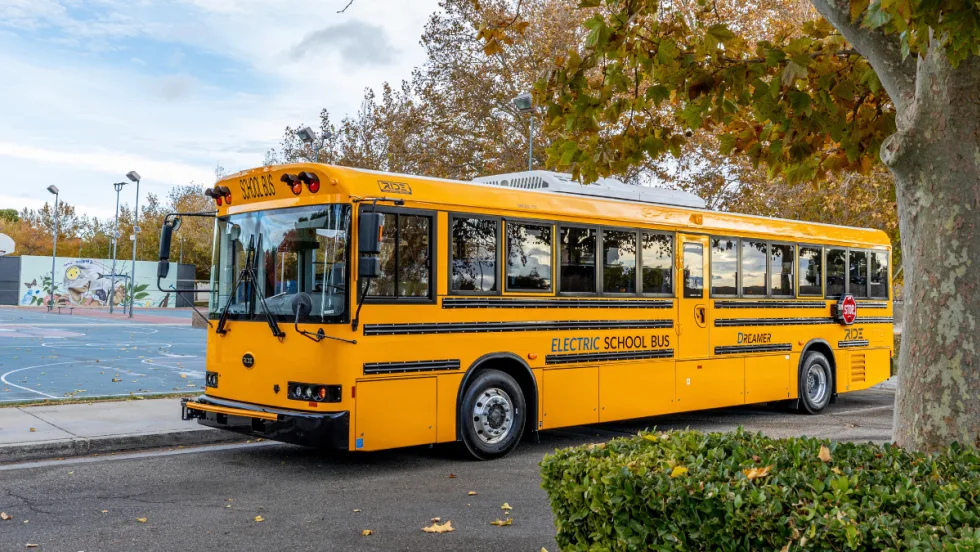
The Secret Life of an Electric School Bus Battery
Batteries change throughout years of daily routes, but degradation doesn’t necessarily mean the end. Here’s what operators should know about performance, safety, and second life.
Read More →
CALSTART and Forth Combine to Form Catalyst Mobility
The new name represents a renewed vision for the nonprofit focused on advancing clean, equitable, and affordable transportation solutions that move people and goods.
Read More →
Alt-Fuel Moves: New Buses, Charging Hubs & Real-World EV Testing
Propane and electric school bus deployments continue to grow as districts add new vehicles, expand charging infrastructure, and gather more real-world operating data.
Read More →
Fewer Electric School Bus Models Reshape the U.S. Market
WRI’s latest buyer’s guide points to a consolidating electric school bus market, but fewer options may reflect a maturing industry rather than fewer meaningful choices for school bus operators.
Read More →
The Fuel Budget You Can Actually Predict: How Propane Autogas Keeps Money in the Classroom
Learn how propane autogas helps school districts manage fuel costs with predictable pricing, lower maintenance, and reduced emissions from former transportation director Joel Stutheit.
Read More →