




10 Tips for Stepping Up School Bus Security
From thorough pre-trip inspections to building rapport with students, here are 10 practices that can help prevent or respond to security threats.

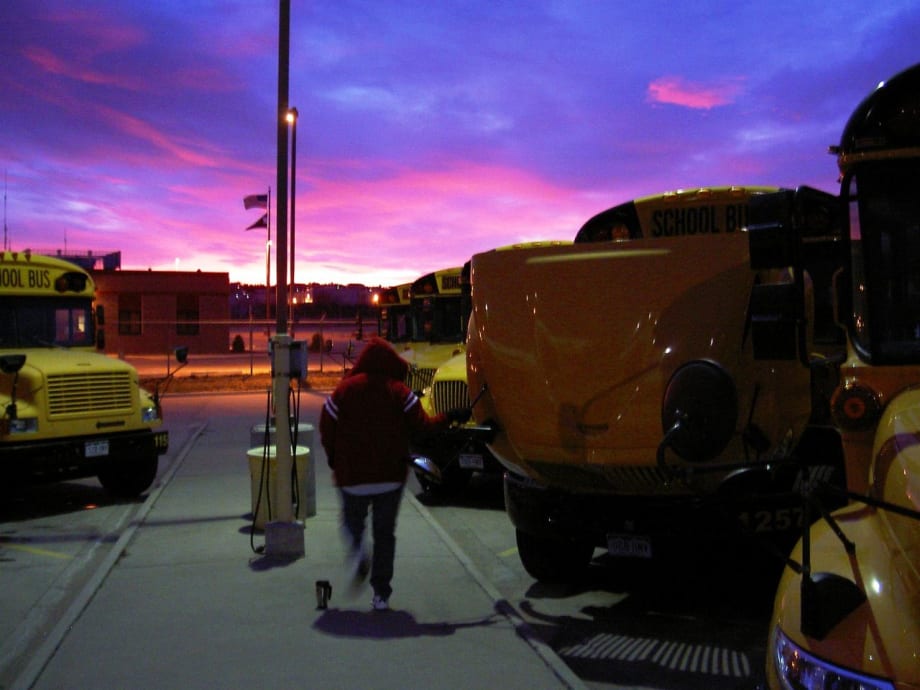
Photo by John Horton
There’s a lot that goes into keeping school buses and their passengers safe and secure.
It’s a team effort that involves the drivers, dispatchers, instructors, managers, technicians — really everyone in the school transportation operation.
It’s about performing daily duties thoroughly, building relationships with students, planning and training on how to respond to threats, and watching for anything out of the ordinary that could be considered suspicious.
As security expert Jesus Villahermosa puts it, “We need to be vigilant, not hyper-vigilant. … Proactive, not paranoid.”
Here are 10 pupil transportation practices that can help bolster security on the bus.
1. Inspect thoroughly
Drivers’ pre- and post-trip inspections of their school bus serve multiple purposes, including looking for any mechanical issues and checking for sleeping children. Another aspect should be a security check.
Gary Moore, safety coordinator for the Missouri Center for Education Safety, says that school bus security starts with the driver doing a thorough pre-trip. Moore stresses the importance of checking that the rear emergency exit door is working properly. That’s important for any type of emergency, whether it’s a crash, a fire or an armed intruder.
Disabling that exit could be part of a planned attack, notes Moore, a retired Missouri Highway Patrol captain. “If someone comes aboard [and] the back door has been screwed shut, you’ll have a higher kill count than any school has ever seen.”
In its School Bus First Observer training program, the Transportation Security Administration (TSA) advises that a security sweep should be a part of every pre-trip and post-trip inspection. TSA lists several security-related steps that should be included:
Look for signs of unauthorized entry or tampering.
Check for abandoned items, unusual packages or objects.
Look under the driver’s seat and all passenger seats.
Check under the bus and in wheel wells.
Check inside all internal and external compartments, including the engine compartment, luggage compartments, sign light area, battery box, trash receptacle, glove box and bulkhead.
“Our job is to not only make sure that the vehicle is technically sound, but also that no one has put any threat material on this vehicle that could harm our students,” the TSA program notes.
2. Be observant
A key theme in security is being aware of one’s surroundings and looking for anything out of the ordinary. Moore uses the term JDLR to refer to something that “just doesn’t look right.”
“Everybody has a range of what they think is normal,” Moore says. “If it’s outside of normal, it’s a JDLR. Document it and report it to somebody.”
In the context of a bus stop, that could mean identifying a person who isn’t normally there and seems out of place. At Humble (Texas) Independent School District (ISD), the school bus drivers know the parents, and the same parents are at the stops every day.
“The drivers are aware if someone shouldn’t be there,” says Mark Swackhamer, assistant director of transportation.
The JDLR concept can also be applied to drivers’ observations of their passengers — watching what they’re doing with their hands, being aware of their body language, noting what they’re carrying, etc. For example, if one day a student brings an instrument case on the bus but hasn’t brought it in the past, the driver can ask about it in a non-threatening way, as Moore suggests: “Is that a guitar case? I didn’t know you play guitar. Can I see it?”
In the June 2014 shooting in Troutdale, Oregon, police said that a 15-year-old student brought guns and ammunition to school inside a guitar case and a duffel bag, which he carried aboard a school bus.
3. Build rapport, respect with students
When school bus drivers have established relationships with their passengers, those passengers will be more likely to tell the driver of any concerns they might become aware of.
“We ask our bus operators to get to know their students — establish rapport,” says Greg Akin, director of transportation at Volusia County (Fla.) Schools.
The Department of Homeland Security has a campaign called “If You See Something, Say Something,” which advises that everyone has a responsibility to report suspicious activity. That message is conveyed to students at Volusia County Schools. “That translates into school security and school bus security,” Akin says.
Jesus Villahermosa, president of Crisis Reality Training Inc., says it’s “critical that drivers establish good relationships with the students on their bus.” He recommends that drivers recognize something positive about each student at least once a week. “Reach out to those kids —especially the loner kids.”
Respect should be a key part of the relationship. Villahermosa says that students should be taught to address school bus drivers with courtesy titles (Mr., Mrs., Ms.), and the drivers must establish ownership of the bus.
Building these relationships could make the difference in whether a student comes forward with information about a security threat. Villahermosa notes that in most school shootings, the shooters had told other students about what they were planning to do, but those students didn’t tell an adult.
“But if they respect you, if you own that bus, they will warn you if someone is bringing a weapon on the bus,” Villahermosa says.
4. Use the driver's side window
Keeping unauthorized people from boarding the bus is a vital factor in school bus security. Accordingly, parents or others who want to discuss a concern with the driver should be directed away from the service door — either to the driver’s side window or, better yet, to the transportation office.
“If somebody comes up beating on your door, make sure that person comes around to the driver’s side window,” Swackhamer says. “Prevent them from getting on the bus at all, and make sure you can drive away if needed.”
Moore notes that some people will resist going around to the driver’s window because it will put them in the street.
“If that’s the case, [they should] go to the transportation or school office,” Moore says. “This is not question-and-answer time for parents. They can call the office."
5. Develop radio code words
If the driver becomes aware that a student has brought a weapon onto the bus, he or she should call dispatch. But saying, “There’s a weapon on my bus,” or even, “I have a code 47,” will let everyone on the bus know that there’s a crisis.
“Any time you use the word ‘code,’ people know something is wrong,” Villahermosa says.
Villahermosa, who was a deputy sheriff with the Pierce County (Wash.) Sheriff’s Department for 33 years before he retired last year, recommends that school bus operations establish radio code words for certain emergency situations. For example, a driver telling dispatch, “I have right rear tire mechanical issues,” could be the code for a student with a weapon on the bus. The dispatcher would then know to call 911.
Volusia County Schools has established similar radio protocols. For instance, if a student tells the driver that another student has a weapon, “The driver could say, ‘I have a breakdown. I need assistance,’” Akin explains. “We have codes — the students don’t know what they are.”
6. Prepare for various scenarios
During in-service training at Volusia County Schools, a variety of scenarios is discussed — incidents that have happened on buses in the district and elsewhere — so that drivers will be well versed on how to respond, whether it’s inclement weather or a hostage situation.
“Plans are great to have, but they have to be flexible,” Akin says. “We have to make sure that the individual on the bus is prepared to make that first critical decision.”
Many operations, including Volusia, have their drivers undergo TSA’s School Bus First Observer training. The 30-minute program gives an overview of how terrorists operate and educates drivers on suspicious activities that they should report. First Observer is available at www.tsa.gov/first-observer.
7. Work with police
Establishing relationships with law enforcement can open up numerous opportunities for bolstering school bus security. For example, police departments and school bus operations can collaborate on security training exercises that will benefit the staff of both organizations.
In October, the Harris County (Texas) Sheriff’s Office performed school bus assault training using Humble ISD buses. District transportation staff and police department employees participated in a simulated hostage takeover with students on a bus.
At Volusia County Schools, Akin meets regularly with officials from the multiple police jurisdictions within the county. They discuss a variety of topics, from security issues to stop-arm running. Volusia County Schools has also worked with law enforcement on training that involved a bus takeover and a SWAT team response.
8. Utilize technology
Technology can’t replace driver vigilance and preparedness, but it can supplement them to help enhance school bus security.
Volusia County Schools recently launched a rider verification system. Younger students swipe an RFID card as they enter or leave the bus. Older students have their own code that they enter. “It helps us respond quicker if there is a missing student,” Akin says.
Also on the security front, Volusia’s fleet is equipped with GPS and onboard video surveillance systems. On a low-tech note, the buses all have identification numbers painted on the roof in case they need to be identified from the air in an emergency.
9. Force as a last resort
In cases of imminent danger, the school bus driver may need to respond physically to a threat. As Moore explained in his presentation at the National Association for Pupil Transportation Summit in November, objects on the bus — a fire extinguisher, wasp spray, de-icer, etc. — could be used to fend off a shooter, first by spraying and then by hitting him with it.
Also, the bus itself can be used as a defensive tool, by accelerating, braking or swerving. This could throw a gunman off of his feet, giving the driver a few seconds to “neutralize” him. Three quick ways to do that, Moore says, are gouging the eyes, striking the throat and striking the groin.
10. Bring in outside speakers
Consider occasionally bringing in an outside expert for a security training session for your drivers. That could be a local police official or a nationally known security consultant.
Parkway School District in Chesterfield, Missouri, had Moore come in for a session on active shooter response last year. The previous year, the district held a presentation by Gray Ram Tactical on de-escalation of violence.
Will Rosa, director of transportation at Parkway, says that the district’s goal is to make security an annual training topic, along with updating staff with information and reminders via an electronic bulletin board during the year.
In January 2014, Storey County (Nev.) School District’s bus drivers and other transportation staff learned how to respond to active shooters and other security threats in an eight-hour class by Apex-SCF. Kelly Knapp, the district’s director of transportation, said afterward that the training bolstered her staff’s confidence in being able to maintain school bus security. “Everyone is feeling more empowered, more in control of their routes.”
Here are several organizations that offer training for school bus operations:
S.T.A.R.T. program (School Transportation Active-Threat Response Training)
Crisis Reality Training (Jesus Villahermosa), www.crisisrealitytraining.com
Missouri Center for Education Safety (Gary Moore), moces.org
Gray Ram Tactical, grayramtactical.com
More Safety

How to Build a Better School Bus Driver Training Program
Is it time to strengthen your driver training? Here’s how to pick the right talent and improve recruitment, retention, and safety. This video is brought to you by IC Bus.
Read More →
Recent School Bus Accidents Leave 2 Dead, 2 Injured
Four school bus crashes in Florida, Illinois, and Georgia highlight risks in transportation lots, at bus stops, and during student loading and unloading.
Read More →
When Every Second Matters, Clarity Keeps Routes Moving
From routine delays to urgent incidents, strong communication practices help drivers, dispatchers, schools, and families respond with confidence.
Read More →

What Happens When a School Bus Catches Fire — and What Can Help
School bus fires are rare but can be devastating. Learn how advances in fire suppression and asset protection help fleets detect fires earlier, reduce damage, and improve safety.
Read More →
Geotab Launches Tool to Help Fleets Investigate Road Incidents
Geotab Investigations combines telematics data, video, documents, and other evidence to help fleets reconstruct incidents, resolve claims, and determine what happened.
Read More →
Texas Sixth Grader Wins 2026 National School Bus Safety Poster Contest
Sai Darshana Yekolu of Moseley Middle School in Prosper, Texas, was named the newest winner for her artwork, bringing the theme of “Safe Rides, Everyday Heroes” to life.
Read More →
Doing More With Less: How Transportation Directors Can Prioritize Safety Amid Budget Uncertainty
With diesel prices soaring and nearly one-third of transportation directors expecting budget cuts, maintaining student safety has never been more challenging. Download this guide to learn how leading districts are prioritizing risk, funding critical safety technology, and building stronger budget cases with data.
Read More →
Walton County Schools Adds Gatekeeper Stop-Arm Enforcement System
The Florida district will deploy Gatekeeper’s updated Student Protector technology, which now incorporates AI to improve video evidence.
Read More →
How To Build a More Secure School Bus Yard During and After Hours
As thefts and overnight security threats continue, school transportation leaders are combining stronger operational practices with AI-enabled surveillance to better protect buses, facilities, and staff.
Read More →
FMCSA Names New Chief Safety Officer: What School Bus Operators Should Know
Steve Dowling is set to lead the federal agency's efforts to advance commercial motor vehicle safety and reduce crashes, fatalities, and injuries on the nation's roadways.
Read More →