




5 Questions: Bill Powell on Responding to Hurricane, Building Industry Leaders
It's been a busy year for Bill Powell, who moved into a new transportation facility, dealt with the impacts of Hurricane Harvey, and became president of the Texas Association for Pupil Transportation.

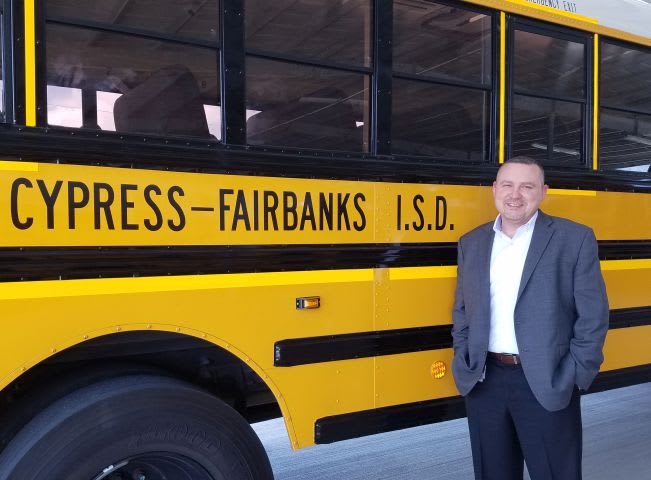
Bill Powell, president of the Texas Association for Pupil Transportation, says that some districts have had to adjust school bus routes and bell schedules, among other changes, in the wake of Hurricane Harvey.
Bill Powell, president of the Texas Association for Pupil Transportation, says that some districts have had to adjust school bus routes and bell schedules, among other changes, in the wake of Hurricane Harvey.
It’s been a busy year for William “Bill” Powell, director of the department of transportation at Cypress-Fairbanks Independent School District (ISD) in Houston. As he shares here, he moved into a new transportation facility, dealt with the impacts of Hurricane Harvey, and became president of the Texas Association for Pupil Transportation (TAPT).
1. Tell us about how your operation responded to Hurricane Harvey.
Prior to the storm, we secured our facilities and designated buses to be utilized by our local volunteer fire department. When the storm engulfed our community, the fire department needed our assistance, and we had several technicians and drivers eager to help evacuate those with rising water in their homes.
2. Are there ongoing impacts of the storm for school transportation?
Several school districts in our area have campuses that have been devastated and will not be operational for months to come. We have an elementary campus that we have had to house out of another facility and have had to reroute those buses.
Other districts are being very creative with their bell schedules and routing to get students back to school and some sense of normalcy. Humble ISD was forced to have their two high schools share one building, causing students to only attend either morning or afternoon classes. Other districts are utilizing community colleges and other local facilities.
3. Tell us about TAPT’s role in the recovery process.
We are attempting to assess the needs of all districts impacted by the flooding and provide any assistance we can. We have asked all our member school districts to assess their fleets to determine if they may even be able to provide a bus or two if the need arises, as initial reports were that some districts had several buses that were flooded. We have also provided some helpful reminders from Brian Weisinger [former technician and transportation director] of what needs to be checked on vehicles that have taken on water.
4. You moved into a new facility earlier this year. How is that working out so far?
Our four facilities were overcrowded, and we needed a new transportation center due to our growth. We were very fortunate to have the fifth facility included in our 2014 bond program, which has allowed us to utilize our current buildings at their designed capacities. Starting this school year, we are almost at capacity as projected, and we anticipate we will need our sixth center by 2020.
We built a second floor at the new center to include our global transportation administrative team and added our second body shop that has a full paint booth for buses. We also opened our doors to assist our school district police department to operate a substation in the southwest portion of our district for about 25 officers. That was not part of our original plans.
5. Do you see a need for mentoring new people in the industry?
Every industry would be remiss if mentors were not at least accessible to those entering the vocation of their choice. A formal mentorship program takes an abundant amount of time, effort, and resources. Without an abundant amount of time and resources, I believe our industry has created an effective alternative through our state and national certification programs and through the relationships developed in our workshops and conferences. However, I would also encourage leaders in school districts and our state and national organizations to consider having some type of succession plan if they have not done so already.
The primary objective of any succession plan should include identifying individuals that model those characteristics that further our mission to safely and efficiently transport our schoolchildren, and then help prepare and grow them through our professional certification programs. I believe this is essential not only on a local level, but also state and national levels, to continue the success of our industry.
Learning from those who began our TAPT professional certification program, and becoming a part of that program in 2002, has afforded me the opportunity to share my experiences and the knowledge I have gained since I started driving a school bus 29 years ago while attending college. Being on the TAPT executive committee has also allowed me to help identify those who have the same passion for transportation that my mentors instilled in me and encourage them to become more involved with their district and with TAPT.
More Management

How to Build a Better Driver Training Program
Ready to boost up your school bus instructor training? Here’s how to pick the right talent and improve recruitment, retention, and safety.
Read More →
CALSTART and Forth Combine to Form Catalyst Mobility
The new name represents a renewed vision for the nonprofit focused on advancing clean, equitable, and affordable transportation solutions that move people and goods.
Read More →
What Makes a Great School Bus Driver Trainer?
Choosing the right school bus driver trainer takes more than experience. Learn six keys to selecting and developing trainers and evaluating program effectiveness.
Read More →


School Bus Contractors Expand Through New Deals, Acquisitions & Partnerships
STA's Canadian division acquires Ontario-based G&L Stevenson Transport while Durham School Services adds a new district contract in California, First Student adds a New Jersey contract, and Minnesota Coaches acquires Halo Transportation.
Read More →
Logan Bus Company Rolls Out AI Phone System for NYC School Bus Families
A summer pilot found that AI agents could handle most routine calls, freeing up time for customer service staff to focus on emergencies and complex family concerns.
Read More →
From Intent to Impact: What I Learned About Leadership from TAPT
A Texas transportation supervisor shares lessons on self-awareness, accountability, managing stress and building trust — and why investing in leadership development matters at every stage of your career.
Read More →
NAPT Names 2026 Award Recipients, Hall of Fame Inductee
Who earned national recognition for their work in student transportation? This year, NAPT named five recipients of its 2026 awards for service, safety, and leadership, plus its newest Hall of Famer.
Read More →
2026 State of Student Transportation Report
Driver shortages. Rising costs. Growing safety expectations. More data, but not enough time to act on it. The 2026 State of Student Transportation Report reveals what transportation leaders say is putting the most pressure on their operations—and where they’re investing next. See how your priorities compare.
Read More →
How to De-Escalate an Angry Person: 5 Steps for Handling Workplace Conflict
What makes emotions run high, and how should you handle an angry colleague or parent? Follow these steps for staying calm, listening, showing empathy, and resolving conflict.
Read More →
What Readiness Looks Like This School Year
Learn about the challenges shaping the 2026–2027 school year, from persistent driver shortages and budget pressure to technology and readiness gaps. See how school districts are responding and adapting in Zonar’s 2026 Back-to-School Readiness Report.
Read More →