With Expert Teamwork, District Brings Transportation In-House
With only a few months’ notice, staff members at Savannah-Chatham County Public School System in Georgia bring their varied skills to the table to create a pupil transportation program nearly from scratch.
Nicole Schlosser・Former Executive Editor
September 12, 2017
7 min to read
When a school bus company and Savannah-Chatham County Public School System parted ways a little more than a year ago, the school board decided that the district would take the wheel.
In the spring of 2016, the district officially launched its in-house transportation program. This followed a decision from school bus contractor Reliant Transportation, a subsidiary of MV Transportation that was in the middle of a two-year contract with the district, to no longer serve as the district’s transportation service, says Vanessa Miller-Kaigler, deputy superintendent for Savannah-Chatham County Public Schools.
“The board decided that they would transition the department internally,” she explains.
The decision made sense, given that the district owns a fleet of about 451 buses and has three bus parking lots. Additionally, because of the timing, the district did not look into selecting another contractor because then it would have had to go through the formal solicitation process and negotiations, and have the contract approved very close to school opening.
However, that left the district with mere months to come up with an alternate form of school transportation for summer school, which was just around the corner, and the subsequent 2016-17 school year. The tasks facing the district included interviewing, screening, hiring, and training drivers, monitors, mechanics, and transportation directors; completing department of transportation inspections; and purchasing new equipment such as computers, workstations, furniture, and uniforms.
“We literally started the department from ground zero,” Miller-Kaigler notes. “The only thing that was in place were the school buses.”
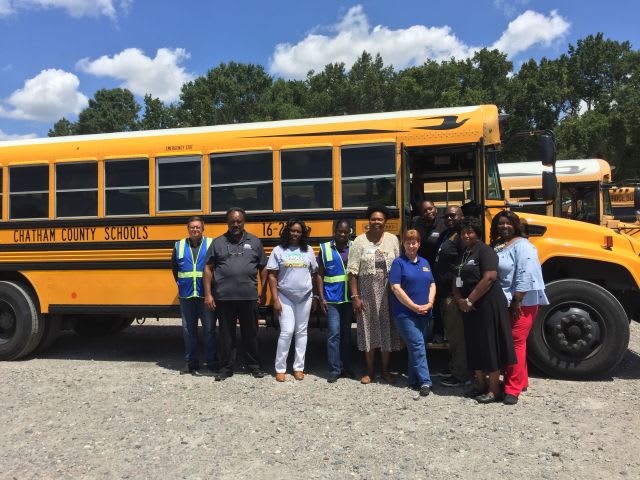
In the face of these challenges, staff members pulled together and combined their skills to help make the new program a success.
Fleet Facts
In-house start: Spring 2016 Headquarters: Savannah, Georgia Total buses: 451 Bus types: Blue Bird, IC Bus, Thomas Built Service area: 426 square miles Routes serviced daily: 336 Drivers: 334 Other staff: 100 Students transported daily: 26,858
Teamwork
Multiple departments in the district teamed up on the transition, including operations, academic affairs, human resources, technology, and the public safety department. Additionally, the board allocated the necessary resources — both human and capital — to make the move successful.
“We all worked together as a team,” Miller-Kaigler says. “As the superintendent said, we all work for transportation as part of the transition.”
To help streamline the process, team members from multiple district departments developed what they called a “management action plan” that listed every task to be completed by each department involved, in categories ranging from technology to human resources to academics.
Another team player of sorts was software solutions supplier Transfinder, which was instrumental in helping the district develop its routes. Staff members trained extensively with a representative from the supplier.
“We worked very closely with them that very first year,” Miller-Kaigler says.
Meanwhile, the technology department integrated software systems for the district and the new transportation department. The transportation department wanted to use Zonar not just for bus pre-trips and post-trips, but as its timekeeping system, and to interface with Kronos, the district’s timekeeping system. The technology department also worked with the management team and with Transfinder to ensure that student data could transfer from PowerSchool, the district’s student record-keeping system, into Transfinder. Then, once bus routes were developed, the public safety department made sure they were all safe.
In another collaborative effort: The district used Transfinder software to adjust bell schedules (start times) for students on Tybee Island during Hurricane Matthew in October 2016.
The Transfinder system was different from what the school bus contractor had used for routing for many years, so getting the bus routers accustomed to new software also presented a challenge, according to Annette “Kecia” Ling, director of operations for Savannah-Chatham County Public Schools. (Transfinder presented its third annual Ambassador of the Year award to Ling during its Annual Client Summit in May.)
However, Transfinder did much of the routing work, which allowed the district to downsize from 376 routes to 336 routes, according to Ling.
“All of the departments in the district played a role in the transition, with specific roles, responsibilities, and deadlines,” Miller-Kaigler says.
She advises other school districts who may be transitioning from contracted to in-house transportation to develop a comprehensive management action plan to streamline the process.
“Buy-in and ownership from the top down is critical to the success of the transition,” Miller-Kaigler says, including among board members and all applicable district departments: finance, human resources, public safety, and facilities.
Ad Loading...
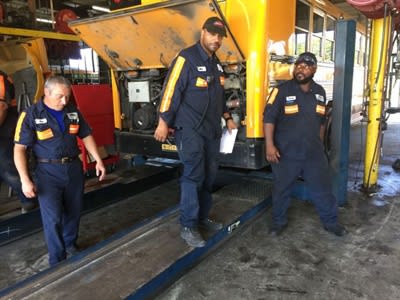
Savannah-Chatham County Public School System’s transportation department is closer to becoming fully staffed: With 15 mechanics, it is aiming for about 25.
Hurdles
Even with everyone doing their part, Ling pointed out when accepting the award from Transfinder that her team still worked 13-hour days for two months to be ready for summer school and the start of school in the fall.
The first year of the new program also presented significant staffing challenges.
The staffing process included making sure all background checks and physicals were completed, that the department had the number of drivers and monitors to accommodate the number of routes needed, and that enough uniforms were purchased. The department also needed to focus on completing department of transportation inspections, Miller-Kaigler says.
Meanwhile, a new interim transportation director, Rosalind Nathaniel, was hired in April 2017. For her, the biggest challenge as she stepped into the new program was gaining acceptance from the team and buy-in to the purpose of getting children to school and home safely.
“As long as we keep our purpose in front of us, and I keep reminding [staff members] of it, we will meet each challenge as an opportunity to continue to improve and succeed,” Nathaniel says.
The transportation department is still working to fully staff its ranks with mechanics, with 15 on board now, and is aiming for about 25, Miller-Kaigler says.
The department also wasn’t initially able to staff every route with drivers, she points out. Some of the field supervisors and trainers, dispatchers, and routers who were CDL-licensed stepped in to augment the driving staff.
However, this year on the first day of school, Aug. 3, the transportation department was only short three drivers.
“All but one of our routes were covered on the first day of school, and we had a field supervisor to cover that route,” Miller-Kaigler says.
To keep driver staffing levels up, the transportation department has established an intern program for drivers who are in training. Once they complete the program, they officially join the staff as drivers. Now, the department is close to having a “bench” or a group of backup drivers, Miller-Kaigler says. Additionally, drivers who had previously worked for the district through the contractor and left are choosing to return to the district.
“I think a lot of it was the unknown for some of the drivers, because they had worked for a third-party provider for a number of years and were transitioning over to the district,” Miller-Kaigler says. The department must have done something right, because they lost very few drivers at the end of the first year, she adds.
“It’s up and running masterfully right now.”
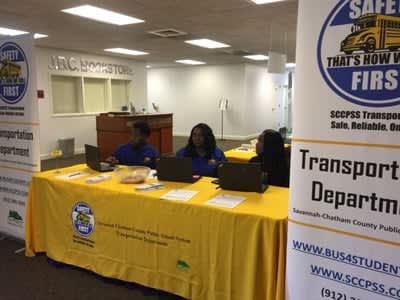
Customer service representatives recently conducted a back-to-school information session at a local church, answering questions about pupil transportation for the 2017-18 school year.
Success
Miller-Kaigler’s strong contracting, negotiating, and finance experience also contributed to the success of the transition.
Miller-Kaigler had been with the district for 25 years before becoming deputy superintendent of the district. She joined Savannah-Chatham County as a senior buyer, and about five years ago was moved to the facilities department. There, she managed operations, construction, and facilities, and when the partnership between the district and contractor ended, the task of managing pupil transportation fell to her as the operations chief.
“I did not have any previous transportation experience,” she says. “So, it was a challenge, but it was a challenge that I was willing to take on.”
School board members who weighed in have seen changes for the better as a result of the transition to in-house student transportation.
Before returning student transportation to the district, the board of education and school board representatives often received complaints from parents about school bus transportation, says Irene Hines, a school board member for the district.
“There were many challenges before us as we prepared for the beginning of the 2016-17 school year, but with competent leaders, a strong, supportive school board, superintendent, and staff, we were successful in safely transporting over 20,000 students to and from school,” Hines says.
Moving into the second year of transporting students, the school board has received very few complaints, if any, from parents.
“I am happy that we are now transporting our students and no longer need or desire to have third-party transport,” Hines adds. “The transportation team worked tirelessly in getting the job done. To Mrs. Kaigler and staff, thanks for all that you do in transporting our students to and from school.”
Board member Shawn Kachmar’s concerns about bringing transportation service in-house were appeased because Miller-Kaigler’s leadership team laid out a thoughtful, detailed, and comprehensive plan and executed it well, he says.
“We had some bumps the first year,” Kachmar says, “but those bumps were quickly and efficiently addressed through the new customer-oriented approach, implemented by district staff.”
The new name represents a renewed vision for the nonprofit focused on advancing clean, equitable, and affordable transportation solutions that move people and goods.
Choosing the right school bus driver trainer takes more than experience. Learn six keys to selecting and developing trainers and evaluating program effectiveness.
STA's Canadian division acquires Ontario-based G&L Stevenson Transport while Durham School Services adds a new district contract in California, First Student adds a New Jersey contract, and Minnesota Coaches acquires Halo Transportation.
A summer pilot found that AI agents could handle most routine calls, freeing up time for customer service staff to focus on emergencies and complex family concerns.
A Texas transportation supervisor shares lessons on self-awareness, accountability, managing stress and building trust — and why investing in leadership development matters at every stage of your career.
Who earned national recognition for their work in student transportation? This year, NAPT named five recipients of its 2026 awards for service, safety, and leadership, plus its newest Hall of Famer.
Driver shortages. Rising costs. Growing safety expectations. More data, but not enough time to act on it. The 2026 State of Student Transportation Report reveals what transportation leaders say is putting the most pressure on their operations—and where they’re investing next. See how your priorities compare.
What makes emotions run high, and how should you handle an angry colleague or parent? Follow these steps for staying calm, listening, showing empathy, and resolving conflict.
Learn about the challenges shaping the 2026–2027 school year, from persistent driver shortages and budget pressure to technology and readiness gaps. See how school districts are responding and adapting in Zonar’s 2026 Back-to-School Readiness Report.