




10 factors that affect vehicle dynamics
Understanding vehicle dynamics will help the driver maintain optimum control of the bus, which is essential to maintaining student safety. Here, factors ranging from tires and centrifugal force to weight shift and acceleration are addressed.

For the past 28 years, I have been a member of the Washington State Driver Training Planning Committee. During this time, our agency built a strong working relationship with the Washington State Patrol. Together, we designed an advanced training curriculum on vehicle dynamics for Washington driver trainers to teach in an effort to prepare our state’s 12,000 school bus drivers for unexpected moments out on the open road.
Given that we transport precious cargo, knowing the dynamics of your vehicle is essential. Understanding vehicle dynamics will allow you to maintain optimum control, even in the most unexpected driving conditions and during inclement weather, because you will understand the effects when maneuvering in and out of traffic on roadways, and you will understand how road conditions impact the operation of your bus.
Here, I’ll explain some factors and their role in vehicle dynamics.
1. Pre-trip inspection
If you are expecting a vehicle to be able to respond and react to your immediate needs, you must first perform a thorough pre-trip inspection. The vehicle needs to meet all state and federal criteria to operate on a public roadway.
2. Tires
The tires are often the most neglected area of a vehicle, but they are one of the most vital components for you to maintain control of the vehicle. Proper tread depth and inflation are key factors.
3. Centrifugal force or inertia
This is the force that keeps an object traveling in a straight line. As a vehicle attempts to negotiate a curve in a road, centrifugal force or inertia tries to push the vehicle to the outside of the curve, keeping it moving in a straight line. Imagine a ball on a string as you swing it around in a circle and then let it go — it will continue going straight.
4. Friction
Friction is resistance to slipping. Non-moving friction is called static friction, and moving friction is dynamic or coefficient friction. Our job is to keep as much friction between the tires and the surface of the road as possible. Without friction, a vehicle would be impossible to control.
5. Contact patch (footprint of bus)
The contact patch is where the tires and road surface actually meet. If you were to hold your hand up, the contact patch would not be much larger than your hand while the bus is at a resting position. Multiply this by six for a school bus with six tires. Your contact patch will vary in size according to the inflation of the tires; it is best to use the recommended air pressure for the tires you have.
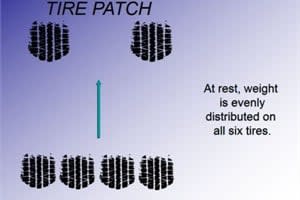
Both under- and overinflated tires will decrease the contact patch. Underinflated tires will have a tendency to invert cup the tire and reduce the contact patch with the roadway. Overinflated tires will peak the tire, meaning it is bulging in the center. Once again, this will decrease the contact patch with the road surface.
[PAGEBREAK]
6. Weight shift/weight transfer
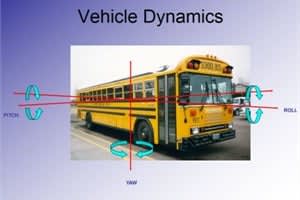
This signifies when weight is transferred to the front, rear or sides of the vehicle. Weight shift transfer is critical to overall vehicle control. This occurs anytime the driver brakes, accelerates or turns the bus.
We are all familiar with how the bus leans on a curve. This lean is because of the increased downward force on the side of the vehicle. The pitch of the vehicle is caused when weight shifts to the front or rear. The roll is caused when weight shifts side to side. Yaw is created when a vehicle rotates around the center axis.
7. Acceleration
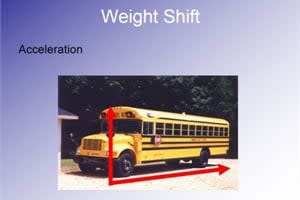
When you accelerate a bus, the weight shift transfers to the rear of the bus, increasing traction to the rear tires as their footprint becomes greater in unison, thereby decreasing the traction to the front tires.
As the footprint becomes smaller at the front of the bus, it can create a poor steering situation.
[PAGEBREAK]
8. Braking
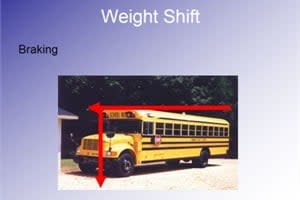
When braking, the weight shifts to the front of the vehicle, providing increased traction to the front tires. The footprint at the front is now larger, creating a better steering situation.
9. Curve negotiation techniques
Plan on reducing your speed to your maximum negotiable speed before entering a curve. The best rule of thumb is to use the threshold braking method: be firm but smooth on the brakes at first and more aggressive on the brakes up to the start of the curve, but never too abrupt. Do not stab the brakes, as this may cause wheel lockup. Get off the brakes as you start your turn. This is also called straight-line braking. This technique provides more steering ability to your front tires.
10. Apex
The apex is the halfway point of the curve. Set yourself up “high” prior to entering a curve. You would want to be in the lane as far to the outside as possible. This would be on the opposite side of the curve’s turn. If it is a left curve, follow the fog line; for a right curve, follow the center line, but never go over the center line.
Smoothly steer the vehicle toward the apex, maintaining a constant speed — do not brake during the lateral weight change (turning in the curve). Continue through the curve until the roadway begins to straighten out. You start high in the curve, drift low and drift back high again to the furthest portion of the lane. Apply power at or just past the apex, accelerating to rebalance the footprint of the tires.
Summary
Identifying how vehicle dynamics affect operating the vehicle is essential to student safety. The primary objective is to maintain a positive contact patch between the vehicle’s tires and the surface of the road.
Marcia Hahn is a school bus driver trainer instructor for the state of Washington. She is also transportation director at Wenatchee (Wash.) School District #246.
More Management
American Student Transportation Partners Acquires AJ Myers and Sons
A new deal brings a 75-year Pennsylvania student transportation provider into one of the nation’s largest private school bus contracting groups.
Read More →
What I Brought Home From SBFX: Relationships, Leadership, and Preparing What's Next
Who could lead your transportation operation tomorrow if you couldn't? Bernando Brown explores succession planning, mentorship, and preparing emerging leaders to step up.
Read More →
Inside School Bus Fleet ConneX 2026: Industry Leaders Connect in Scottsdale [Photos]
See highlights from SBFX 2026 in Arizona, where school bus operators and suppliers gathered for meetings, education, networking, awards, and more.
Read More →

School Transportation’s Biggest Pressures and Opportunities: SBFX Attendees Weigh In
School bus operators point to rising costs, staffing, and vehicle prices as immediate pressures while identifying technology, training, and routing as opportunities for growth.
Read More →
STA Acquires Sunrise Transportation
Student Transportation of America expands in Illinois and Connecticut through Sunrise's fleet of nearly 1,000 vehicles.
Read More →
EPA Opens $180M DERA Funding Round for Diesel Upgrades
The 2026 Diesel Emissions Reduction Act program seeks applications from eligible organizations to accelerate the retirement of legacy diesel vehicles.
Read More →
HopSkipDrive’s CareEngine Targets the ‘Exceptions’ in Student Transportation
The new platform works alongside districts’ existing transportation management systems to coordinate specialized rides, automate last-minute changes, and turn ride data into operational improvements.
Read More →
The Right Ride for Every Student: Navigating the New Student Transportation Ecosystem
How should districts blend school buses with small-vehicle transportation and other options? EverDriven CEO Mitch Bowling discusses safety, costs, partnerships, and strategy.
Read More →
Annette Brown Always Takes the Extra Time: Meet Our 2026 School Bus Driver Hero
For more than 30 years, the Wa-Nee Community Schools driver has treated students like family, combining safety, compassion, and servant leadership to make a lasting difference on and beyond the school bus.
Read More →
How to Build a Better Driver Training Program
Ready to boost up your school bus instructor training? Here’s how to pick the right talent and improve recruitment, retention, and safety.
Read More →