




Get Informed: How to Create a Safe Social Space in School Transportation
Safe Transportation of Motorized Wheelchairs and Scooters
The evolution of motorized wheelchairs demands a strategic approach to transportation safety. With sophisticated features and high costs, meticulous procedures for loading, securing, and unloading are imperative. Collaboration with specialists and adherence to regulations are essential to ensure student safety and facilitate independence.
by Kathy Furneaux and Jean Zimmerman
June 1, 2001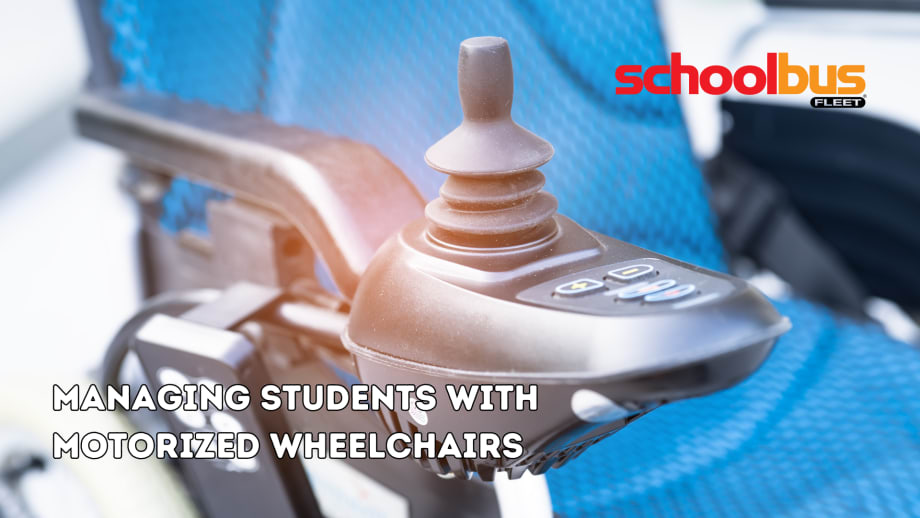
The long-term goal of any student's education is to prepare her to live as independently as possible. This means learning how to eventually use public transportation. So when it has been determined that a student is capable of maneuvering her own motorized wheelchair onto the bus lift, it is recommended that she be allowed to do so.
Source: Canva
8 min to read
Motorized wheelchairs are becoming increasingly sophisticated. Some motorized wheelchairs have power tilt and power recline capabilities. Some can be controlled by head movements, eye blinks and air pressure blown into a mouth tube (sip and puff control). Needless to say, these wheelchairs are not inexpensive. With some motorized wheelchairs costing up to $25,000, it is the responsibility of everyone involved in transportation to take special care in loading, unloading and securing them.
Motorized Wheelchairs on School Buses
Motorized wheelchairs vary with the needs of each student. In addition to talking with a student's parents, it is important to work with the student's therapist and rehabilitation technology specialist before transporting her. The Individualized Education Program (IEP) team must evaluate the wheelchair, determine the frame location where the chair may be tied down and locate the gear system. School bus operators should have written procedures on how students in motorized wheelchairs are to be loaded onto and taken off the school bus. The following five steps walk you through the loading, unloading and securement process for motorized wheelchairs:
Motorizing onto the lift: The long-term goal of any student's education is to prepare her to live as independently as possible. This means learning how to eventually use public transportation. So when it has been determined that a student is capable of maneuvering her own motorized wheelchair onto the bus lift, it is recommended that she be allowed to do so.
Safety on the lift: Once positioned on the lift, the chair's power must be turned off. If the power is not turned off and the joystick is inadvertently bumped, the chair could easily start moving and fall off the lift. Secure the wheel locks on chairs that have them. Leave the chair's gears engaged as the lift rises. The gears act as a wheel-locking mechanism.
Wheeling into place: Once the lift is level with the bus floor, leave the power off and disengage the gears. A staff member located inside the bus should move the motorized wheelchair into the bus manually. If the IEP team has determined that the student is capable of maneuvering her own chair once inside the bus, the power can be turned back on to allow her to do so. The gears will also need to be re-engaged for the wheelchair to move. As an added safety precaution, you may want to raise the lift back into the folded position before turning the chair's power back on. If the combined weight of the motorized wheelchair, the medical equipment and the student is too great for staff to manually move the chair into the bus, the student may have to be allowed to turn the wheelchair power on and motorize herself onboard. This is a unique situation that needs to be evaluated by the entire transportation team, including the student's parents and the student herself. The team's decision should be documented. If a student is allowed to motorize herself onboard, it is critical that her wheelchair be used at its lowest speed.
Tying down the chair: Once the student's wheelchair is in position on the bus, the power should again be shut off. Gears should remain engaged. The motorized wheelchair can then be secured in the same manner as a manual wheelchair. It is recommended that heavy motorized wheelchairs (in excess of 275 pounds) be secured with four rear tie-downs rather than with two. If possible, the tie-downs should be attached to different locations on the wheelchair, as close to the center of gravity of the chair as possible. If it is not possible to locate four separate tie-down sites, you should tie down the wheelchair at the same two rear tie-down sites. When using four rear tie-down straps, be sure the straps maintain a 45-degree angle with a direct, clear line to the floor tracks. Crossing or overlapping the tie-down straps reduces their effectiveness.
Reversing the process: When unloading students in motorized wheelchairs, they should be allowed to motorize just to the inside edge of the bus but never onto the lift itself. When ready to board the lift, the chair's power should be turned off, the gears disengaged and the chair physically maneuvered onto the lift. Even heavier wheelchairs can usually be pushed onto the lift. Once the wheelchair is on the lift, the gears should be re-engaged and manual wheel locks applied. At ground level, the power can be turned on, and the student, if capable, can motorize herself off the lift.
Managing Motorized Scooters on the Bus
Three- and four-wheeled scooters are growing in popularity as mobility devices among young people. The advantage of scooters is that they cost half the price of motorized wheelchairs. They are a viable alternative to motorized wheelchairs for students who do not need a permanent seating system, but who cannot walk long distances or propel a manual wheelchair. Scooters expand the equipment securing challenge for school transporters, who must take into consideration scooter size and weight, attachment hardware, belt placement and occupant safety.
Occupant safety: Most scooter manufacturers agree that students should not be transported in scooters, but that they should instead be transferred to a bus seat. Though many scooters come equipped with seat belts, these restraint systems are not for the purpose of securing a student in a vehicle. They are merely intended to protect a student during normal scooter use.
Careful loading: Scooters are not "one size fits all." Every model of scooter, both three-wheeled and four-wheeled, differs from other models in size and weight. Before loading a scooter, transporters should make sure that the securement area on the bus is big enough for the scooter and that a good angle can be achieved on the tie-downs for stability purposes. All scooters should be loaded onto the school bus lift in the same manner as a motorized wheelchair, with the power off and the gears engaged.
Attachment hardware: Most scooters do not come equipped with securement hardware, like "D" rings or other equipment, welded to the frame. However, some manufacturers do offer this hardware as add-on equipment for their scooters. Even with these attachments, it is recommended that occupants transfer out of the scooter for transportation purposes. Use of "wrap-around" belts, which loop the frame or other portions of the scooter and hook into a ring that is attached to the belt, accommodate the most common frame posts on scooters. The Quick Strap, manufactured by Sure-Lok of Branchburg, N.J., or the Webbing Loop from Q'Straint of Ft. Lauderdale, Fla., may accommodate ratchet "J" or "S" type hooks or "snap-hook" style belts.
Securement locations: Whether three- or four-wheeled, scooters come in one basic design. The control panel is on an adjustable tiller, while the battery, drive train and axles are covered by a panel called a cowling or shroud. The cowling/shroud blocks the frame and inhibits attachment of tie-downs, making scooters difficult to secure on a bus. The cowling/shroud can be cut away to allow a securement belt to be attached, but few owners want to deface the equipment in this way. Generally, the only sections of the frame that are accessible to tie-downs are the seat frame, armrest frames (if the model has armrests) and the steering mechanism post. These locations may not be the strongest portions of the frame, but they are adequate for securing equipment during transport. Follow conventional rules and place the rear belts on the seat frame or the armrest frame, with the belt path as straight as possible and at an angle that will enhance stability. Since the student will not be transported in the scooter, the purpose of securing it is to prevent it from becoming a projectile during a collision.
Tie-down equipment: Sure-Lok representatives recommend the company's Cargo-belts for transportation of non-occupied equipment such as three- and four-wheeled scooters. Representatives at Q'Straint recommend the use of its Rear Middle Belt, designed for use in securing tri-wheelers. Front securement belts should be placed over the foot platform of the scooter, with the belts extending forward and down at an angle that will enhance the stability of the scooter. These recommendations are based on the experience of industry experts, rather than on dynamic crash test data, as crash tests have not been conducted on scooters. In the absence of specific recommendations from securement manufacturers, place belts at an angle that will enhance stability. This angle may vary depending on the weight and design of the scooter. It is also advisable to observe the actual stability of the scooter during transport. Securement/cargo belts should be placed where they will reduce the risk of damage to the scooter. To minimize movement and to lock the scooter in place, the power should be off and gears engaged during transport.
Transporting batteries: Medical and technological advancements have yielded equipment that has extended and improved the lives of many children. As school transporters, we are seeing an increase in this sort of equipment on the bus, from powered wheelchairs and scooters to respirators, ventilators and nebulizers. For school bus operators, one important question is: "What about that battery. It contains an acid that is potentially dangerous. Should we be placing it on a school bus?" There are two battery types authorized to be transported "gel sealed and absorbed glass mat (AGM). Federal Department of Transportation (DOT) regulations require that batteries meet the Ònonspillable" test criteria after September 1995 and be clearly labeled "nonspillable" or "nonspillable battery." Any battery that is not clearly labeled as "nonspillable," "gel sealed" or "AGM" should not be transported on a school bus. Both gel-sealed and AGM batteries use the non-liquid form of the acid contained in them. Gel sealed batteries, sometimes called dry cell batteries, contain acid in an almost gelatinous state, which prevents leakage. AGM batteries have two microglass fiber mats that absorb and fix the acid in the separators inside the battery. These batteries are extremely resistant to vibration. Both of the batteries are low maintenance, deep cycle and leak-proof. The thick polypropylene protective seals on the outside further enhance the safety of these batteries during transport. They require no special handling during transport and can be stored in any position without risk of spillage.
Author Kathy Furneaux is a training specialist for the Pupil Transportation Safety Institute in Syracuse, N.Y. Author Jean Zimmerman is supervisor of occupational and physical therapy at Palm Beach County School District in West Palm Beach, Fla.
Subscribe to Our Newsletter
More Special Needs Transportation
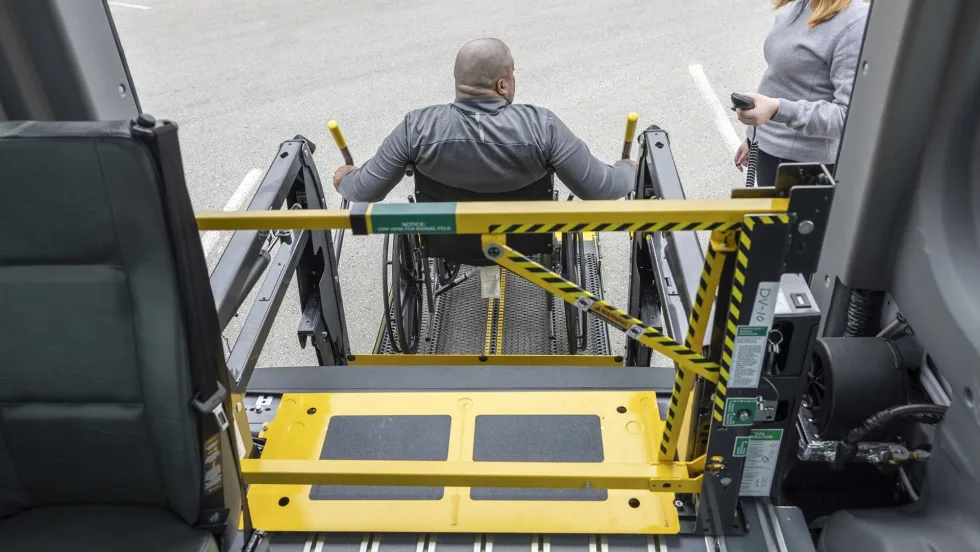
BraunAbility Introduces New Safety Barrier for Wheelchair Lifts
LiftSentinel is designed to add another layer of protection during wheelchair loading and unloading and can be retrofitted to many existing commercial lift installations.
Read More →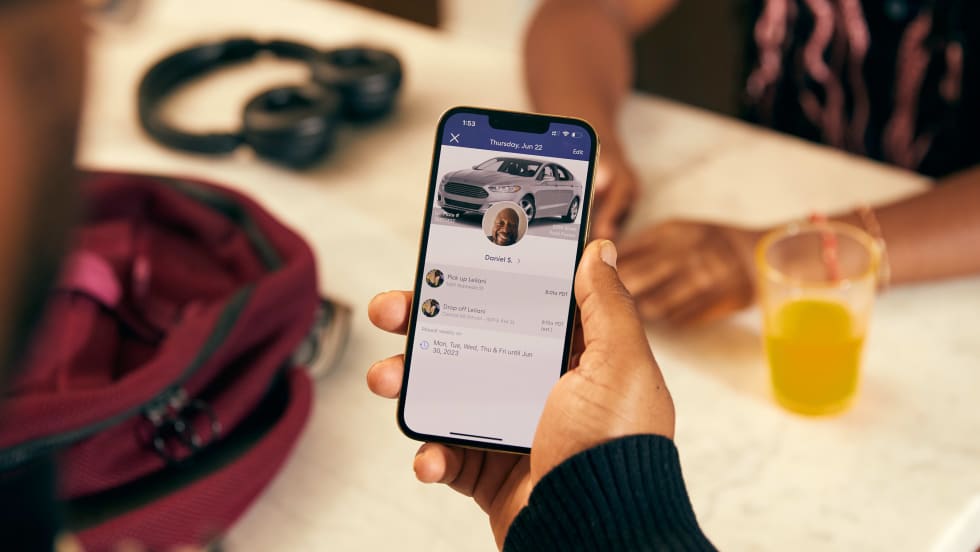
HopSkipDrive Launches New Safety, Driver Consistency Features for 2026-27 School Year
The company’s free ride recording, live ride tracking, and consistent driver assignments aim to improve safety and continuity for diverse student transportation needs.
Read More →
The Most Common Wheelchair Securement Mistakes on School Buses (and How to Fix Them)
Small missteps in wheelchair securement can have serious consequences. Here are 32 tips from experts to reduce risk and increase student safety on the bus.
Read More →
Inside AMF Bruns’ New Showroom: School Bus Securement Solutions Explained
Go inside AMF Bruns America’s new Ohio showroom with Maritza Valentin to see its FutureSafe technology, driver training tools, securement systems, and seating innovations.
Read More →
What AMF Bruns’ New Facility Means for Customers [Video]
Inside AMF Bruns’ new Stow, Ohio, operations: See how expanded space and innovation will enhance customer support and operations.
Read More →
AMF Bruns Expands in Ohio, Investing in Growth and Community
With expanded production space, local investment, and a growing workforce, AMF Bruns is scaling its U.S. presence. Here’s an exclusive first look inside the new Stow, Ohio, HQ.
Read More →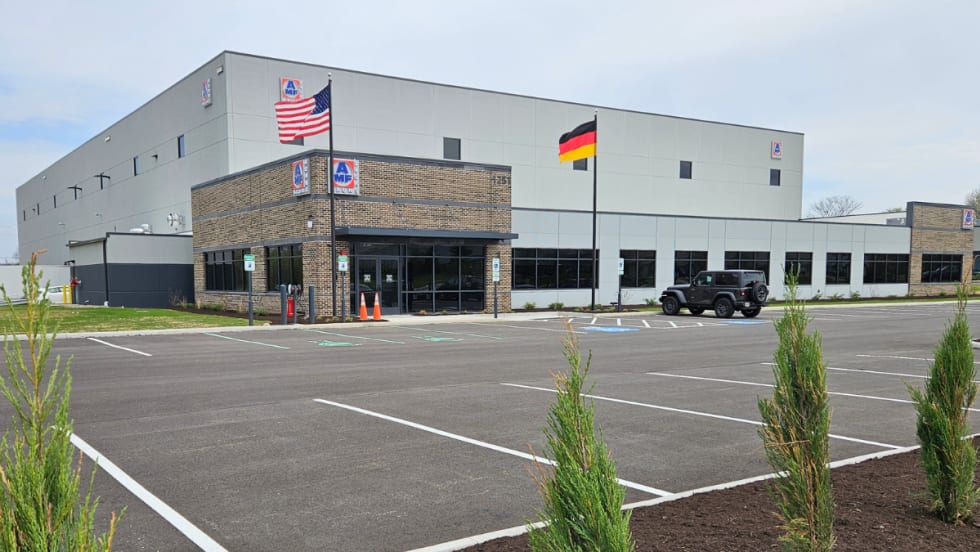
Inside AMF Bruns of America’s New Ohio Manufacturing Facility [Photos]
Take a behind-the-scenes look at AMF Bruns of America’s new 41,000-square-foot Stow, Ohio, headquarters, featuring advanced manufacturing, expanded space, and future-ready mobility solutions.
Read More →
First Student Boosts Student Support in Wichita & Texas
First Student and Wichita Public Schools are using behavioral support strategies to improve student ride experiences, while a separate initiative expands access to after-school programs through a bus donation.
Read More →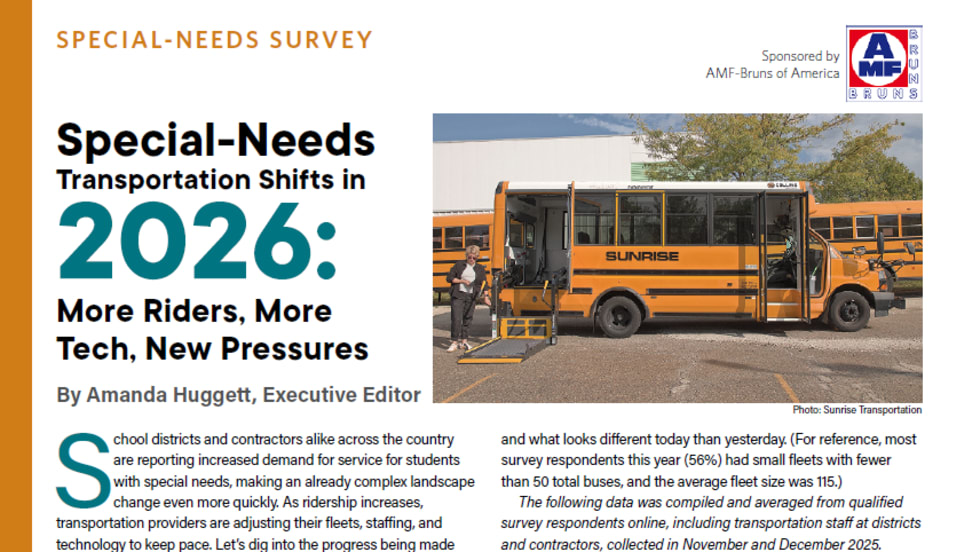
2026 Special-Needs Transportation Survey
What’s changing in special-needs transportation? This year, student transportation operators report a rising need, easing driver shortages, growing tech adoption, and evolving challenges. Sponsored by AMF Bruns of America.
Read More →
The Lived-Experience Gap in Mobility Tech: An Expert Take on Safe Student Transportation
Brianna Pauwee, a product application specialist at AMF Bruns of America and a wheelchair user, drops in to The Route to share practical securement and training insights, plus the story behind the new “Beyond Mobility” podcast. The Route is sponsored by IC Bus.
Read More →