




Driver Dilemma? How to Attract Younger Generations to the Yellow Bus
The Role of Accountability in Retaining School Bus Drivers
Disengagement is a sure path to driver vacancies, but a lack of accountability leads to an even bigger problem. Here are eight practical steps to strengthen accountability for both yourself and your team.
by Christopher McLeod, Henry County Schools
February 17, 2025
Some food for thought McLeod offers: Do you hold yourself accountable for results? How does that lead to developing a culture of accountability for your organization? How are your results impacted?
Photo: School Bus Fleet
7 min to read
Across the country, school transportation departments are grappling with an ongoing bus driver shortage. The demand for qualified, reliable drivers far outweighs the supply, leading many directors to adopt a mindset of leniency to keep driver seats filled. However, rather than relaxing standards, we must double down on accountability — both personal and team-based — to foster a culture where drivers feel valued, respected, and committed for the long haul.
How Accountability Retains School Bus Drivers
Too often, accountability is viewed through a punitive lens. In reality, it is the foundation of a strong, supportive work environment.
A lack of leadership accountability is not unique to pupil transportation; it plagues organizations across industries, leading to disengagement, inefficiency, and ultimately, high turnover. When employees — especially bus drivers entrusted with the safety of our students — perceive a culture of inconsistency, favoritism, or minimal expectations, they disengage. And in an industry already struggling with retention, disengagement is a direct path to even more vacancies.
One might be led to believe that increased accountability contributes to retention issues (to be sure, of course there can be pains associated with losing people due to accountability measures). However, the case that I am making is that a lack of accountability leads to more vacancies in the long run.
Conversely, when leaders hold themselves accountable and model responsible behaviors, they set the tone for the entire department. Accountability fosters trust, clarity, and a sense of shared purpose — qualities that keep drivers invested in their roles. This is why we must look at accountability as two-fold; one that focuses on ourselves (all leaders in transportation from directors to route supervisors to trainers) and increased accountability for our team of bus drivers.
In professional development sessions I’ve led, transportation leaders have reflected on their own accountability, assessed areas for improvement, and adopted strategies to lead with greater integrity and transparency. The impact of these shifts is undeniable: teams become more cohesive, job satisfaction improves, and drivers are more likely to stay.
Tips for Strengthening Your Transportation Team
So, how do we cultivate a culture of accountability in school transportation? It starts at the top. Transportation leaders must commit to self-assessment, identifying where their own behaviors may be contributing to workplace frustrations. Next, they must establish clear, consistent expectations for their teams — expectations that are fair, realistic, and aligned with department and school system goals. Finally, leaders must create an environment where feedback is welcomed, not feared. When employees feel heard and supported, they are more likely to hold themselves to high standards.
Before we can delve into how to cultivate a culture of accountability in school/pupil transportation, we have to understand this: Why we do not always hold ourselves accountable? First and foremost, it’s hard. It’s not always comfortable to accept responsibility. Again, it has to start at the top. It’s plausible that we have not acknowledged that every decision has consequences. Those consequences can be positive or negative. Just as Newton’s Third Law of Motion states, we (as well as our teams) must come to terms that “every action has an equal and opposite reaction.” While Newton was referring to physical interactions, the Third Law of Motion also translates to complex life situations.
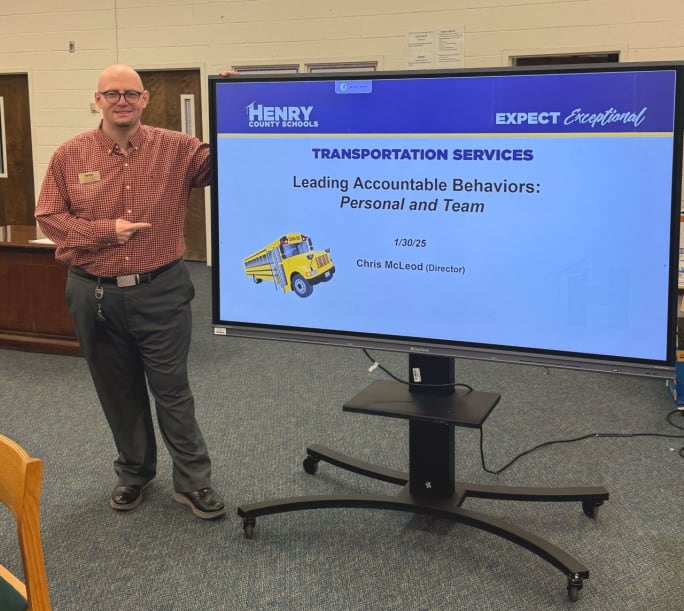
In late January, McLeod led the district’s transportation services leadership team through a professional development session on “Leading Accountable Behaviors: Personal and Team.”
Photo: Henry County Schools
Additionally, people don’t tend to hold themselves accountable because they may not fully know what is expected of them. Have we as leaders clearly communicated the goals and objectives? Do we model what it is that we expect? Do we (as leaders) know what our superiors expect of us? Of course, it makes sense that if employees do not know what is expected of them, they cannot be held responsible for meeting those expectations. This creates inconsistency in performance and makes it difficult to track progress. And, if we have not made goals and objectives clear, then we do not have a baseline to measure success against.
Without a defined standard for performance, accountability becomes subjective and inconsistent. For example, one employee’s line manager may have a meeting and issue a letter of redirection every time an employee is reporting late to work. Another employee’s line manager (in the same department) may only do this for employees that they wish to professionally separate from. The reality is that when roles and responsibilities are vague (as most posted job descriptions are), it becomes easier for individuals to deflect responsibility. Employees may claim, “I didn’t know that was my job,” or “that’s so-and-so’s job” which leads to tasks being left undone.
Lack of leadership control is another reason that we don’t have high accountability for ourselves and our teams. Leaders who fail to set clear schedules for themselves and lead “by the seat of their pants”, cannot effectively hold their team accountable. While we all wish to have an “open door policy,” we also must learn to block out time to ensure we are able to keep up with all of our responsibilities.
Let’s face it, the role of a leader in school transportation is multifaceted. We are the ultimate “wearers of many hats.” We have to protect our time and balance it with being accessible to our teams. Without doing so, we will fail to prioritize and follow through on critical tasks, have inconsistent follow-through, our stress levels will be high and morale low, and we may have difficulty knowing our own progress toward key performance indicators as well as have difficulty measuring the performance of our staff.
Now that we all know why self and team accountability is important as well as some of the reasons we lack it, let’s focus on how we can strengthen accountability. So, don’t beat yourself up about it. Take action.

Disengagement is a sure path to driver vacancies, but a lack of accountability leads to an even bigger gap.
Photo: Chris McLeod
8 Practical Steps to Strengthen Accountability
Self-Assessment and Reflection: Transportation leaders must regularly evaluate their decision-making and communication styles. Conducting periodic self-assessments, seeking input from colleagues, and being open to constructive criticism can provide valuable insights into areas for improvement. Self-assessments are an opportunity for you to be truthful and honest with yourself; this is your look in the mirror.
Set Clear and Measurable Expectations: Ambiguity breeds inconsistency. Leaders should establish well-defined policies for attendance, performance, and conduct, ensuring every team member understands what is expected of them.
Provide Regular Feedback and Recognition: Constructive feedback, both positive and corrective, helps reinforce accountability. Recognizing drivers and other staff who consistently meet or exceed expectations can also motivate others to follow suit.
Lead by Example: If leaders fail to adhere to the same standards they expect from their teams, credibility is lost. Consistency in enforcing policies and demonstrating professionalism sets the right tone for the entire department. Always lead by example! This does not mean that you cannot protect your time and must go drive every route that needs coverage (even though you may find yourself doing that from time to time). It means hold yourself accountable and take responsibility before holding everyone else accountable.
Encourage Open Communication: Creating a safe space for drivers and other team members to voice concerns, ask questions, and offer suggestions fosters trust and transparency. Regular meetings, anonymous feedback options or surveys, and open-door policies (within reason, as I mentioned) can enhance communication.
Implement a Mentorship Program: Pairing newer drivers and other team members with experienced mentors can instill best practices and reinforce a sense of responsibility. A mentorship model also fosters camaraderie and professional growth. Sometimes it may help to look beyond the transportation department and find leaders in other school district departments to pair office staff and supervisors with. Remember, EVERYONE could use a mentor, yourself included!
Use Data to Drive Decisions: Monitoring key performance indicators, such as attendance records, on-time delivery, incident reports, and surveying our employees, allows leaders to identify trends and address concerns proactively. A quick five-minute Google Forms survey of various facets of your team can provide powerful information! A wise former leader of mine once said “always remember, you will have outliers (angry people often complete surveys). However, it’s when you start to see a pattern that you should do some self-reflection.”
Hold Everyone Accountable Equally: Favoritism and inconsistency undermine trust. Leaders must ensure accountability measures apply fairly to all employees, regardless of tenure or personal relationships. Transportation teams often are a tight-knit group of professionals that may have worked together for many years. We become friendly with our teams and want to assume the best in everyone. However, we must always keep ourselves “above the line” and never be willing to shy away from accountability. No matter who the person is and how nice they may be.
Accountability is not about making life harder for our drivers and other team members—it’s about making the job worth staying for. When we invest in a culture of responsibility, we don’t just improve retention; we build teams that take pride in their work, knowing they are part of something bigger than themselves. In this era of driver shortages, accountability isn’t a burden — it’s the solution.
Subscribe to Our Newsletter
More Management

How to Build a Better Driver Training Program
Ready to boost up your school bus instructor training? Here’s how to pick the right talent and improve recruitment, retention, and safety.
Read More →
CALSTART and Forth Combine to Form Catalyst Mobility
The new name represents a renewed vision for the nonprofit focused on advancing clean, equitable, and affordable transportation solutions that move people and goods.
Read More →
What Makes a Great School Bus Driver Trainer?
Choosing the right school bus driver trainer takes more than experience. Learn six keys to selecting and developing trainers and evaluating program effectiveness.
Read More →

School Bus Contractors Expand Through New Deals, Acquisitions & Partnerships
STA's Canadian division acquires Ontario-based G&L Stevenson Transport while Durham School Services adds a new district contract in California, First Student adds a New Jersey contract, and Minnesota Coaches acquires Halo Transportation.
Read More →
Logan Bus Company Rolls Out AI Phone System for NYC School Bus Families
A summer pilot found that AI agents could handle most routine calls, freeing up time for customer service staff to focus on emergencies and complex family concerns.
Read More →
From Intent to Impact: What I Learned About Leadership from TAPT
A Texas transportation supervisor shares lessons on self-awareness, accountability, managing stress and building trust — and why investing in leadership development matters at every stage of your career.
Read More →
NAPT Names 2026 Award Recipients, Hall of Fame Inductee
Who earned national recognition for their work in student transportation? This year, NAPT named five recipients of its 2026 awards for service, safety, and leadership, plus its newest Hall of Famer.
Read More →
Sponsored•September 2, 2026
2026 State of Student Transportation Report
Driver shortages. Rising costs. Growing safety expectations. More data, but not enough time to act on it. The 2026 State of Student Transportation Report reveals what transportation leaders say is putting the most pressure on their operations—and where they’re investing next. See how your priorities compare.
Read More →
How to De-Escalate an Angry Person: 5 Steps for Handling Workplace Conflict
What makes emotions run high, and how should you handle an angry colleague or parent? Follow these steps for staying calm, listening, showing empathy, and resolving conflict.
Read More →
Sponsored•September 1, 2026
What Readiness Looks Like This School Year
Learn about the challenges shaping the 2026–2027 school year, from persistent driver shortages and budget pressure to technology and readiness gaps. See how school districts are responding and adapting in Zonar’s 2026 Back-to-School Readiness Report.
Read More →