





NSTA Advocacy in Action: The Status of the Electric Vehicle Debate in the United States
Maryland Considering 5-Year Electric Bus Pilot Program
The Potomac Edison proposal is meant to help Maryland achieve climate goals and help public schools meet transportation needs.
January 18, 2024
The proposed pilot program would support Maryland's Climate Solutions Now Act of 2022.
Image: Canva
2 min to read
Potomac Edison, a subsidiary of FirstEnergy Corp., has submitted a proposal for a 5-year pilot program for electric school buses to the Maryland Public Service Commission.
If approved, the pilot would support Maryland’s Climate Solutions Now Act of 2022, requiring that any new school buses bought or contracted by public school systems in the state be zero-emission vehicles.
"We believe the data collected during the pilot will allow us to better understand how we can help meet our school districts' evolving transportation and electrification needs and ultimately help the districts save money in the long run,” said Don McGettigan, acting president of FirstEnergy’s Maryland operations. “Our pilot program is also intended to help the state meet climate goals by reducing greenhouse gas emissions, which will create cleaner air and improve overall health in local communities we serve."
To aid in the electric school bus transition process, the company expects to provide:
Financial incentives for school districts to acquire and deploy electric buses.
Reimbursements for EV charging infrastructure and information technology-related costs associated with the electric bus transition.
Assessments of grid capacity and other technical and administrative support.
Connection to the Potomac Edison grid, including coverage of all related costs.
Public school districts that opt into the pilot program will get funding that reduces the cost difference between an electric school bus and an equivalent diesel-fueled bus. Electric buses also will be equipped with lap and shoulder belts for students to comply with the new safety law.
"Approval of the initiative by the PSC also will enable us to explore opportunities to use the stored energy in electric school bus batteries to address electricity needs during grid emergencies, potentially yielding positive outcomes for all our customers in the future," McGettigan said.
More Alternative Fuels

Alt-Fuel Moves: New Buses, Charging Hubs & Real-World EV Testing
Propane and electric school bus deployments continue to grow as districts add new vehicles, expand charging infrastructure, and gather more real-world operating data.
Read More →
Fewer Electric School Bus Models Reshape the U.S. Market
WRI’s latest buyer’s guide points to a consolidating electric school bus market, but fewer options may reflect a maturing industry rather than fewer meaningful choices for school bus operators.
Read More →
The Fuel Budget You Can Actually Predict: How Propane Autogas Keeps Money in the Classroom
Learn how propane autogas helps school districts manage fuel costs with predictable pricing, lower maintenance, and reduced emissions from former transportation director Joel Stutheit.
Read More →
Hendrickson, Driventic Introduce New Electric Powertrain for School Buses
ELECTRAAX, the electrified, lightweight drive axle offers integrated ePowertrain efficiency and modular flexibility for Class 6–7 school bus use.
Read More →
The Mobility House Joins PowerFlex in Fleet Electrification Deal
The acquisition combines intelligent charging software, bidirectional charging expertise, and fleet electrification services to support the growing adoption of electric school buses across North America.
Read More →
Alt-Fuel Moves: Electric School Bus Investments Hit the Road
See which districts across the U.S. are putting electric school buses into service, expanding charging infrastructure, and planning the next phase of fleet electrification.
Read More →
With Fuel Volatility Ahead, School Districts Turn to Propane
While diesel prices peaked above $5 this spring, districts with propane autogas-powered fleets paid under $2 per gallon, according to PERC.
Read More →
EPA Unveils Proposed Changes to 2027 Heavy-Duty Engine Rules
The federal agency has proposed changes to next year’s targets that would eliminate DEF derates, ease warranty requirements, and retain current NOx emissions standards.
Read More →
Alt-Fuel Moves: EV Charging & Infrastructure Projects Gain Momentum
The latest developments include new funding, charging infrastructure, utility investments, and fleet technologies designed to support the transition to electric school buses nationwide.
Read More →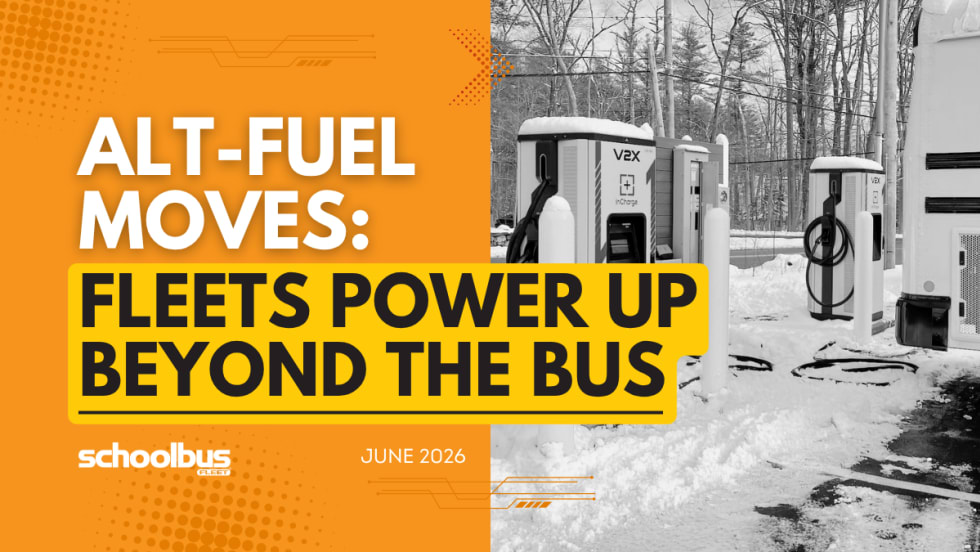
Alt-Fuel Moves: Fleets Power Up Beyond the Bus
See how districts are pairing electric buses with charging, solar, and V2G technology to cut costs, boost resilience, and unlock new fleet value.
Read More →