





SEE FOR YOURSELF
Check out this photo gallery from the IC Bus CE Series reveal event in Reno, Nevada!
IC Bus Relaunches Flagship CE Series School Bus with Diesel, Electric Powertrains
The new design incorporates user feedback and a modular design that allows Navistar to share parts commonality between buses and trucks.
July 15, 2023
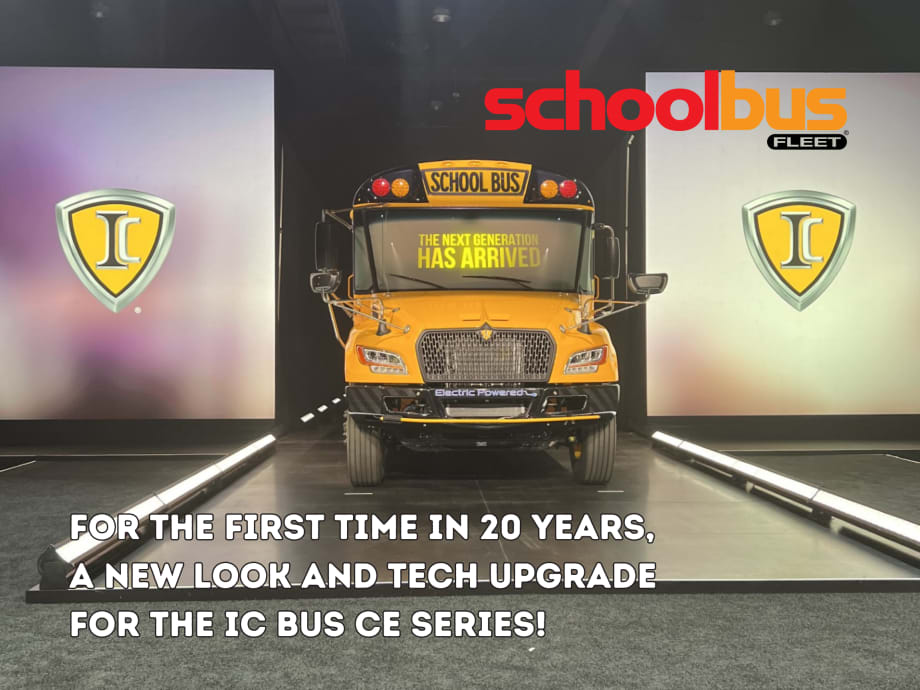
Image: Wes Platt/Canva
5 min to read
The CE Series school bus from IC Bus, first launched 20 years ago, got a modern redesign that comes with either electric or Cummins B6.7 diesel powertrains, enhanced driver comfort and operational efficiency, and increased safety features.
“Our CE Series has remained best-in-class for decades,” said Justina Morosin, IC Bus vice president and general manager. “We have taken into consideration the legacy features our drivers love and built upon them to enhance both operator and rider experience. Additionally, we offer an electric powertrain to our customers to aid in achieving their own sustainability goals while maintaining the efficiency needed in day-to-day operations.”
The bus made its debut July 14 in a reveal event in Reno, Nevada, with presentations from Morosin, Navistar President and CEO Mathias Carlbaum, and other key IC Bus leadership.
New School Bus Design, New Outlook
Morosin, who grew up in Canada, discussed riding the school bus starting when she was six. Now, as mother of three boys, she depends on the bus for its reliable transportation.
“It’s almost hard to capture in words, but (the bus) transports us to the next phase of life as a student, as a parent, as an ordinary driver with whom buses share the road,” Morosin said. “For some, as a chosen career path.”
The revamped CE Series school bus owes a lot to the people who drive the vehicles, inspiring new designs that improve comfort, safety, and efficiency.
For Morosin, the new design represents a “refreshed outlook.”
“A different perspective that’s aligned with the transformation happening in an industry that’s been stagnant for years,” she said. “The timing couldn’t be more perfect.”
During his presentation, Carlbaum told the crowd that student transportation is about mobility, bringing people together, and creating opportunities.
“IC Bus has such a rich history, a legacy,” he said. “But even more, we see that the future is bright. It’s exciting. It’s innovative, it’s safe, it’s electrical, and it’s connected.”
Electric Powertrain Availability
The electric powertrain in the all-new CE Series provides a quieter ride for drivers and passengers, with three levels of selectable regenerative braking to provide a smoother ride, battery efficiency, and operating experience.
It comes standard with alternating current (AC) and direct current fast charging (DCFC) capability, and a digital instrument cluster.
Battery pack options include:
210 kWh with a range of 135 miles.
315 kWh with a range of at least 200 miles.
It operates at peak power of 255 kW or 342 horsepower.
IC Bus uses a three-step approach to electric vehicles (EVs) – consulting, charging, and deployment – which allows customers a simpler approach to transitioning their fleets from traditional fuels to zero-emissions options.
Trish Reed, IC Bus’s vice president for zero emissions, said: “Our dedicated zero-emissions team supports customers with deployment management and e-mobility ecosystem consultation. As we implement e-mobility solutions in collaboration with our dealer network, we consult with customers, assist in designing their infrastructure, and oversee the deployment. This enhanced, consultative approach allows us to support customers through their EV transition and ensure a seamless integration in meeting their unique needs.”
Improved School Transportation Operating Efficiency and Costs
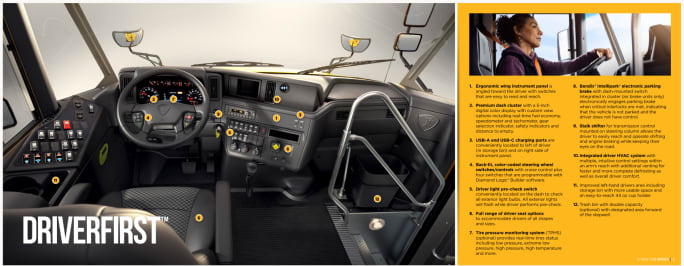
The new CE Series IC Bus model includes a dashboard cluster designed with driver comfort and efficiency in mind.
Image: IC Bus
The next-generation CE Series integrates new technologies and ergonomic improvements to maximize driver comfort and operational ease, including:
New HVAC system with improved performance, blend-air system, and automotive-type controls.
Standard stalk shifter for transmission control mounted on the steering column, giving the driver easier access and smoother shift operation and engine braking while keeping eyes on the road.
Driver comforts including a range of driver seat options to suit drivers of all shapes and sizes, improved driver and passenger entry and egress, and a new ergonomic wing instrument panel angled toward the driver with backlit controls.
The new CE series also has factory installed telematics that can help school transportation administrators proactively manage fleet health and maximize uptime. The buses come standard with five years of connectivity, including 24/7 diagnostics and predictive maintenance tools via Navistar’s OnCommand Connection, seamless communications, and up-to-date repair status updates via IC Bus 360, over-the-air updates for units with Cummins engines, and access to use gateway integrations with telematics service providers.
The modular approach of the next-generation IC Bus design allows for improved accessibility to routine maintenance items, such as:
HVAC filter and air dryer.
Fuel filter.
Stepwell heater.
Oil filter.
Instrument panel fuses are now found inside the bus with a chassis fuse block featuring a spill-resistant cover for increased safety and easy accessibility.
The CE Series school bus also offers improved corrosion resistance features inside and outside of the bus, including a coated fuel tank and bumpers, modesty panels, and a one-piece driver floormat, reducing opportunity for corrosion.
Michael Grahe, executive vice president of operations for Navistar, said that the new CE Series shares 80% parts commonality with International’s MV series truck – up from 20% in the previous CE Series iteration.
“This approach allows more collaboration so we can realize global efficiencies, scales, and solutions across the entire Traton Group, while still having a regional adaptation and validation to meet our customers’ needs in the North American market,” Grahe said. “In other words, we offer more with less.”
In an interview with School Bus Fleet, Carlbaum noted that the modular approach is good for supply chain optimization and serviceability.
“What you deploy on a medium truck in Germany, let’s say, can go in a school bus in the United States shortly thereafter, and vice versa,” he said. “We can plug and play elsewhere.”
“This modularity piece really allows us to be much more strategic,” Morosin said.
Enhanced School Bus Safety Features
Passive and active safety features also are integrated into the new CE Series, including a redesigned front end with a sloped hood for enhanced driver visibility and a new grille, new entrance doors with single glass panels and no separator (providing improved driver visibility out the entranceway), and an enhanced dash cluster with a five-inch LCD color display that provides alerts and customizable views for the driver.
Among the integrated safety systems in the new design:
Optional tire-pressure monitoring system.
Standard electronic stability control.
Bendix Intellipark electronic parking brake for air brake models.
Door ajar driver alerts.
Bendix Wingman advanced safety package with autonomous emergency braking.
Active cruise control with braking features for air brake models.
More Alternative Fuels

CALSTART and Forth Combine to Form Catalyst Mobility
The new name represents a renewed vision for the nonprofit focused on advancing clean, equitable, and affordable transportation solutions that move people and goods.
Read More →
Alt-Fuel Moves: New Buses, Charging Hubs & Real-World EV Testing
Propane and electric school bus deployments continue to grow as districts add new vehicles, expand charging infrastructure, and gather more real-world operating data.
Read More →
Fewer Electric School Bus Models Reshape the U.S. Market
WRI’s latest buyer’s guide points to a consolidating electric school bus market, but fewer options may reflect a maturing industry rather than fewer meaningful choices for school bus operators.
Read More →
The Fuel Budget You Can Actually Predict: How Propane Autogas Keeps Money in the Classroom
Learn how propane autogas helps school districts manage fuel costs with predictable pricing, lower maintenance, and reduced emissions from former transportation director Joel Stutheit.
Read More →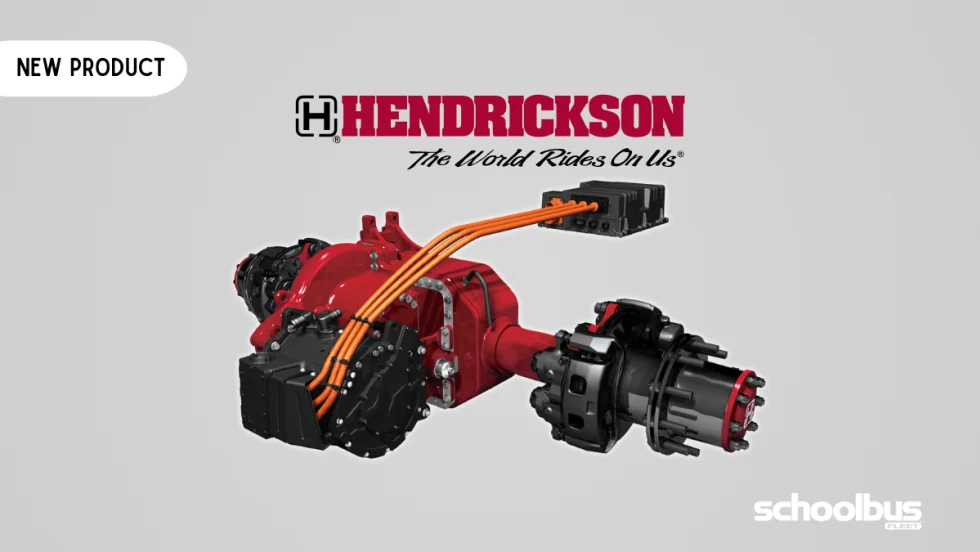
Hendrickson, Driventic Introduce New Electric Powertrain for School Buses
ELECTRAAX, the electrified, lightweight drive axle offers integrated ePowertrain efficiency and modular flexibility for Class 6–7 school bus use.
Read More →
The Mobility House Joins PowerFlex in Fleet Electrification Deal
The acquisition combines intelligent charging software, bidirectional charging expertise, and fleet electrification services to support the growing adoption of electric school buses across North America.
Read More →
Alt-Fuel Moves: Electric School Bus Investments Hit the Road
See which districts across the U.S. are putting electric school buses into service, expanding charging infrastructure, and planning the next phase of fleet electrification.
Read More →
With Fuel Volatility Ahead, School Districts Turn to Propane
While diesel prices peaked above $5 this spring, districts with propane autogas-powered fleets paid under $2 per gallon, according to PERC.
Read More →
EPA Unveils Proposed Changes to 2027 Heavy-Duty Engine Rules
The federal agency has proposed changes to next year’s targets that would eliminate DEF derates, ease warranty requirements, and retain current NOx emissions standards.
Read More →
Alt-Fuel Moves: EV Charging & Infrastructure Projects Gain Momentum
The latest developments include new funding, charging infrastructure, utility investments, and fleet technologies designed to support the transition to electric school buses nationwide.
Read More →