




New York District Receives TSA Audits, Training
Shenendehowa Central Schools partners with the Transportation Security Administration to conduct audits and training related to safety and incident command.

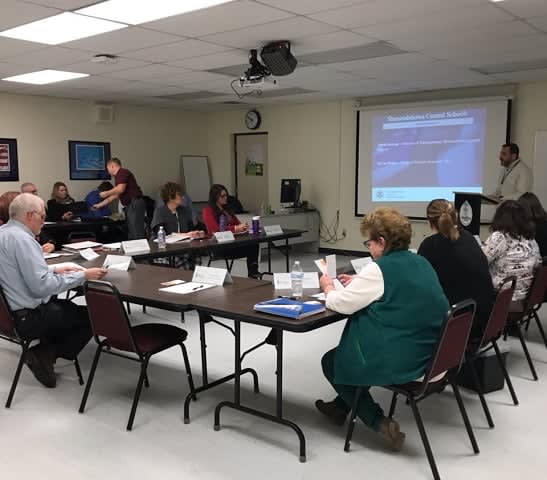
Shenendehowa Central Schools transportation staff participated in a two-hour training workshop led by the Transportation Security Administration on March 7. Photo courtesy Shenendehowa Central Schools
Shenendehowa Central Schools transportation staff participated in a two-hour training workshop led by the Transportation Security Administration on March 7. Photo courtesy Shenendehowa Central Schools
CLIFTON PARK, N.Y. — A school district here recently partnered with the Transportation Security Administration (TSA) for training related to security and incident command.
Alfred Karam, the director of transportation for Shenendehowa Central Schools, told School Bus Fleet that the district had the idea for the training after the department underwent safety and security audits conducted by the TSA in 2015 and 2018.
The TSA, through its Highway Baseline Assessment for Security Enhancement (BASE) review, performs audits of transportation entities, evaluates security programs, offers technical assistance, and shares best practices for security, according to the agency’s website.
The audits performed for Shenendehowa Central Schools focused on four key assessment areas: management and accountability, personnel security, facilities security, and vehicle security.
“They looked at our policies and procedures, gave us a score based on the assessment, and also provided us with some review recommendations,” Karam added.
On March 7, the district followed up the audits with a two-hour training workshop, in which the TSA presented the transportation department’s office staff with two security scenarios. The first scenario included reports of suspicious individuals surveilling the district’s bus garage, while the second dealt with reports of one of the district’s buses being hijacked. The tabletop demonstration, which is called the TSA’s Exercise Information System (EXIS), guided staff members through a series of questions testing their response to the two events.
“Staff members became a part of the incident command team through this process, and they were put through the training to understand each other’s roles,” Karam said. “[The training] was an absolute success across the board because my team learned more about themselves and each other than they had ever learned before.”
While the next step of the TSA’s training program requires risk mitigation assessment, Karam said Shenendehowa Central Schools will surpass that step of the program and move forward with the TSA’s Security Enhancement Through Assessment (SETA).
The transportation department will use SETA, a three-step process, to test school bus driver compliance with the department’s policies and procedures.
During the first step, TSA representatives will come to the district and perform an unannounced observation of drivers conducting pre- and post- trips and other standard protocols. In the second step, TSA representatives will share the assessment results with the transportation department as a whole. To complete the process, TSA representatives will conduct another impromptu observation to reassess the drivers’ progress in adhering to the district’s security standards.
“We’ve already changed our daily vehicle inspection reports, and added recommended interview questions for hiring new employees based on [the TSA’s] recommendations,” Karam said.
As for whether or not the district will complete another audit, he said “possibly in a year or two.”
Shenendehowa Central Schools holds a total of six safety training refreshers a year, including active shooter training.
“We’re always changing gears and doing something different,” Karam added. “It’s a valuable lesson to keep at the forefront to help employees maintain their focus on the safety of our students.”
More Management
How to Build a Better Driver Training Program
Ready to boost up your school bus instructor training? Here’s how to pick the right talent and improve recruitment, retention, and safety.
Read More →
CALSTART and Forth Combine to Form Catalyst Mobility
The new name represents a renewed vision for the nonprofit focused on advancing clean, equitable, and affordable transportation solutions that move people and goods.
Read More →
What Makes a Great School Bus Driver Trainer?
Choosing the right school bus driver trainer takes more than experience. Learn six keys to selecting and developing trainers and evaluating program effectiveness.
Read More →


School Bus Contractors Expand Through New Deals, Acquisitions & Partnerships
STA's Canadian division acquires Ontario-based G&L Stevenson Transport while Durham School Services adds a new district contract in California, First Student adds a New Jersey contract, and Minnesota Coaches acquires Halo Transportation.
Read More →
Logan Bus Company Rolls Out AI Phone System for NYC School Bus Families
A summer pilot found that AI agents could handle most routine calls, freeing up time for customer service staff to focus on emergencies and complex family concerns.
Read More →
From Intent to Impact: What I Learned About Leadership from TAPT
A Texas transportation supervisor shares lessons on self-awareness, accountability, managing stress and building trust — and why investing in leadership development matters at every stage of your career.
Read More →
NAPT Names 2026 Award Recipients, Hall of Fame Inductee
Who earned national recognition for their work in student transportation? This year, NAPT named five recipients of its 2026 awards for service, safety, and leadership, plus its newest Hall of Famer.
Read More →
2026 State of Student Transportation Report
Driver shortages. Rising costs. Growing safety expectations. More data, but not enough time to act on it. The 2026 State of Student Transportation Report reveals what transportation leaders say is putting the most pressure on their operations—and where they’re investing next. See how your priorities compare.
Read More →
How to De-Escalate an Angry Person: 5 Steps for Handling Workplace Conflict
What makes emotions run high, and how should you handle an angry colleague or parent? Follow these steps for staying calm, listening, showing empathy, and resolving conflict.
Read More →
What Readiness Looks Like This School Year
Learn about the challenges shaping the 2026–2027 school year, from persistent driver shortages and budget pressure to technology and readiness gaps. See how school districts are responding and adapting in Zonar’s 2026 Back-to-School Readiness Report.
Read More →