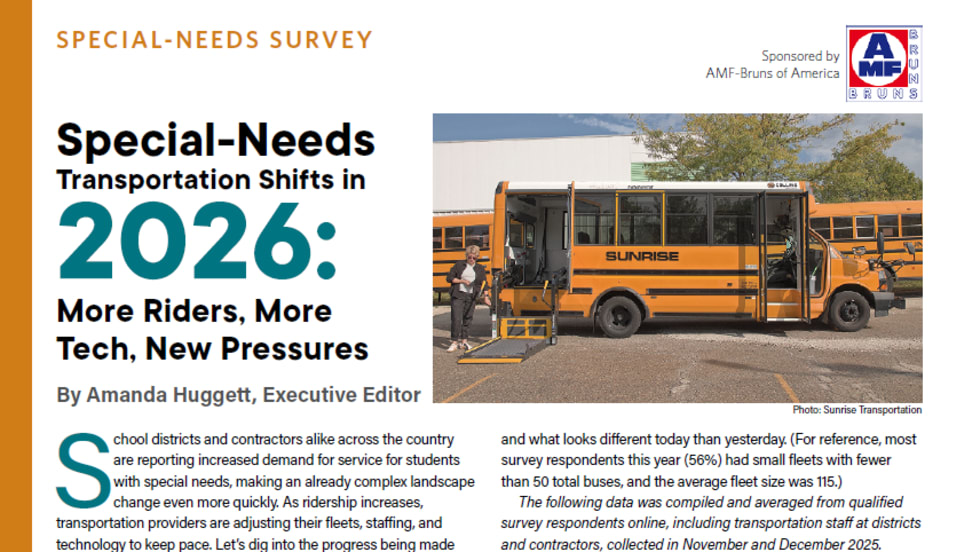
With so many new types of wheelchairs on the market, spec'ing a wheelchair lift for a school bus has become a complex task.
Some help is availab...
by Janna Starcic, Assistant Editor
June 1, 2001With so many new types of wheelchairs on the market, spec'ing a wheelchair lift for a school bus has become a complex task.
Some help is available through the 2000 National School Transportation Specifications and Procedures, a compilation of recommendations and guidelines approved at the National Conference on School Transportation (NCST). The document, adopted by a few states and used as a guideline by many others, contains a section on wheelchair lift specifications.
"It is my belief that all school districts should follow it as a minimum," says David Sluder, specification and equipment specialist for the North Carolina Department of Public Instruction.
The operative phrase is "as a minimum." Specification committees, even in states that adopt the 2000 specifications and procedures document, have the option of making their standards more stringent.
Research and refine
At a local level, school districts need to make sure their wheelchair lift specs are revised to keep pace with changing equipment trends. Not only should they be aware of new developments in wheelchairs but also in wheelchair lifts. That's why it's important to talk to manufacturers of both lifts and wheelchairs.
"Obtain as much information as you can and make logical decisions based on those criteria," says Sluder. Data supplied by manufacturers should be analyzed carefully, and references should be requested. "Most of these manufacturers will give you names of people you can contact that are actually using these products," Sluder explains.
Tracking the repair work necessary on existing wheelchair lifts in the fleet can also help in making sound spec'ing decisions. "We try to evaluate any repair problems beforehand," Sluder says. "It's been a process of several years that has gotten us to the point where we are with our lifts."
What to look for
Size. Wheelchairs vary greatly in size, now more than ever. Because large power wheelchairs and scooters are becoming more common, the minimum dimensions for platform lifts should be 30 inches wide and 48 inches long, according to the NCST document.
"The main thing is getting a wheelchair lift that fits the wheelchair," says Michael Noah, mechanic for Northwest Local School District in Cincinnati. "Some of the wheelchairs are getting longer, so the platforms need to be longer."
Mark Egan, fleet maintenance supervisor for Commtrans, a school bus contractor in Pittsburgh, says he's now spec'ing longer and wider platforms. "Last year, we had a couple of electric wheelchairs that were too long and too wide to fit on the lift," Egan says.
At some school districts, wheelchair lifts need to accommodate the bus driver or aide in addition to the wheelchair.
"State law requires my driver or the aide to ride the lift with the wheelchair," says James Nichols, transportation director for Elysian Fields (Texas) Independent School District, which has two buses equipped with wheelchair lifts.
Capacity. The ability of a wheelchair lift to bear a significant amount of weight is also an important factor for transportation personnel. According to the NCST document, lift capacity should be at least 800 pounds.
"We want a motor that has enough capacity to move the weight," says Joe Reed, assistant transportation director at Palm Beach County (Florida) School Board. "In this day and age we have so many large power wheelchairs with some large kids in them. The days of picking up 200 to 300 pounds are over."
Sluder suggests that lifts be capable of handling a minimum of 1,000 pounds.
Safety features. Anyone who has witnessed a wheelchair tumbling off a lift knows the critical importance of safety.
Handrails that provide support to the wheelchair occupant and platform barriers that prevent the wheelchair from rolling off the lift during operation are recommended in the 2000 specifications and procedures.
"We want the handrails in order to assist the driver or aide loading or unloading the wheelchairs," says Richard Hansen, director of transportation for School Districts 47 and 155 in Crystal Lake, Ill. "It's a safety aspect where the aide will be less likely to take a misstep on the lift."
Phil Bowser, director of transportation operations at Denver Public Schools, agrees. "We ask for dual handrails and an occupant restraint belt system," he says. "Basically, if the belt is not fastened, the lift will not move."
Reed recommends a feature that prevents the roll stop guard on the end of the lift platform from being disabled until the lift has reached the ground.
Another consideration is lighting. In North Carolina, buses with wheelchair lifts are spec'd for additional lighting in the interior lift area as well as outside the bus, Sluder says.
Longevity. How long a wheelchair lift lasts is a crucial concern when compiling lift specifications.
Mark Summers, mechanic coordinator for Rochester (Mich.) Community Schools, says that mechanics are good sources of information about a lift's longevity and reliability. "A forum of school bus mechanics allows us to get together and compare stories. It's pretty helpful," he says.
Location, location...
Where should the lift be placed, in the front or rear? Arguments can be made for each location.
"We always have the lift in the front," says Summers. "That's where the bus seems to give the best ride, and some of the children we carry are severely fragile."
Bowser agrees. "We feel it's better to have it located in the front because it places the child closer to the driver," he says.
But Reed says the issue isn't clear cut. "It's an operational decision which is tough for some folks to make," he says. Placing the lift in the rear of the bus increases seating capacity, a benefit for operators with high load rates. In addition, says Sluder, a rear-located lift has certain safety benefits. "By locating it in the rear, we are able to have crash barriers in front of any chair position," he says.
Advances in wheelchair lifts
That age-old lament, "They don't make them like they used to," is actually a good thing -- when talking about wheelchair lifts.
Phil Bowser, director of transportation operations at Denver Public Schools, remembers many years back when he operated a tailgate wheelchair lift. "If you weren't careful, it would fall out when the door was opened and hit you on the head," says Bowser. "Sometimes lifts were built so heavy that they caused the bus to tip to one side," he adds with a chuckle.
Those days are long gone. The latest wheelchair lifts boast numerous technological advances and safety features like the newest ADA-compliant models produced by Braun Corp., Ricon Corp. and Maxon Mobility Products.
The Millennium Series Lift is Braun's newest model. It is available in standard platform widths of 30 and 33 inches, with floor-to-ground travels of 42 and 48 inches.
The Millennium models feature dual handrails, eight-inch aluminum ARS (automatic roll stop) and a new inboard barrier system that serves as a bridge between the lift platform and the vehicle floor when in the down position. "We can get the most platform width out of the narrowest door with our Millennium series," says Perry DeGroot, Braun's national sales manager. This is possible, he adds, "because we've actually moved our roll stop cylinder underneath the platform."
In its S-Series product line, Ricon Corp. offers a wide array of ADA-compliant (as well as non-ADA) wheelchair platform lifts with dimensions of up to 34 inches wide and 54 inches long.
In addition to the S-Series line, Ricon has added the new KlearVue K-2005 ADA wheelchair lift with a platform size of 32 inches wide and 51 inches long. The KlearVue for ADA has a unique platform design that folds in half into the upright position, giving passengers an unobstructed view and minimizing blind spots for the driver. "Passengers riding in the vehicle like the fact that they can see out the window," says Gerald E. Dann, vice president of sales. "And when the KlearVue is folded, it locks up tight, so there is no noise. It doesn't rattle when you're driving down the road."
Accidental deployment is prevented through Ricon's Sto-Loc technology. Ricon's patented interlocking occupant safety system has been designed to prevent lift operation unless the belt is engaged.
Maxon Mobility Products, with its WL-6A models, is another key player in the wheelchair lift market. The company offers four versions of this lift, in varying dimensions. The largest version has 33 inches of usable platform width and 53 inches of length, with a floor-to-ground travel distance of 48 inches.
The Maxon lift has features similar to Braun and Ricon's lifts, such as an inboard and outer roll stop that prevents the wheelchair from rolling while on the lift. Like the Ricon models, the WL-6A also has an occupant restraint system that must be latched in order for the lift cycle to begin.
"The belt system is an extremely important safety feature in that it creates a passive barrier that helps retain the passenger within the wheelchair," says Bill Hinze, Maxon's vice president of sales. "Technically, we have a lot of differences with the design of the lift. Our base plate assembly is designed for easier servicing because there is more access to hoses and electrical harnesses."