




How to Publish an Effective Department Newsletter
Department newsletters can help to disseminate information, spotlight positive achievements and build morale. Keys to a successful newsletter include proper planning, content development and consistency.
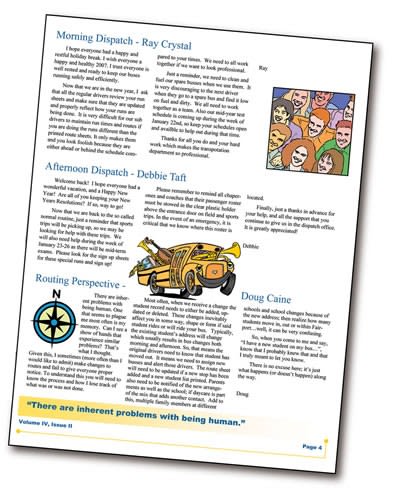
Let’s face it, most of us in the pupil transportation business are not trained journalists, so putting out a publication regularly is not an easy task. Even a modest four-page bimonthly newsletter can be a laborious and unpleasant task. So why go to all the trouble?
While many transportation people discount the value of publishing a department newsletter, the benefits are worth the effort. First off, a newsletter allows you to keep employees, supervisors, principals and administrators aware of issues in your department. Just like any publication, whether it’s published on paper or disseminated electronically, it helps to spread news and keep its readers informed.
In addition to merely spreading news, a newsletter also allows you to spotlight your department’s strengths and to recognize the many individuals who help to maintain the safety and efficiency of your program. A department newsletter can act as a catalyst for bringing your team together and improving morale.
Clearly, a newsletter can be a great tool for increasing communication within your transportation department and throughout your school district, but creating a newsletter from scratch can be an intimidating challenge. This article will provide you with some suggestions that will help you to get the ball rolling or, if you’re already publishing a newsletter, to evaluate its effectiveness.
Getting started
Proper planning is critical to the successful launch of any publication. Some items to consider for your newsletter:
Who will write it? Edit it?
What format will you use?
How will it be disseminated?
Who will receive it?
How much will it cost to print?
What will be recurring themes or columns?
What type of articles do you want to publish?
How often will you publish it?
But, first things first. All newsletters should have a meaningful name, and choosing it should not be taken lightly. Ask your staff for suggestions and possibly offer a prize to the person who comes up with the winning title.
Inspiration for a name can come from many places. The New York Association for Pupil Transportation named its newsletter after a past president, Arthur Schock. The newsletter is called “The Schock Absorber.” My department’s newsletter is named “The Steering Gear.” The name is appropriate because the publication is designed to steer everyone in the right direction.
The writing bug
Who will write your newsletter? Having a variety of writers provides your newsletter with different perspectives. In general, the transportation manager writes at least one article for the newsletter (the “director’s update”) and maybe more, depending on his or her workload.Other office staff can also be enlisted to submit articles or to perform some of the editing. You may want to enlist the help of your driving staff, especially if they’re interested in contributing or have special skills in that area.
Once you determine who will help assist you with developing, writing and editing content for the newsletter, you need to think about how you are going to assemble the stories in a clear and easy-to-read format. Check with your technology department or school librarian to see what software programs your school district uses for publishing its newsletters.
Many programs can help you format your newsletter. I prefer Microsoft Publisher because it is easy to use and has a wizard to help get you started. Publisher comes standard with some Microsoft Office packages. If your district does not have a program that is specifically tailored to create newsletters, you can always use a standard word-processing program like Microsoft Word. Using a word-processing program will force you, however, to set margins and adjust settings that are automatically adjusted in the newsletter programs.
Dressing it up
If anyone on your staff has some training in desktop publishing or graphic design, you might want to get them involved in creating a template for your newsletter. You can also consult any number of books published on the topic of creating a newsletter. They provide design guidelines that will help to make the newsletter visually attractive as well as readable.[PAGEBREAK]
Attention-getters for your newsletter include photos and clip art. They help to add visual interest to the page and to break up gray areas of text. Adding your district’s logo to the opening page adds a nice touch and links your department with the organization.
Printing the newsletter in color is nice if your distribution list is not too large. Our subscriber list includes more than 150 people, making it too expensive and time consuming to print in color. Instead, we use colored paper with black ink and change the color of the paper with each quarterly issue.
We print directly to a copier, which prints on both sides of the paper, staples and collates the newsletters for us. In addition, we convert our newsletters to a PDF format and e-mail them to an additional 50 people. We also post all issues on the staff page of our district’s Website www.fairport.org/staff/Transportation/default.asp.
Choose content wisely
Recurring themes or columns act as an anchor point for your newsletter. They can help to raise your readers’ expectations and provide them with a satisfying predictability. (But it’s also important to introduce new columns and story ideas every now and then.)Sample themes include the following — garage updates, safety, dispatch, routing, director’s update, employee updates, employee questions and answers, employee profiles, “Dear Abby” or similar column, favorite recipes, safety crossword and word-find puzzles. The nature of the themes or columns should fit your operation and address areas that are ambiguous or need recognition.
What types of articles do you want to publish? Are the articles focused on addressing your transportation staff only? Is this information useful to other administrators in your school district? Quite often, transportation professionals express frustration over not being in the loop on district activities.
Sharing information from your department through a newsletter can create awareness of how important your department is to the operation of your school district. Our department’s newsletter is electronically copied to all principals, vice principals, directors, superintendents and board of education members. Sharing of our newsletter has paid dividends to my department because the schools have commented that they learned something new or will try to help us with an ongoing situation.
Keeping your board of education informed on your department’s operations and challenges helps them feel confident in your department’s operation. An informed school board is often a supportive school board! Depending on your personal ability to articulate your needs, a newsletter may allow you to succinctly express what you mean to say easier than at a school board meeting held in front of the community.
Watch those deadlines
How often you publish your newsletter will depend on your schedule and the amount of help you receive in putting together each issue.Some people prefer a short monthly newsletter of one to two pages, and others prefer a quarterly newsletter of four to six pages. Our newsletter is published quarterly, and I supplement these newsletters with a biweekly or weekly transportation bulletin of one to three pages to address current events and concerns.
Once you’ve set up the frequency of your publication, you should try to stick to the schedule. A newsletter that comes out late or skips issues will eventually lose its appeal, both to the reader and the publication staff.
Thanks for sharing
A newsletter is a great way to share district facts and help inform employees of school district history, upcoming events, capital improvement projects and election of board members. Changes like the “S” endorsement on our driver’s licenses are easily explained in a question-and-answer format. When a new policy or procedure is established, sharing the change in the newsletter is an effective way to inform your employees.While writing a newsletter can be a challenge, the efforts put into the publication will pay dividends for you and your department. These suggestions are offered as a starting point. Talk with your staff and drivers to see what they think. You will be amazed by how gratifying it can be to publish a newsletter and watch it take on a life of its own.
Peter Lawrence is the transportation director at Fairport (N.Y.) Central School District.
More Management
EverDriven Launches Route Consolidation Calculator to Estimate Diesel Savings
As diesel prices hit record highs, the largest alternative transportation provider says a 10% route consolidation could save a 120-route district more than $78,000 a year in fuel alone.
Read More →
Zum Secures Continued Financing Support for School Bus Expansion
Generate Private Credit has financed approximately $75 million in school bus deployments across three states, supporting more than 500 buses as Zum expands across the county.
Read More →
Beyond Discipline: A Different Approach to Student Behavior on the Bus
After implementing a dean of students program in Oregon, North Clackamas is seeing positive improvements. Here’s how it worked. The Route is brought to you by IC Bus.
Read More →
A Dean of Transportation's Different Approach to Student Behavior on the School Bus
After implementing a dean of students program in Oregon, North Clackamas is seeing positive improvements on the bus. Here’s how it worked.
Read More →
Inside NAPT ACTS 2026: Highlights from Louisville
From federal updates and student behavior strategies to new school bus technology and industry awards, see highlights from NAPT ACTS 2026 in Louisville.
Read More →
Meet the 2025 School Bus Driver Hero Winner: Annette Brown
We caught up with Wa-Nee Community Schools' Annette Brown on site at SBFX, where she was named the 2026 School Bus Driver Hero Award winner. Hear about her reaction, what she loves most about being a school bus driver, and more!
Read More →
Predictability Is Like Ketchup (According to 6-Year-Olds)
To students, a different school bus can feel like a full-blown crisis. One driver reflects on why familiar routines, showing up on time, and being reliably boring matter more than we think.
Read More →
Samsara Launches Free Driver Rewards Program
The new Driver Perks program gives eligible professional drivers access to discounts and offers without adding a cost for participating fleets.
Read More →
How Tax-Exempt Municipal Leases Can Help Finance School Buses
Let’s explore school bus financing options, including municipal leases, vendor payable accounts, and balloon payments, and how they can help stretch fleet budgets.
Read More →
Nominate Rising School Transportation Pros Under 40!
We’re searching for the next generation of leaders making an impact across the K-12 student transportation industry to recognize as SBF’s 2027 Trailblazers. Nominations are open now!
Read More →