Efficiency in a school transportation operation can include vehicle fuel economy and productivity of technicians. But if we really want to talk efficiency, the discussion must focus on routing — specifically, the policies that shape school bus routes and the processes put in place to evaluate those routes.
When we talk about efficiency in a school transportation operation, it can encompass many things, including vehicle fuel economy and productivity of technicians. But if we really want to talk efficiency, the discussion must focus on routing — specifically, the policies that shape school bus routes and the processes put in place to evaluate those routes.
The lion’s share of school transportation budgets is typically linked directly to routing. In 2007-08, North Carolina spent 70 percent of total transportation costs (not including driver training and insurance) on driver salaries and fuel. That is, bus routes. And that’s not to mention an additional 7 percent for contracted transportation, of which there is also a major routing component.
With increasing pressure on school system budgets and those kinds of percentages, routing effi ciency is more important than ever.
Data, planning and incentives
Certainly efficient routing starts with planning. And to plan for efficiency, you need data. Most basic to route planning is location data for students and school bus stops.
These days it’s hard to think about compiling a really good transportation plan without a computer routing system. A routing system helps to generate reports and disseminate information to schools, parents and students.
Our state got into the computer routing business two decades ago, and the reports and route descriptions are invaluable. But we began computer-assisted routing because of the potential to develop efficient, optimized school bus routes.
For the best results, though, planning must be done with the proper incentive for efficiency. Make no mistake — a computer routing system can also be used to create or even perpetuate an inefficient routing plan. That’s where the incentive comes in.
Given the proper guidance by the local board of education — or sufficient initiative by the transportation department — data can be used to make drastic improvements in routing that save real money. The proper incentive can energize a school district to set aside traditional methods in order to achieve efficiency goals.
Inspect what you expect
But planning alone is not enough. Just as school buses are inspected to ensure that they are mechanically sound, so should bus routes be inspected to ensure efficiency. Maybe audited is a better word.
School transportation is a dynamic venture, and because driver salaries and fuel are the budget lines that are directly related to time and miles traveled, there must be checks and balances to ensure that those budget lines are in sync with the plan.
A transportation plan results in expected times and mileages for each school bus. Hopefully, this is maintained in a well-calibrated computer routing system, or at least in a spreadsheet. And certainly actual road mileage for each school bus is documented on a regular basis. So the key is putting in place procedures to check one against the other.
At a minimum, having a supervisor ride the bus to document time and mileage provides data to compare with payroll and fuel data. Inexpensive technology solutions include a “historical” vehicle tracking device — that is, a GPS unit installed on a vehicle that is downloaded later to compare actual routing data with expected routing data. Such comparisons also are provided by more robust, more expensive real-time GPS systems that offer a great deal more functionality.
Suppose the plan says a bus should be traveling 70 miles per day and that it should take 250 minutes. Now suppose actual mileage records for a particular week show an average of 72 miles per day, but payroll records show 282 minutes per day. That is, the bus seems to be traveling the miles expected, but the cost is more than expected. Investigation is needed to determine whether cost records are somehow being inflated or whether the plan did not predict the proper amount of time.
Efficiency, safety and service
Balancing efficiency, safety and service is tough — like walking a tightrope. But, as pupil transportation professionals, that is our charge. Here’s an excerpt from North Carolina school law regarding school bus routes: “… so as to assure the most efficient use of such bus and the safety and convenience of the pupils assigned thereto.” How about that? Efficiency, safety and service all rolled into one requirement! Whether explicit or implied, it is what is expected of most school district transportation departments.
The American School Bus Council has noted that school bus transportation is not only the safest way for students to get to and from school, but it is environmentally friendly compared to the number of family cars that would otherwise be needed. And it provides essential access to the education system for many students.
That said, plans that only promote efficiency but reduce student ridership do not usually benefit the community. A parent survey in North Carolina showed us that most parents have an expectation of service levels — the length of a bus ride or the distance to the bus stop — which, once exceeded, would result in them not choosing the school bus as their child’s method of transportation.
So now we are back to planning. If changes made in the name of efficiency harm the overall community by displacing students from the bus and into fuel-consuming private cars, we must re-examine what can be done within available resources.
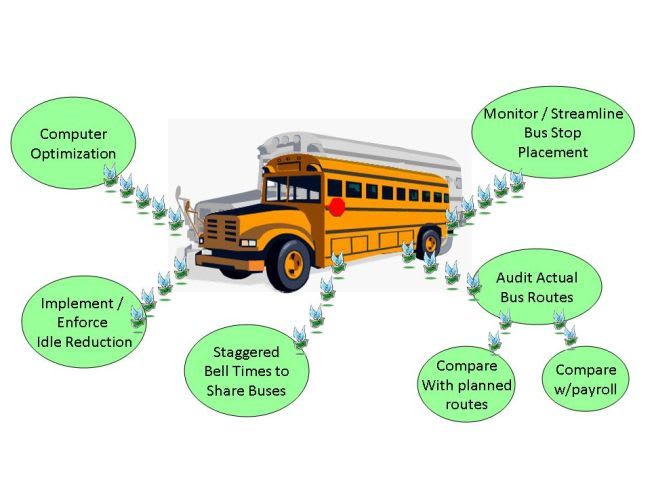
Even in good operations, there are generally additional efficiencies to be found. And if operations haven’t changed in a long while, there may be significant savings opportunities. Optimization and route auditing, as well as looking at reduced idling, bus stop placement and staggered bell times, are all tools to improve efficiency.
But the key is to make changes without depriving students and parents of the economic, environmental and educational access benefits of the yellow school bus.
Graham, an SBF editorial advisory board member, has been the state pupil transportation director in North Carolina for 15 years. Prior to that, he managed the statewide implementation of the Transportation Information Management System. For more information, go to www.ncbussafety.org/TIMS.html.