




To see more photos from the history of Thomas Built Buses, including streetcars, buses, and company leaders (pictured here is founder Perley Thomas), go to schoolbusfleet.com/ThomasHistory.
How Perley A. Thomas Built a School Bus Dynasty
Past and current leaders of Thomas Built Buses discuss how play-inspiring streetcars, family legacies, and a timely switch to yellow bus manufacturing all figure in to the company’s compelling history.

Thomas McMahon・Executive Editor
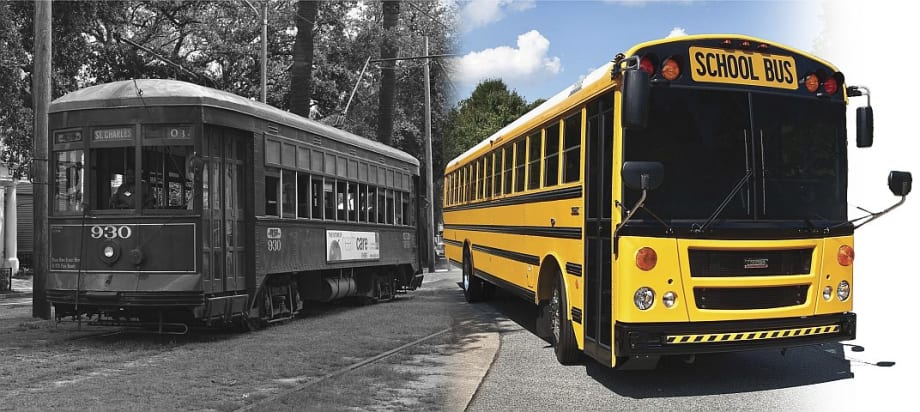
For many decades, Thomas Built Buses' bread and butter has been yellow school buses, but the business began as a manufacturer of another utilitarian form of transportation: streetcars.
7 min to read
For many decades, Thomas Built Buses' bread and butter has been yellow school buses, but the business began as a manufacturer of another utilitarian form of transportation: streetcars.
“Tennessee Williams would not be worth a hill of beans if it were not for Perley A. Thomas.”
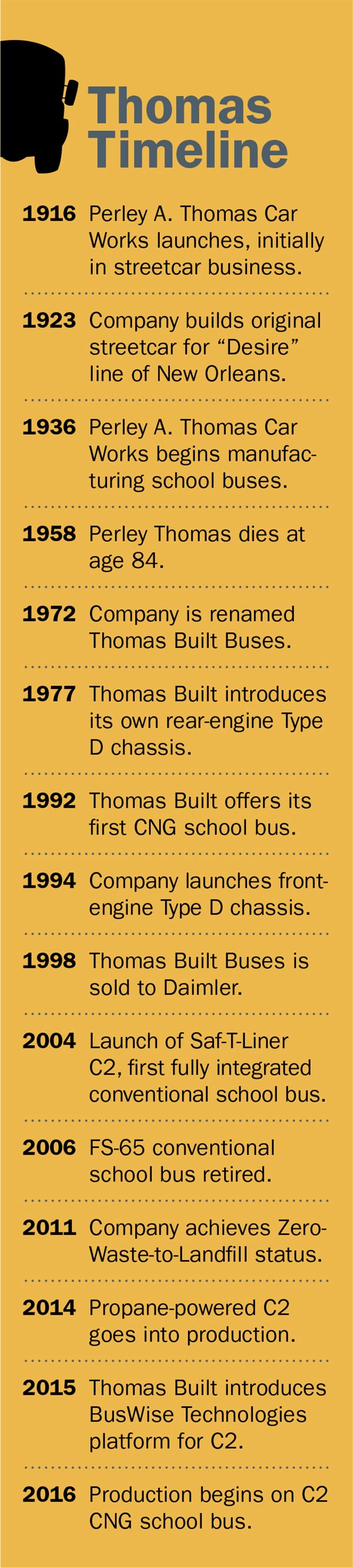
That was the opening line of choice for John Thomas II, grandson of Perley Thomas, when he spoke to civic clubs about the history of Thomas Built Buses, which marks its 100th anniversary this year.
For many decades, the High Point, N.C.-based company’s bread and butter has been yellow school buses, but the business began as a manufacturer of another utilitarian form of transportation: streetcars.
American playwright Tennessee Williams found inspiration in those streetcars in New Orleans, which supplied the title of his most famous play: A Streetcar Named Desire.
“We built the original streetcar that ran on the ‘Desire’ line of New Orleans in 1923, which the play and film were based on,” John Thomas II says.
Yet by the time Williams’ play debuted in 1947, Perley Thomas was no longer manufacturing streetcars. He had made a business move that proved vital to his company’s survival and long-term success. Perley Thomas built buses.
New business model
After two decades of renovating and manufacturing streetcars, business had dried up.
Perley Thomas had launched his company, Perley A. Thomas Car Works, in 1916 after losing his job as chief engineer for Southern Car Works, which had shut down. Thomas had assembled a team of former coworkers and acquired a building in High Point, North Carolina, and soon Thomas-brand streetcars were shuttling the public in big cities around the country.
But by the 1930s, there was declining demand for streetcars, brought on by the Great Depression as well as the rise of buses and personal automobiles.
At this crossroads in history, the call of destiny came in the form of an RFP. The state of North Carolina was calling for bids for the manufacture of 500 school buses. For Perley Thomas and his company, the job was a natural fit.
“Interestingly enough, school buses at that time were made of wood, with wooden and canvas roofing — exactly how streetcars were built at the time,” John Thomas II says. “Perley bid on the buses, won the job [to build 200 of the buses], and his future in school buses began as Perley A. Thomas Car Works.”
As the company’s venture into school bus building began in 1936, its production of streetcars drew to a close.
Roots of innovation
Today, Thomas Built Buses is perhaps best known for its Saf-T-Liner C2 school bus, which the company designed to work as a cohesive unit.
“The Saf-T-Liner C2 was the first fully integrated conventional school bus, meaning the chassis and the body both were designed exclusively for each other,” says Caley Edgerly, current president and CEO. “Before the introduction of the Saf-T-Liner C2, a bus body was placed on a truck chassis. … [It] changed how other Type Cs are manufactured.”
Even the C2 manufacturing facility was designed specifically to build the new bus, which launched in 2004. The plant incorporates robotic technology into the assembly line to carry out some tasks, such as mounting bodies on chassis, adding glue to roof bows, and painting the buses. The use of robotics for the painting is said to provide a more controlled application of the paint and to shorten dry time.
That’s a far cry from the production techniques of Perley Thomas’ day, but John Thomas II says that the company’s commitment to innovation was established by his grandfather’s creativity in school bus design.
“Perley was an innovator,” John Thomas II says, pointing to his grandfather’s efforts in such areas as increasing driver visibility and changing entrance doors to open outward instead of inward. Before the latter redesign, “if a book fell in the stepwell, the doors would be completely blocked and children could not get in or out of the bus.”
John Thomas II says that Perley Thomas also had a hand in improving the strength of roof bows.
“I see the same vision, the same innovation, with the new design of Thomas Built school buses,” John Thomas II says. “Safety also was always a big concern for Perley. Safety was always on his mind when he designed the bus, and that is still a major concern today.”
Family affair
By the 1940s, Perley Thomas was turning over day-to-day operations to his children, but he stayed involved in the business, serving as a design consultant until his death in 1958 at age 84.
The company, which was renamed Thomas Built Buses in 1972, remained a family enterprise until just before the end of the 20th century.
“At one time, we had 127 shareholders, all of whom were family,” says John Thomas II, who served as president from 1973 to 1992. “Every grandson had a portion of the business, and there was never any family conflict. We all worked together beautifully.”
Besides the Thomases, another family that has had a long legacy in the company is the Hedgecocks. In 1958, Kenneth Hedgecock began a 40-year career at the company, during which he worked as a welder, an assembly technician, and a stock room manager.
“My dad was so proud to work at Thomas Built Buses,” says his son, Ken Hedgecock. “Back in his day, I would hear him brag that ‘We build the Cadillac of school buses.’”
Ken Hedgecock started working for the company as a summer employee after graduating from high school in 1975. He continued that summer gig throughout college and during his eight years as a Spanish teacher. In 1987, he started working full time at Thomas Built Buses, which he considers an extension of his original calling to be in education.
“I am still very much in the education business,” says Hedgecock, now vice president of sales, marketing, and service. “Even though I am not standing in front of a classroom teaching Spanish any more, I am making sure students get to school safely, which is just as important.”
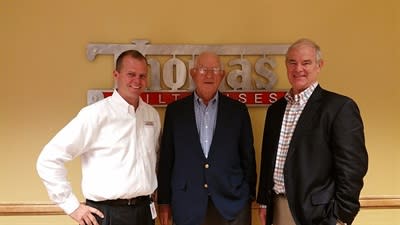
Caley Edgerly (left), current president and CEO of Thomas Built Buses, is seen here with former company leaders John Thomas II and John Thomas III.
New ownership
In 1998, the Thomas family sold Thomas Built Buses to Daimler, and it became a subsidiary of Freightliner LLC (now Daimler Trucks North America). John Thomas III, then president of Thomas Built, continued in that role until 2002, when he stepped down to serve in a consulting capacity.
Hedgecock says that the acquisition was “a very positive development and a significant accomplishment for the Thomas Built brand. Being a part of the world’s largest manufacturer of commercial vehicles has been a tremendous asset to this company.”
Edgerly, who came to Thomas Built in 2012 and was named president and CEO in March 2015, replacing Kelley Platt, says that the company continues to respect its past as it looks to the future.
“Our job today is to continue to focus on innovation, to leverage the benefits that Daimler brings us, and focus on the values our family heritage has instilled in us,” Edgerly says.
Looking ahead
Developments in telematics and alternative fuels are key trends that will continue to shape the pupil transportation industry in the coming years, Edgerly says.
On the telematics front, Thomas Built recently unveiled a new platform of factory-installed options for the Saf-T-Liner C2, dubbed BusWise Technologies. Along with safety features like collision avoidance warnings and a 360-degree exterior view camera system, BusWise integrates with Zonar’s solutions to provide managers with telematics like driver monitoring and bus function tracking.
“I think telematics is the turning point for our industry,” Edgerly says. “As with the introduction of our BusWise Technologies platform, I expect technology and telematics to drive change in our industry.”
Also, an increased focus on cost of ownership has prompted more school bus operators to consider alternative fuels.
“We already are seeing a heightened interest in propane and compressed natural gas, but I expect to see even more interest in the coming decades,” Edgerly says.
Past and present
While Thomas Built school buses are a common sight in small towns and big cities across the nation as they transport students to school each day, there is still at least one place where Perley A. Thomas streetcars can be seen in active service: New Orleans, where the fictional Blanche DuBois was told to “take a streetcar named Desire.”
The streetcars are a living link to Thomas Built Buses’ roots, and a reminder of Perley Thomas’ timely decision to adapt to a new business model, building yellow buses, which would prove to be a viable enterprise even in the next century.
Still, the 100-year milestone comes as something of a surprise to at least one of Perley’s successors.
“I never thought I’d see the day Thomas Built Buses would be a 100-year-old company,” says John Thomas II, who started working for the family business in 1949 and retired in 1992. “That is a significant event for any company.”
Subscribe to Our Newsletter
More Management

EverDriven Launches Route Consolidation Calculator to Estimate Diesel Savings
As diesel prices hit record highs, the largest alternative transportation provider says a 10% route consolidation could save a 120-route district more than $78,000 a year in fuel alone.
Read More →
Zum Secures Continued Financing Support for School Bus Expansion
Generate Private Credit has financed approximately $75 million in school bus deployments across three states, supporting more than 500 buses as Zum expands across the county.
Read More →
Beyond Discipline: A Different Approach to Student Behavior on the Bus
After implementing a dean of students program in Oregon, North Clackamas is seeing positive improvements. Here’s how it worked. The Route is brought to you by IC Bus.
Read More →
A Dean of Transportation's Different Approach to Student Behavior on the School Bus
After implementing a dean of students program in Oregon, North Clackamas is seeing positive improvements on the bus. Here’s how it worked.
Read More →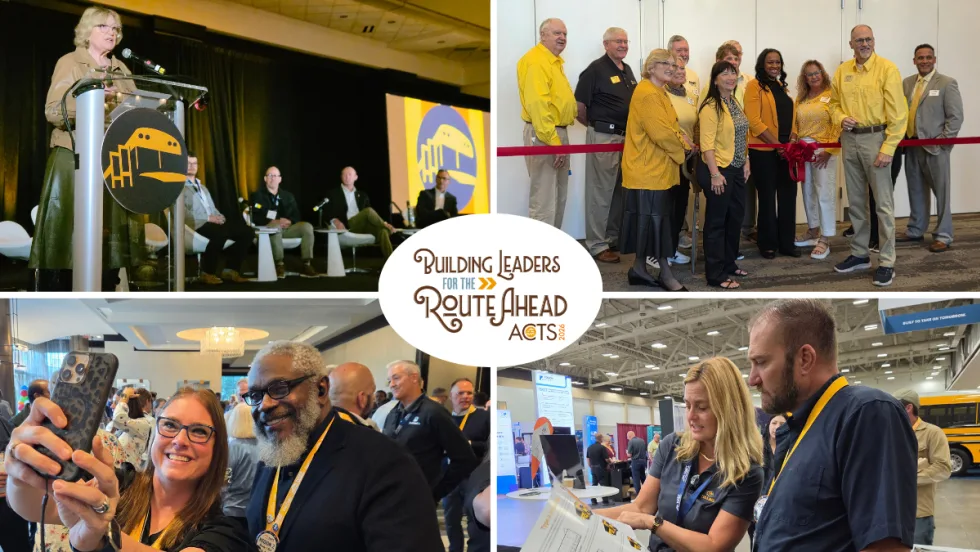
Inside NAPT ACTS 2026: Highlights from Louisville
From federal updates and student behavior strategies to new school bus technology and industry awards, see highlights from NAPT ACTS 2026 in Louisville.
Read More →
Meet the 2025 School Bus Driver Hero Winner: Annette Brown
We caught up with Wa-Nee Community Schools' Annette Brown on site at SBFX, where she was named the 2026 School Bus Driver Hero Award winner. Hear about her reaction, what she loves most about being a school bus driver, and more!
Read More →
Predictability Is Like Ketchup (According to 6-Year-Olds)
To students, a different school bus can feel like a full-blown crisis. One driver reflects on why familiar routines, showing up on time, and being reliably boring matter more than we think.
Read More →
Samsara Launches Free Driver Rewards Program
The new Driver Perks program gives eligible professional drivers access to discounts and offers without adding a cost for participating fleets.
Read More →
How Tax-Exempt Municipal Leases Can Help Finance School Buses
Let’s explore school bus financing options, including municipal leases, vendor payable accounts, and balloon payments, and how they can help stretch fleet budgets.
Read More →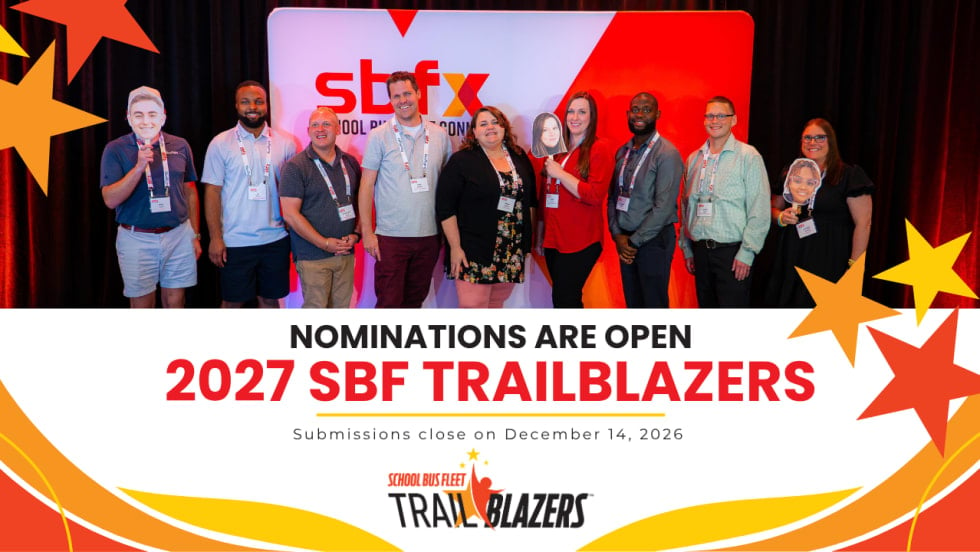
Nominate Rising School Transportation Pros Under 40!
We’re searching for the next generation of leaders making an impact across the K-12 student transportation industry to recognize as SBF’s 2027 Trailblazers. Nominations are open now!
Read More →