Boosting Security at the Bus Stop With Mobile Data Terminals
Tablets with ridership apps can help the driver ensure that the right students get on and off the bus. The key is to make the technology part of the driver’s routine — rather than a distraction.
This article is the second in a series that covers the use of mobile data terminals. The first article appeared in the January 2018 issue and can be found here.
A mobile data terminal (MDT) is more than an off-the-shelf GPS device — it is an interactive computer that can host numerous applications, each of which brings with it a number of pros and cons.
In general, the advantages relate to assisting the driver and improving operational efficiency. The disadvantages — which can cause hesitation to embrace the use of MDTs in school transportation — center on the issue of driver distraction.
There is little at the state or federal level that establishes standards, or even best practice, when it comes to the use of MDTs by school bus drivers at the school bus stop. Nevertheless, important MDT applications include those that can monitor student ridership and, therefore, improve student security. Such apps are most powerful when there is interaction by students at the bus stop, and sometimes by drivers as well.
Ad Loading...
School Bus Mix-Ups
All too common, unfortunately, are the episodes where a student gets on the wrong bus, or gets off at the wrong bus stop.
Now, if a student is on the wrong bus, at least he’s in “our care,” and the story usually has a happy ending. But that’s after the period of time when the frantic parents are worried sick about why their child did not get off the bus at the appropriate time and place.
When a child gets off at the wrong bus stop, things are much more problematic. How often have we seen news stories about a young student found wandering far from home by a good Samaritan? Certainly not on a regular basis, but it does happen.
I know of events where students from one county boarded a bus from the neighboring county one morning and ended up at the wrong school in the wrong district.
And then there’s the time a young-looking 26-year-old radio personality waited at a middle school bus stop, boarded the bus, and talked with the rest of the morning show crew on air as he rode from one stop to the next. It was the first day of school, and the driver did not have sufficient information to know whether or not he was a student assigned to the route.
To address these types of issues, there is much information available today that can help the school bus driver ensure that the right students are getting on and off at the right bus stops.
The reality is that many students don’t have a parent present at the bus stop. Mobile data terminals can help drivers ensure that the right students get on and off.
Student Data and MDTs
With student information systems and computerized routing systems, student data needed for transportation are available. But a paper printout of the students assigned to each bus stop — while extremely valuable — has its limitations, especially when being manipulated by a substitute driver in the darkness of early morning.
Technology can assist. Students can be required to “swipe on and swipe off,” using one of a number of interfaces, such as RFID cards (which the students might also use in the lunchroom and library).
But what happens when there is a glitch? If the card and the system don’t match — or the student does not have his or her card — the driver must determine whether to grant entry or exit at the school bus stop.
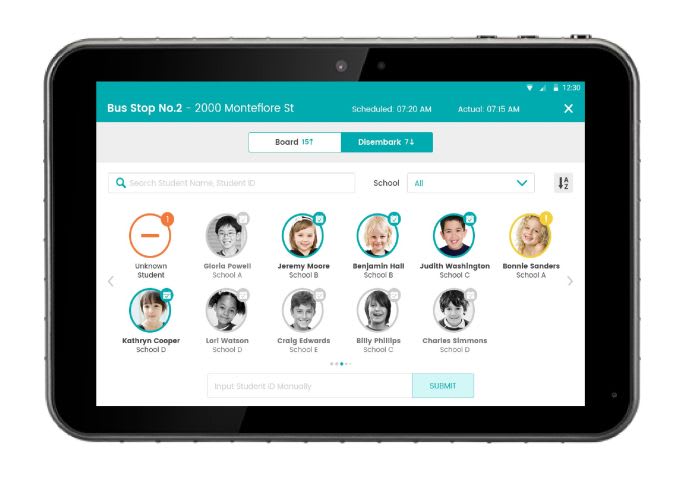
The student data used for transportation can now include photographs of students (typically those pictures taken for a school directory or year book). And when the student is assigned to a specific morning and afternoon school bus stop, it’s just a matter of getting all of that information to whoever is driving the bus that day.
That is a straightforward task when using an MDT. The driver can see who is to get on or off and can be allowed to override the system when a student doesn’t have his or her boarding card. And the driver can see if the wrong student is using the boarding card. Most importantly, the driver is informed if a student — for whatever reason — attempts to swipe on or off at a wrong bus stop.
Subject to district policy, the driver can use the MDT to override, validate, or simply verify the transaction.
Avoiding Driver Distraction
As mentioned earlier, the resistance to implementing MDT technology for student ridership often centers on driver distraction. Anyone familiar at all with pupil transportation knows that students are most at risk when getting on or off the bus.
At school bus stops, drivers are responsible for the safety of the students boarding and exiting. The driver must pay attention to the key responsibilities of scanning the mirrors, counting students, and looking for missing students or other pedestrians in the area — not to mention the threat of passing motorists.
Understandably, serious consideration must be given to the implementation of any additional procedures required of the drivers during the passenger loading and unloading process.
It is at the school bus stop where driver interaction with a student ridership app takes place. Clearly, in such an application, harnessing the power of an MDT — a computer — provides the most information to the driver and to the transportation operation: Who is on the bus at any time? Who is allowed to get on or off the bus at any given stop? What if the data do not match and the driver must follow procedure to make exceptions?
The key is to make sure that using a student ridership application is integrated into the driver’s routine and responsibilities at the school bus stop. Just like activating the eight-way light system, counting students, and giving the student crossing signal, interacting with an MDT must be done in such a way that the other processes cannot be overlooked. Training, training, training.
Derek Graham is an industry consultant with clients that include Education Logistics (Edulog), a provider of school bus routing software solutions, school bus GPS tracking, and other related systems. He previously served as state pupil transportation director in North Carolina for 21 years.
Enhancing Communication
The world of MDTs goes beyond student ridership apps. The presence of an MDT with cellular connections on a school bus opens up new opportunities for communication with drivers. Here are some examples:
Bus stop/passenger changes • Johnny is not riding the bus today, so you can eliminate the 3-mile loop required to serve his stop. • Suzy is back on the bus, having recovered from an injury, so be sure to make her stop today. • We are directing students from the Shady Grove Apartments to board your bus this afternoon. Please add this stop to the end of your afternoon route.
Traffic/detours • There has been a water main break that will impact your route, so you will need to take the bypass and come in to the school from the other direction.
Emergency communications • There has been a bomb threat. Drive to a specified location — not to the school. • Do not let Johnny off at his stop. He will be in danger.
Vehicle health • Tire pressure has dropped to an unsafe level. • Engine conditions require the driver to pull over immediately. • (These warnings are displayed to the driver and sent as automatic notifications to maintenance staff.)
The key here is to make sure that messages are communicated in such a way that the driver cannot read them while the bus is in motion. Perhaps a light/indicator could inform the driver whether to pull over and check in immediately, between runs, or when parked at the end of a shift.
Experience Can Guide Policy
Including a small computer in the driver’s area of the school bus opens up numerous opportunities and potential applications. The pupil transportation community should keep an open mind to improvements offered by MDT technology while balancing the safety-based responsibilities of the driver.
The experience needed to address these issues can only be gained at the local level, which can be used to help forge state and federal policy going forward.
Districts nationwide are adopting Transfinder’s routing, tracking, and parent apps as the company also earns its ninth Best Companies to Work for in New York honor.
The Georgia-based OEM has acquired Girardin Group’s stake in the 50/50 Micro Bird joint venture, bringing the business fully under one brand, one team and one operating approach.
Stop reacting to engine lights and start predicting them. This guide reveals how transitioning from a "break-fix" model to a data-driven maintenance strategy can drastically reduce fleet downtime and protect your district's budget. Learn how to transform your garage operations from a cost center into a reliability powerhouse.
EverDriven is bringing its experience with complex transportation into a new school bus routing support division. In this video, Greg Jackson breaks down what the service offers and why districts need this kind of help now more than ever.
Three decades after almost walking away from the school bus, studying behavior changed everything for Kathy Calkins. Now, she oversees 181 buses and leads the 225-person team at North Clackamas with intent and purpose.
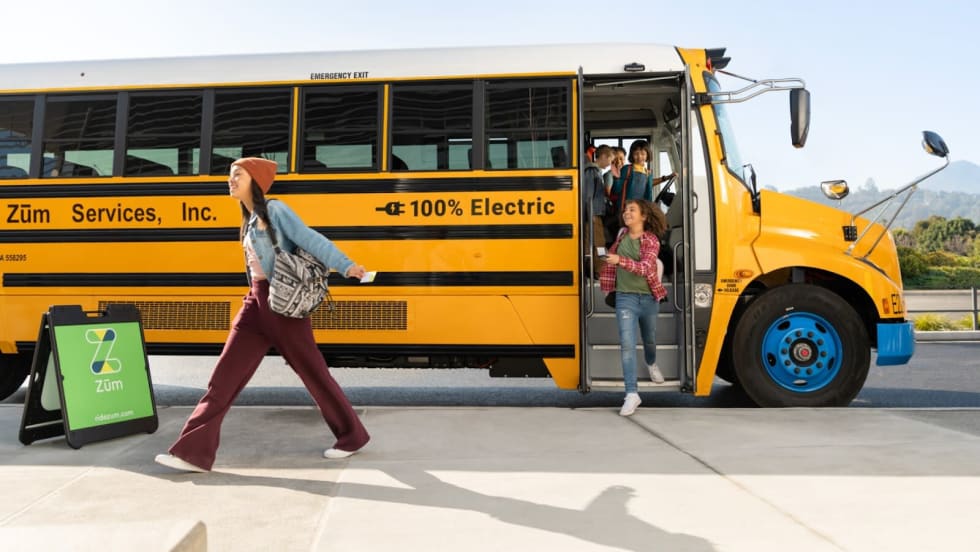
While the yellow school bus remains the backbone of student transit, 75% of administrators identify limited transportation access as a major driver of chronic absenteeism. This guide explores how districts are strengthening their fleets by integrating flexible, supplemental solutions to serve students with the most complex needs. Learn how a multimodal approach can bridge service gaps, restore attendance, and support your most vulnerable populations.